[Problem M11—M15; F12—F17]
Rough automatic draft, low quality: expect mistakes and awkward wording. It will be replaced by a better translation. Original →
45
M11. On 44 trees located in a circle, 44 cheerful siskins sat (one siskin on each tree). From time to time, two siskins simultaneously fly to neighboring trees in opposite directions (one clockwise, the other counterclockwise, see Fig.1). Prove that siskins will never gather on one tree.
What if there are siskins and trees ?
Higher Medical School at Moscow State University*)
M12. What quadrilaterals can be cut by a straight line into two similar quadrilaterals?
*) See page 61 of this issue of the magazine.
The best solutions to problems submitted by readers will be published in the journal. We will be able to consider decisions that will be received by the editors no later than a month and a half after the publication of the corresponding issue of the journal.
M13. Prove that if the difference between the largest and smallest real numbers is , and the sum of the models of all pairwise differences of these numbers
is equal to , then
M14. A convex white polygon has some faces shown in black red so that no two black faces have a common edge (Fig.2). Prove that if at least one of the following conditions is satisfied:
a) more than half of black faces;
b) the area of the black edges is more than half the area of half the surface of the polygon,
then a ball cannot be inscribed in this polygon.
46
M15. A square table is filled with non-negative numbers so that the sum of the numbers in each row and the sum of the numbers in each column is 1. Prove that from the table you can select positive numbers, no two of which appear in any column or row.
F12. Two identical heavy steel balls rotate on light rods of length and around a point , and the distance between which is (Fig. 3). At the initial moment, the balls are at points and , having speeds and , respectively. How many times will the balls collide in time ? How long will it take for the balls to collide times? The impacts of the balls are considered to be absolutely elastic.
G. L. Kotkin
F13. Two identical cylinders with pistons are connected by a tube (Fig. 4). There is water in the cylinders. Identical cylindrical glasses with equal amounts of water are placed on top of the pistons. Then a body of mass is lowered into one of the glasses, and a body of mass , which do not sink, is lowered into the other.
At what distances from each other will the ends of the pistons and the water levels in the glasses be when the system reaches equilibrium? The day area of the glasses is , the area of the pistons is .
F14. Two pipes with sections and are connected to each other and plugged with pistons whose masses are and (Fig. 5). After an explosion in the space between the pistons, the pistons fly out of the pipes. One of them flew out at a speed of . At what speed did the second one fly out if: a) the pipes are fixed and cannot mix, b) the pipes are not fixed and their total mass is ? Neglect the friction of the pistons against the pipe walls.
F15. The amount of heat that penetrates through the walls of the refrigerator in an hour is kilocalories. The temperature inside the refrigerator is , and in the room . What is the minimum power consumption of this refrigerator from the network?
V. N. Kopylov
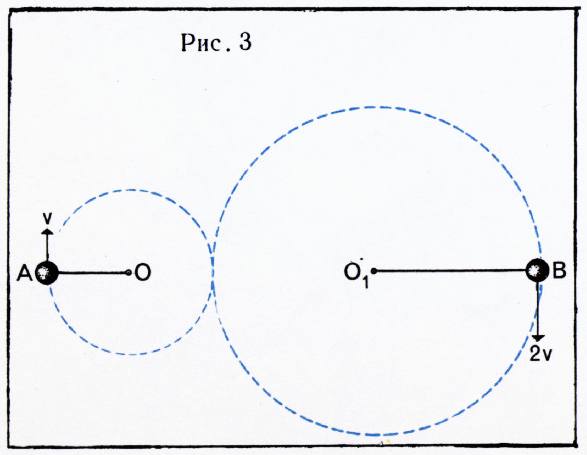
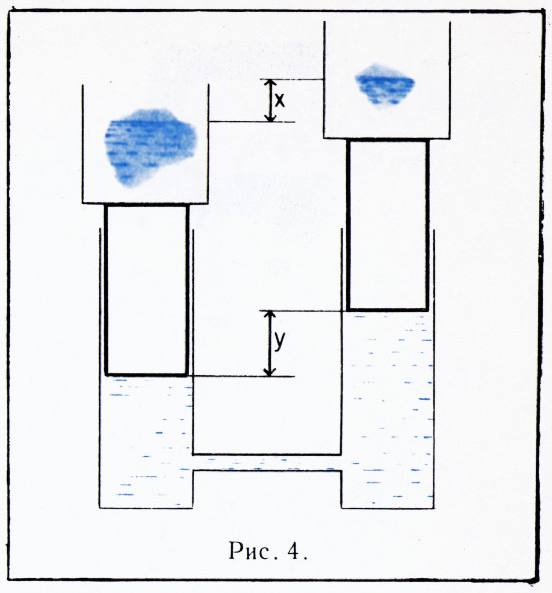
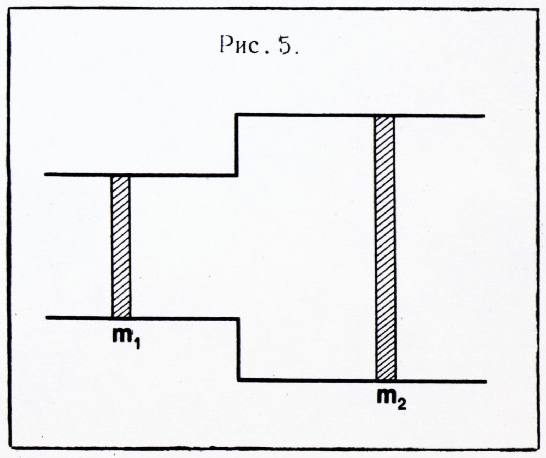
Fig. 3
Fig. 5.
47
F16. A car of weight , both axles of which are driven, starts moving. The automatic engine operates with a constant power of , the coefficient of friction between the wheels and the road is . Find the dependence of the automatic speed on time and draw a graph of this dependence. Neglect air resistance and friction in the mechanisms.
A. T. Drozdov
F17. A plate having a charge was placed between the plates of a short-circuited flat capacitor. The plate is moved parallel to itself at a distance (Fig. 6). What charge passes through the external circuit of the capacitor if the distance between its plates is ?