Rough automatic draft, low quality: expect mistakes and awkward wording. It will be replaced by a better translation. Original →
HOW IS IT EASIER TO SHARE?
What is the easiest way to divide a smaller number by a larger one if the larger number ends in 9?
Let you need to divide the number a by the number b, and a < b. Let b = 10c + 9. Now check that
where is the remainder when is divided by , so is an integer.
Let be the decimal notation of the quotient. Then and .
Denoting by , we write the equality , from which we similarly find and so on.
Examples of measures
- We need to divide 37 by 89. We do this: we divide 37 not by 89, but by 9, since the number of ones in the divisor is 9, and the number of tens is 8, 8+1=9. Then the remainder is added before the quotient and again divided by 9 and so on. Partial decimal digits of the fraction .
So,
(For the ending, see page 29.)
22
the solution was first obtained by Euler analytically, but remained lost among the mass of formulas, and only thanks to simple and visual interpretations of Poinsot was presented before the eyes of scientists with all clarity.
What role fell to Poinsot in explaining the question of the motion of a solid body, the same role belongs to Helmholtz in explaining the question of the motion of a liquid.
Almost all of Helmholtz’s works on mechanics are related to fluid mechanics. It can be said that modern hydrodynamics owes its development mainly to Helmholtz. Meanwhile, the most important work of the scientist in this area appeared in 1858*), 43 years after the formulas containing the reasons for the preservation of wines were found by Cauchy. But Cauchy considered the result he obtained only from the analytical side and did not foresee the mass of questions that could be solved with proper geometric illumination of the conclusions.
I will now try to explain to you as simply as possible the concept of wine established by Helmholtz.
Let us imagine a cylindrical vessel of finite height (Fig. 1) with a scale larger
*) This refers to Helmholtz’s work on the equations of hydrodynamics corresponding to linear motion.
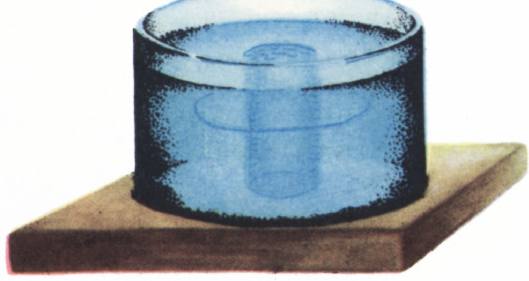
Fig 1
with a solid base, filled with liquid (or gas), and suppose that this liquid moves like this: a central cylindrical column of some thickness rotates like a solid body around its axis, and the mass of liquid always spins around this column in circles with speeds inversely proportional to the distance from the axis of the column, and these speeds, increasing as they approach the central column, transform on its surface into the speed of the column.
This movement of liquid is called a vine, and the cylindrical column that characterizes it is called a vine cord. Let’s say that the direction of the cord is equal to half the product of the velocity of the liquid on the surface of the cord and the perimeter of the normal section of the cord.
Twice the value of this product is called the circulation velocity.
In general, the circulation of speed along some closed contour within the movement of a fluid is equal to the product of the length of the contour and the average of all the velocities of the points of the contour in the direction tangent to the contour.
Since in the movement of a fluid, let us depict on figure 1, the velocities are inversely proportional to the radii, the velocity circulation along all horizontal circles having a center on the axis of the column and enclosing it are equal to each other and, therefore, equal to the double direction of the cord, and the velocity circulation along contours consisting of segments of two circles between segments of two radii, and lying outside the cord (contour ABCD on figure 2) are equal to zero. In addition, it can be proven that the circulation of speed along any closed contour that encloses the direction is equal to twice the direction of the direction, and the circulation of speed along any closed contour that does not cover the direction is equal to zero.
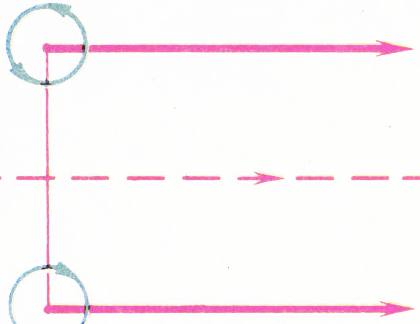
Fig. 5.
equal, then this center would recede into an infinite distance, and both cords of bezaline would move forward in a direction perpendicular to the straight line connecting the centers, as can be seen from figure 5.
figure 6 shows the trajectories (paths) of three vinre cords, of which 1 and 2 rotate counterclockwise, and 3 rotate clockwise.
The concept we have established of a straight cord enclosed in a very wide cylindrical vessel extends to cords that originate in a liquid mass. In this case, vinre cords can be searched by drawing up circulations
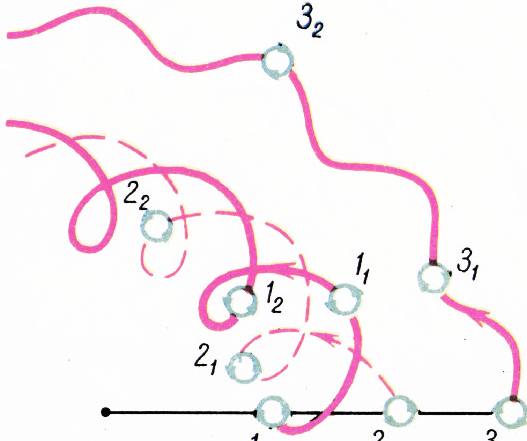
Fig. 6.
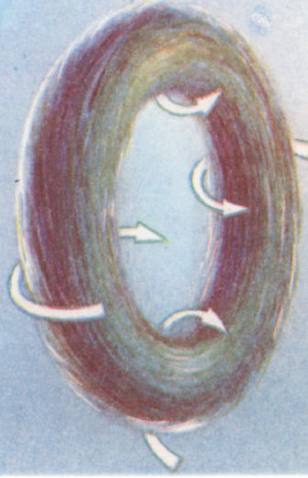
Fig. 7.
25
During the movement, either its ends will lie on the edges of the liquid (on the walls of the vessel or on the free surface), or it will remain closed.
In fact, in order to leave the walls of the vessel, the base of the vortex must be reduced in size to zero; and since the circulation of speed along the contour of the base must remain unchanged, the convergence would require that the speed of the round fluid at the bottom of the cord increase to infinity.
The hydrodynamic pressure of the fluid decreases as the speed increases. Therefore, when the vortex pressure on the wall of the vessel decreases, the pressure in this place will quickly decrease, and the remaining mass of the liquid will press on the particles of the end of the vortex cord and prevent them from moving away from the wall. The vortex cord, so to speak, sticks with its ends to the walls of the vessel. If the end of the cord lies on a free surface, then such suction can be seen by the funnel that forms on the free surface at the “bottom” of the cord.
If the ends of the vortex cord do not lie on the edges of the liquid, then they must be closed together, and thus a closed vortex cord is obtained - one in which, so to speak, both ends are sucked to each other.
The simplest type of closed vortex filament appears to be a vortex ring, shown at figure 7.
All parts of the liquid lying outside the ring swirl in a closed curve passing through the ring so that the circulation of velocity along all these curves is the same and equal to the circulation of velocity on the contour of the cross section of the ring. By crossing the vortex of the ring, we will receive various circulations for the trajectory of its part. Liquid point velocities
the largest on the surface of the ring. They decrease with distance from this surface inside the ring and are equal to zero on a certain center line. They also decrease as they move away from the ring in the mass of liquid surrounding it. For fluid points at a significant distance from the ring, the velocities are inversely proportional to the cubes of the distance from the ring.
We have seen that two straight parallel cords originating in a liquid mass, around which the liquid is round with equal directions of the vortex in opposite directions, will move in a direction perpedicular to the plane drawn through them. For the same reason, the vortex ring will not remain motionless, but will move in a direction perpedicular to the plane of the ring, in the direction in which the liquid flows out of the ring.
We see on figure 7 that particles of the liquid mass moving in the upper closed trajectories will move to the lower edge of the ring and move it to the right; in the same way, particles of the liquid mass moving along the lower closed trajectories will move to the upper edge of the ring and also move it to the right. All rings will move evenly to the right side, carrying behind them the round liquid around them. This movement will be faster, the greater the direction of the vortex and the smaller the size of the ring.
We said that inside an ideal liquid there should be persistence, and new cords cannot be formed. Meanwhile, in nature we often see and fade vortices. This is due to the fact that our waters and air have a certain degree of viscosity, due to which the above theoretical results are somewhat modified. On the one hand, vortices can become quenched (mainly
26
in those places in which two layers of liquid slide over each other at different speeds), on the other hand, the vinrys that stick together are not preserved, but gradually disappear.
Helmogoly demonstrated the formation of direct vortices with one excellent experiment, described in his speech on vinre storms. We will repeat this experience here.
A small hole is made in the denne of the cylindrical vessel (Fig. 8), plugged with a stopper. The vessel is filled with water. By means of air jets directed by a tube to one edge of the free surface of the water, we cause the liquid to slowly rotate. The liquid begins to flow out of the hole, approaching from the edges of the vessel to its axis. Since the circulation speed along a circle drawn from a point on the cylinder axis through the same particles of liquid should not change with time, then with a decrease in the radii of these circles the speed of part of the liquid will increase. The rotation of the liquid as it approaches the axis will become faster and faster, and we will notice a sharply formed winry, above which a funnel will appear, deeper and deeper.
I will also demonstrate the formation of winry using a rapidly rotating disk.
At figure 9 the device of Prof. F. N. Shvedova. Through the bottom of a glass cylindrical vessel, a vertical axis is sold in the stuffing box, ending with a small disk. This axis can be brought into rapid rotation through endless repairs. Water and oil are poured into the vessel, which floats on top of the water. Rotating the disk, we will notice that the water gradually begins to rotate and forms a winding cord above the disk, which is replaced along the funnel at the interface between water and oil. This funnel is filled with oil, which descends to the disk in the form of a descending tornado. At the moment when the oil comes into contact with the disk, its entire mass is dispersed through the water.
Even more interesting is the way direct winrays are formed in the air. The air above the surface of the water causes rotation with the help of a special rapidly rotating impeller placed at a certain height above the water (Fig. 10). The air vinry captures water along its axis and lifts it in the form of an ascending tornado all the way to the lionfish.
Vortex rings in the air are demonstrated using the Theta instrument. It consists of a box (Fig. 11), the back side of which is covered with leather, and a hole with sharp edges is made in the front. Form from-
28
Until now, we have produced the rings from a round hole. Let’s now try to form them from an elliptical and square hole. We see that in this case the ring does not retain the shape of the hole, but oscillates, trying to transform into a round ring, which is thus the only stable form of a closed cord.
Let us now consider the influence of foreign objects on the output loop. Bringing solid bodies from the side to the moving ring, we see that they push the ring away. But if the ring runs onto a stationary plane parallel to its plane, then, approaching it, it increases more and more in size, so to speak, spreads over the plane. If we let the peg run onto a knife, the plane of which passes through the axis of the peg, then the latter will be cut by the knife into two half-rings, the ends of which will slide along the surface of the knife; but, having passed this surface, the ends come together again, and the ring is restored.
In addition to smoke rings in the air, you can also observe air rings in the water. This interesting phenomenon, which at first glance seems paradoxical, is simply explained by the fact that, due to the centrifugal force, significant pressure is applied to the axes of the output ring. If, when forming a ring ring, we introduce several air bubbles into the water, they will immediately climb into the place of the liquid where the pressure is lowest, that is, on the axis of the ring, and will remain there all the time while the ring moves along the mass of water, despite the fact that air is 800 times lighter than water.
I will show here a device for the formation of air rings in water, which is a modification of the device of the professional Osborne Reynolds. There is (Fig.12) a large glass bathtub filled with water. A glass bent at a right angle is immersed in it.
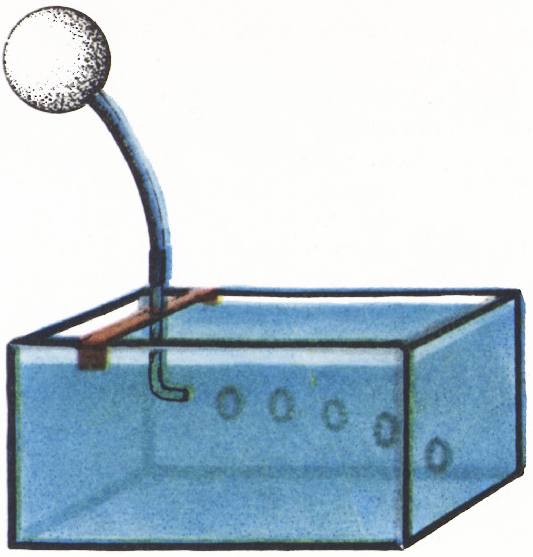
Fig. 12.
naya tube. A sleeve made of a rubber ball is put on the upper end of the tube coming out of the water, through which air can be driven into the tube and water can be pushed out of it. Quickly squeezing the ball, we push a container of water out of the horizontal bend of the tube and do this so that the air almost reaches the lower end of the tube, but does not come out of it in large quantities. The container of water, having flowed out into the surrounding liquid, is wrapped in a glass ring. At the same time, several bubbles will be pushed out along with the water; the wine ring will be clearly visible: it will be formed as if from shiny grains of beads. Running along the entire bathtub, the wells will hit the opposite wall of it and here, expanding, disappear.
Using our device, we can clearly demonstrate the reflection of rings from the free surface of water. To do this, just turn the tube so that its lower end points slightly upward. The ring, running up to the free surface of the liquid, reflected from it
29
shrinks, and the angle of incidence is equal to the angle of reflection.
Since real liquids have viscosity and rub against the walls of the vessels in which they move, during their movement they are constantly filled with vortex cords. Helmholtz showed that a liquid mass in any imaginable movement can be considered as continuously filled with vortex cords, and as a means of studying the movement of these cords.
Brief information about the scientists mentioned in N. E. Zhukovsky’s lecture.
Euler is the greatest mathematician of the 18th century, a St. Petersburg academician, one of the creators of analytical mechanics. Laplace called Euler the father of modern mathematical analysis.
Poinsot is a French scientist, mathematician and mechanic. In 1834 he obtained an elegant geometric solution to some problems in the dynamics of rotation.
Helmholtz was an outstanding German physicist and mathematician of the 19th century. He became famous, in particular, for his work on acoustics (Helmholtz resonators) and thermodynamics. He is also the founder of the vortex theory.
Cauchy is a French scientist of the late 18th - first half of the 19th century, who was rightfully considered one of the creators of modern mathematics. He left over 800 memoirs on various branches of mathematics.
Shvedov V.F. is a professor at Odessa University, a well-known specialist in the hydrodynamics of viscous fluids (second half of the 19th century).
Tag is a professor of physics in Edinburgh (England, second half of the 19th century).
Reynolds is a professor at Owen College in Manchester (England, second half of the 19th century). He became famous for working on hydrodynamics.
- 28 must be divided by 59. 5+1=6.
So,
This method of division is simpler than the generally accepted one and easier to perform. It was proposed by the German mathematician G. Spitzer in 1847. But soon they forgot about him.
G. D. Novinsky