Rough automatic draft, low quality: expect mistakes and awkward wording. It will be replaced by a better translation. Original →
11
If experience shows that during processes of a certain type some physical quantity does not change, it is possible to formulate a “conservation law” of this quantity during processes of this type. The most famous example of such a law is the law of conservation of energy, which is satisfied in any processes occurring in systems that are well isolated from the influence of other bodies. Using conservation laws, one can often imagine the final result of an experiment only based on the initial conditions, without knowing what happens at the intermediate stages. For example, if the kinetic energy of a body is transferred to a body, its quantity does not depend on the way in which this happens.
This article will discuss the law of conservation of magnetic flux. This law, however, is fulfilled only under special conditions and does not pretend to have such a universal role as the law of conservation of energy, but in its field it is also a very useful law, I would like to add, beautiful.
Let us first define what is called magnetic flux. Let’s imagine that in space there is a constant underexposed magnetic field of any most complex shape. It can be visually depicted using magnetic lines of force, the direction of which will indicate the direction of the field (for this you need to put arrows on the lines), and the density, that is, the number of lines passing through an area of 1 cm² perpendicular to them, will indicate the strength of the magnetic field. With the help of continuous non-intersecting lines of force, which are either closed or go into the distance, to infinity, it is possible to depict any magnetic field, no matter how complex its shape. Moreover, in the described model there will be no place where it would be necessary to add or remove a line segment in order to correctly depict the field voltage. That’s how the magnetic field works, as they say. In any case, all attempts to detect deviations from this rule in experiment have so far failed. As we now see, it is only thanks to this property of the magnetic field that the concept of magnetic flux can be introduced.
If there is some kind of closed curve in space - a “circuit” (let’s imagine it made of thin wire), then the number of magnetic lines of force covered by this circuit will be called the magnetic flux through this circuit. To correctly calculate this number, you must proceed as follows. First, tighten this outline with an imaginary film (any shape, just not holey) and mark it on
12
There are different sides to it - the “face” and the “wrong side”. After this, you need to count all the lines of force that pierce the film from the inside on the face, and subtract from this number the lines of force that pierce the film in the opposite direction, if there are such lines. The difference and dact us the magnitude of the magnetic flux, which, thus, can be negative. Precisely because the ignoring lines of force do not circulate, it does not matter what kind of film the contour is covered with - wrap it sparingly or sew a whole net to the contour - the flow will be the same (Fig. 1). The flow is denoted by the letter F (perhaps because it is similar to a line of force producing a circuit). If we change the magnetic field in Gauss, the dimension Ф will be (ess. ).
If the magnetic flux covered by the circuit changes over time by values in time , and the circuit is made of wire with electrical resistance , then according to the law of electromagnetic induction, the current begins to cycle along the circuit
( is expressed in , is in seconds, and is in ohms). This current in the circuit flows under the influence of the electromotive force of induction
The minus sign in these formulas is connected with this: we consider positive the current in the circuit, which itself creates a magnetic field in it with a positive flux (such a current flows around the circuit clockwise, if viewed from the inside out). The negative sign, therefore, shows that if the flux decreases with time , then the excited current will be positive and will itself create a positive flux. On the contrary, if the flow returns, the current in the circuit creates a flow in the opposite direction (Lenz’s rule). Since the flux Ф consists of the flux of the external field and the flux created by the circuit itself, the induction of current in the circuit leads to a slowdown in the change in the total flux through the circuit.
Let the current be zero at the initial moment, and the flow is created by some external field source, for example a magnet. Now let’s quickly remove the magnet. Then, at the same time, a current will arise in the circuit, which itself creates a magnetic flux of the same magnitude, that is, it will not allow the magnetic flux higher out of the circuit. In order for a current to exist in a circuit with electrical resistance , it is necessary, of course, for the flow to change. Therefore, in subsequent moments, Ф will still gradually decrease, but the slower, the smaller . Likewise, if we want to increase the flow of the internal circuit, this can only be done gradually.
It is necessary to note one great advantage of the law of electromagnetic induction: all our reasoning and formulas remain valid regardless of how we change the magnetic flux through the circuit - whether we change the magnetic field itself or also move, bend,
13
expand the outline that is in this field.
Let us now assume that our circuit is made of a superconductor, the resistance of which is known to be zero. The reader, of course, knows that superconductivity occurs in many metals and alloys at low temperatures, on the order of several degrees of the absolute scale. It should also be recalled that superconductivity is destroyed under the influence of a magnetic field with a strength exceeding a certain limit - the critical field , which depends on temperature approximately as shown in figure 2. For a fistula, say, at the lowest temperatures gauss. At fields greater than , the metal again acquires resistance.
If in a circuit with low resistance the magnetic flux changes slowly, then it is natural that in a superconducting circuit it will generally be constant. This can be seen directly from formula (1), but in order not to get a zero in the denominator, it must be written in the form . At . This is the law of conservation of magnetic flux in a circuit with zero resistance.
It was the experimental verification of this law that showed that the resistance of a superconductor is practically zero. The most accurate methods cannot detect a decrease in the magnetic field in a closed superconducting coil, even if the experiment lasts several years.
Let us now consider several examples of the application of the law of conservation of magnetic flux. If you make a pipe with an opening area from a superconductor, place it at a high temperature in a longitudinal magnetic field , then cool it below the transition temperature to superconducting states and turn off the magnetic field, then a “frozen” flux remains in the pipe. Let us now compress the pipe or insert a superconducting rod into it so that the free flow is reduced to . Then we will get a stronger field in the pipe, since it follows from the law of conservation of flux that . It is only necessary that the new field not be greater than the critical field of the superconductor at the temperature of the experiment, otherwise superconductivity is destroyed and the flux in the pipe will decrease until the field reaches the value .
By doing this experiment quickly enough, you can obtain a large field in a pipe made of any normal metal. If you surround a pipe in which there is a magnetic field,
14
ron gunpowder and produce an explosion, then you can make a magnetic flux and get a field of ten million gauss in the tube for a short time, on the order of a few millionths of a second. The force of the explosion is needed not so much to overcome the resistance of the metal, but to compress the magnetic field itself. A current is excited in the walls of the pipe, and a force acts on the current in the magnetic field. Therefore, the magnetic field exerts pressure on the pipe walls. The magnetic flux, when skimmed, behaves like an elastic substance. It can be calculated that a field of 10 million gauss would exert a pressure of approximately four million atmospheres on the pipe walls.
It is impossible to obtain such fields using superconductors known to us, but in coils made of superconducting alloys fields of the order of 100,000 gauss (100 kilogauss) are already being obtained. Current can be supplied to such a superconducting coil in the usual way - through two wires lowered into a Dewar flask, where the coil is located at a low temperature. You can also equip the coil with superconducting wire (Fig. 3, a), connecting the terminals to which wires are connected from an external source
taka. The spiral heats the wiring to a normal state, in which it has significant resistance (superconducting alloys in the normal state have, like other alloys, much greater resistance than pure metals). If you close the key , then the current through the coil and the magnetic flux in the coil begins to grow according to the law, which is easy to derive from formula (2). We neglect the resistance of the wires and the internal resistance of the source. Since in a circuit without resistance the sum of all e. d.s. should be equal to zero, then e. d.s. induction must be equal to minus , where is the electromotive force of the source. From formula (2) we obtain . If a coil has, say, the number of turns with an average turn area , then , where is the average field in the coil. At it will take 20 seconds to create a field of 10 kilogauss in the coil. If during the process you turn off the heater for a while and open the key (Fig. 3, 6), then the wiring together with the coil will form a closed superconducting circuit in which the flux will remain constant. The ideal construction of the field obtained in this way turns out to be extremely convenient for physical research.
15
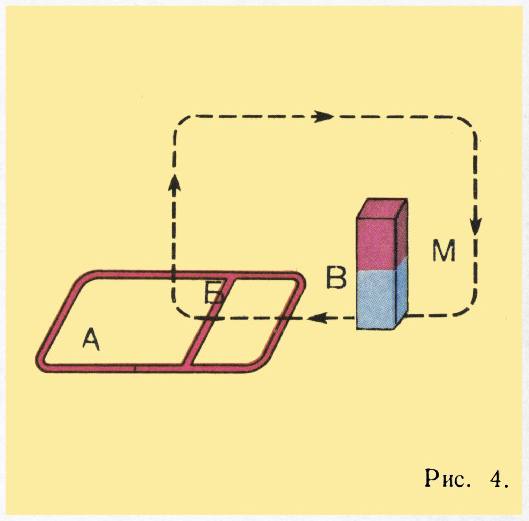
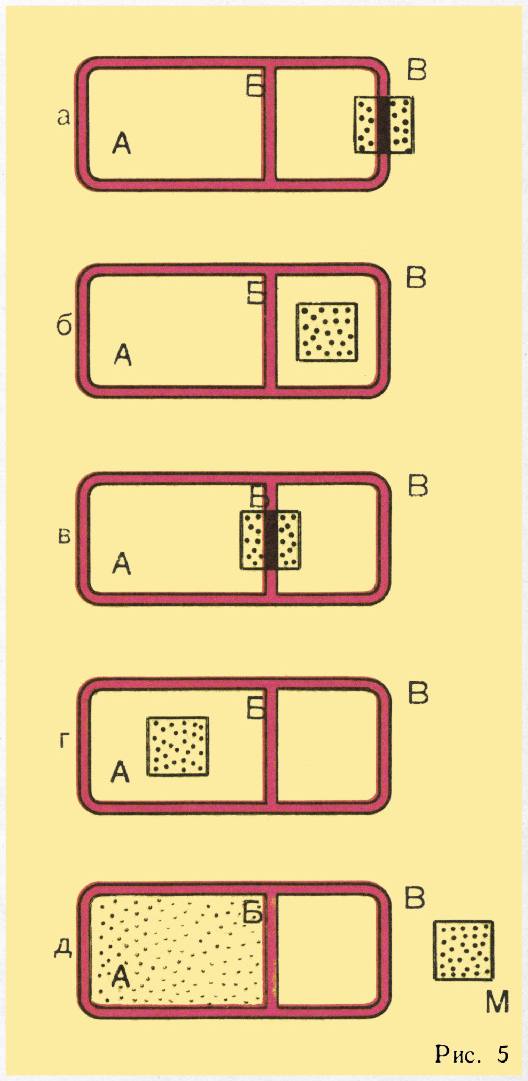
Fig. 3. Connection diagram of a superconducting coil with a superconducting switch. Part of the circuit is at low temperature. The power circuit heating to figure is not shown.
After the superconducting switch is closed, wires are no longer needed and are even harmful, since heat penetrates into the dewar through them.
There is another ingenious way of “pumping” magnetic flux into superconducting coils, which allows you to bypass it without inserting wires into the dewar at all. The circuit of a device based on this method is shown at figure 4. The coil, which for simplicity we have replaced at figure with a flat circuit , is connected in parallel by two superconducting wires and . Magnet can move around the contour. The path of its lower end is shown in figure 4 point. The magnet must be so strong that its field can destroy the superconductivity of wires and .
The successive positions of the magnet when pumping flux into the circuit are shown at Fig. 5,—5,. The magnetic flux coming out of the end of the magnet is indicated by dots - traces of the lines of force. In position the magnet destroyed superconductivity
16
wire , and when the magnet moves, the flux enters the circuit. At moment the flow is confined between wires and . The flow then passes into circuit (positions and ). When magnet is removed from the circuit (position ), the magnetic flux introduced by it is redistributed, but remains captured by circuit . Then the cycle is repeated, and a new portion of power lines enters the circuit .
The examples discussed above refer to various methods of creating a magnetic field. In conclusion, let us mention a device designed to perform the direct opposite task - the most complete removal of the field from any volume. Using the phenomenon of superconductivity, this problem can be solved in a simple and perfect way. Let’s take the flattened superconducting shell and straighten it. Then in the formed cavity the magnetic field will become equal to zero (practical, of course, some field will remain, but, in any case, it acts in this way, you can get as close to as you like). The resulting zero field will remain indefinitely in a closed cavity, despite changes in the field outside.
In the case of superconductors, the law of conservation of magnetic flux is satisfied with great accuracy, but it must be borne in mind that it can be approximately applied to circuits made of any other materials - solid, liquid and even gaseous (plasma), if the process proceeds fast enough. True, in order to accurately define what “quickly enough” means, we would have to go beyond the scope of this article.
Exercise
- How does the current passing through a superconducting coil depend on time if the tongue (see Fig.) began to oscillate with a certain frequency, replacing and breaking the circuit?
The current at the initial moment is equal to , where is the emf. source, and is the resistance included in the circuit.
-
The current in the coil will increase in direct proportion to time. How does the current change in another coil, inductively coupled to the first and closed to some resistance?
-
Two linear single-layer superconducting coils with numbers of turns and , lengths and and sections and are connected in parallel using superconducting wires. Determine how the current supplied from a common source will be distributed between them. The coils are spaced apart so that the field of one does not affect the field of the other. (However, the coils and the wires connecting them can be considered as one superconducting circuit.)
-
When a magnetic field is turned on, perpendicular to the plane of the bulb of radius , a charge flows through the bulb. What charge will flow through the turn if the ring, with a constant field, is folded into a “figure eight”, consisting of two circles, with the radius of the smaller circle being ? The figure-eight plane is also perpendicular to the magnetic field.
-
Based on a permanent magnet located vertically, at some distance from it there is a light superconducting wire bulb, the plane of which is perpendicular to the axis of the magnet. The ring is released, and it begins to fall so that it remains horizontal all the time. How will the flask move vertically?