Rough automatic draft, low quality: expect mistakes and awkward wording. It will be replaced by a better translation. Original →
55
The book by the famous Australian mathematician and popularizer W. W. Sawyer*) reveals the essence of mathematical thinking, showing the main ideas and driving forces of mathematics. The author, in an insidious and entertaining way, shows the full vigor of the ingrained idea of mathematics as a boring and formal science. We present here an abbreviated summary of the introduction to this book.
*) W. W. Sawyer, Prelude to Mathematics, M., “Enlightenment”, 1965.
56
Almost all mathematical discoveries are based on a very simple idea. Textbooks often hide this fact. They usually contain cumbersome conclusions and thereby create the impression that mathematicians are people who spend their entire lives at desks and translating tons of paper. This is nonsense. Many mathematicians work very successfully in the bath, in bed, waiting for a train, or riding a bicycle (preferably with gentle motion). Mathematical calculations are made before or after opening. The discovery itself will arise from the basic ideas.
Few people realize how vast the scope of modern mathematics is. It would probably be easier to master all existing languages than all the mathematical knowledge currently known. It seems to me that all languages could be read in one lifetime, but all mathematics, of course, cannot be read. In addition, the volume of mathematical knowledge does not remain unchanged. New discoveries are published every year. For example, in 1951, an abstract presentation of all mathematical articles published during the year required 900 printed pages of large format. In January alone, 451 titles were mentioned, and articles and books addressing new problems were reviewed; only a few of them mentioned known facts.
A person who wanted to keep abreast of everything new in mathematics would have to read about 15 articles every day, large scales and containing complex mathematical calculations. It is difficult to even dream of performing such a task.
The discoveries that mathematicians make are so varied in nature that one day someone, apparently in absence, would suggest mathematics as “everything mathematicians do.” It seemed that only such a broad definition could cover everything related to mathematics. Mathematicians solve problems that were not considered mathematically in the past, and it is difficult to predict what else they will do in the future.
A more accurate definition would be: “Matematika is a classification of all possible problems and methods for solving them.” This definition is perhaps also vague, since it would even cover such headings as newspaper advertisements “Send all your heartfelt concerns to Aunt Minnie,” which is not what we mean.
For us, a definition would be sufficient: “Matematika is the classification and study of all possible approaches and methods for solving them.” The word “regularity” is used here in a sense with which many may disagree, namely in the broadest sense, as the name of any kind of certainties that can be known by the mind.
Any mathematical theory must necessarily combine the power of method. Conditioning to combine the power of the method conditioning to combine the power of the method.
ease of application to the natural sciences, and beauty, harmony, and attractiveness to the mind. It seems to us that our definition of mathematics satisfies these general requirements.
It is interesting to note that “numerical people with only a sense of strictness towards mathematical form often came to conclusions that later turned out to be extremely important for science. The Greeks studied the properties of the ellipse more than a thousand years before Kepler used their ideas to determine the trajectories of the planets. The mathematical apparatus of the theory of relativity was created thirty to five hundred years before Einstein found application for it in physics. Many similar examples could be given. On the other hand, many worthy theories and problems that any “numerical” mathematician would classify as mathematics arose in physics.
Practitioners, as a rule, have no idea about mathematics as a way to classify all problems. The general experience is to study only those branches of mathematics that have already proven useful to their major. Therefore, they are completely helpless in the face of new tasks. That’s when they turn to math for help. (This division of labor between engineers and mathematicians is probably justified: life is too short to study both abstract theory and engineering at the same time.) Meeting
57
Mathematics and engineering are very funny. An engineer, dealing with machines every day, becomes so accustomed to them that he cannot understand the feeling of a person seeing a machine for the first time. He bombards his mathematician with a huge amount of details, which for the most part know nothing. After some time, the engineer comes to the conclusion that the mathematician is an absolute surprise and that he needs to be obliged to do the simplest things, like a child or Socrates. But, as soon as the mathematician understands what the machine is doing and what is required of it, he translates the problem into the language of mathematical terms. After this, he can tell the engineer one of three things:
- that this problem is known and has already been solved;
- that this is a new problem that he can try to solve;
- that this is one of those problems which mathematicians are certainly trying to solve, and that centuries may still pass before even a step is taken towards solving it, and that therefore the engineer will have to solve it empirically. Unfortunately, the third case is met with dismal results. But the first and second cases are also quite partial, and it is then that the mathematician, thanks to his knowledge of the laws, can bring benefits in those areas about which he in some sense does not know.
What qualities should a mathematician have?
All mathematicians are characterized by audacity of mind. A mathematician does not like to be told about anything; he wants to figure out everything himself. Of course, a mature mathematician has learned about some great discovery and told them that no one has ever been able to divide an angle into three equal parts using a ruler and compass, you will certainly see that one boy will stay after school and try to find a solution. The fact that the pilot has not solved this problem for two thousand years does not stop them from hoping that they will be able to do it during an hour’s lunch break. This, of course, is not very modest, but it also does not indicate their arrogance. They are simply not ready to accept any law, but in fact it has already been proven that it is necessary to divide the angle into three equal parts using a ruler and compass. Their attempt to find a solution is the same as trying to represent the number 2 as a rational fraction.
A good student always tries to get ahead of himself. If he is obligated to complement it to a complete square, he will certainly come to find out whether it is possible to solve the cubic control by complementing it to a complete cube. The rest of the class does not ask such questions. They’ve had enough of quadratic equations; they’re not a fool for additional difficulties.
This desire to explore the second excellent trait of a mathematician. This is one of the forces that contains the growth of mathematics. A mathematician receives satisfaction from the knowledge he has mastered. and always strives for new knowledge.
This idea can be illustrated using the example of fractional exponents from a school algebra course. It is easy to imagine a person who, having become superficially acquainted with fractional and negative exponents, begins to wonder why all this is needed. After all, we have to offer so many logical difficulties! It seems to me that the one who discovered fractional exponents first worked on integer exponents and received such great satisfaction from this work that he wanted to develop this section, and he was ready to take logical risks. After all, at first a new discovery is almost always a matter of faith, and only later, when it becomes clear that this is really a discovery, is it necessary to find a logical justification that will satisfy the highest priority critics.
Interest in patterns is the third necessary quality of a mathematician. Already at the very beginning of the arguments, patterns are encountered. For example, four stones can be used to form a square, but five stones cannot.
58
Mathematical, as well as musical, abilities manifest themselves very early, from the age of four, and sometimes earlier. One boy once told me: “I like the word September, because it turns out sEptEmbEr.” I myself have never noticed the natural progression of vowels and consonants in this word. It is real perfect symmetrical. Such a child will, of course, enjoy arithmetic.
The ability to generalize is one of the most important factors that define a mathematician. The wider the range of questions to which some general principle is applicable, the more often it will help us get out of difficulties. Poincaré said: “Suppose I worked hard on a complex calculation and, with great difficulty, finally got the result; but all my services will be in vain if they do not help to foresee the result in other similar calculations, if they do not make it possible to carry them out with greater precision, avoiding those errors and delusions that I must put up with for the first time.”
Once generalized, the result becomes more useful. You might be surprised to learn that generalization almost always simplifies the result as well. A large selection is easier to perceive than a less extensive one. A general theorem rarely contains anything confusing; its purpose is to draw your attention to the really important facts.
In elementary mathematics we encounter a mixture of all sorts of important and unimportant
details. In higher mathematics we try to separate the various elements and study each separately. In this sense, higher mathematics is perhaps much simpler than elementary mathematics.
Everything we talked about above has the goal of expanding the scope of issues subject to mathematics. Research, discovery of patterns, explanation of the meaning of each pattern, invention of new patterns based on already known ones - all these types of activities expand the scope of mathematics. From a practical point of view, it becomes extremely difficult to keep track of all the results obtained, and it cannot be said that the creation of unrelated theorems represents a smooth development. Being both business people and artists, mathematicians feel the need to collect all these disparate results.
It is not surprising that the entire history of mathematics consists of alternating processes of “expansion” and “contraction.” For example, external mathematicians are attracted by some problem, hundreds of articles are written, each of which covers only one side of the truth. The question will grow. Then some genius, based on all the data collected with such difficulty, declares: “Everything we know becomes almost very convenient if you look at it from this point of view.” After this, there is no longer any need for anyone, except for the sources of mathematics, to study hundreds of individual articles. The scattered conclusions are united into one simple doctrine, the important facts are separated from the chaff, and the direct path to the desired conclusion is open to all. The amount of information that needs to be studied has been reduced. But this is not the end. After the new method has become generally available, new questions will arise for which it is not sufficient, and the Japanese answers begin again, articles are published again, and the process of “expanding” begins again.
If it were possible to reduce all knowledge to two general laws, the mathematician would not be satisfied. He would not rest until he had proved that both of these laws were based on the same principle. But even then he would not be happy; on the contrary, he would become unhappy, since he would have nothing to do. But the prospects for such a part are incredible. Life is such that solving one problem always creates a new problem; otherwise life would be unbearable. There is and always will be material to learn and challenges to overcome.
And it will always be like this. And if it turned out that all essential mathematics considered only phenomena with properties A, B and C, mathematicians would immediately ask: “What happens if some object has only one of these properties? What if none of them?” And they would plunge back into work.
59
running_head:
folio:
To the article “Number systems”
- 201011011100010.
- ((24·60 + 2) 60 + 32)·60 + 42 = 5 193 162.
- 4(18·20^4) + 6(18·20^5) + 14(18·20^2) + 13(18·20) + 15·20 + 1 = 12 489 781.
- a)
Answer: 722634.
Answer: 7180.
b) 123456 0 61728 0 30864 0 15432 0 7716 0 3858 0 1929 1
964 0 482 0 241 1 120 0 60 0 30 0 15 1 7 1 3 1
1
(In the right column we write the remainder of division by 2, which is easy to do orally.)
Answer: 11110001001000000.
5. It is useful to prepare a table of degrees 2:
\begin{array}{c c c c c c c c}
n & 2^n & n & 2^n \\
0 & 1 & 5 & 32 \\
1 & 2 & 6 & 64 \\
2 & 4 & 7 & 128 \\
3 & 8 & 8 & 256 \\
4 & 16 & 9 & 512
Answer: , .
6. + | 0 | 1 | 2
0 | 0 | 1 | 2
1 | 1 | 2 | 10
2 | 2 | 10 | 11
7. a) ; 6) the entry does not mean any number (see exercise 8); b) .
8. Any sequence “” in which , , for all and there is no one after the two (check that this condition is necessary and sufficient for the inequality to hold for all ).
9. Yes. The first one is bigger.
10. b) If weights are classes for one pan of scales, then the smallest required number of weights is 10. You can take, for example, the following weights: 1, 2, 4, 8,…,512 = 2^9. There are not enough nine weights (of any weight), since from them you can choose only 2^9 - 1 = 511 different combinations consisting of one or more weights; even if all these combinations give different weights, we still will not get the weight of the weight from 1 to 1000.
If weights are classes on both scales, then the smallest required number of weights is 7. (For example, the following are also suitable: 1, 3, 9, 27,…,729 = 3^6; see exercise 11.) Six-weights are not sufficient, since the displayed set of three elements {left-hand cup; ruling cup; box with weights} total 3^6 = 729, and different numbers where and are the weight of weights on the left and right pan of the scales, it should be at least 2001 (from - 1000 to +1000).
13. 2q_n \leq q_{n+1}; q_{n-1} + q_n \leq q_{n+1}.
14. a) 10…0 10…0, if ;
6) 100…0; for example, 10101+1=100000.
b) 1010…10; for example, 10101+10000 = 101010.
15. Looking at a table where numbers are written in the Fibonacci system of numbers, they turn out to be digital 1 or an even number of zeros in this system, is the sequence of all numbers that turn out to be an odd number of zeros (in this case, is obtained from by assigning one zero at the end). Continue our table, make sure that this pattern holds, and prove it rigorously. Telegr can easily answer the question about the number 100 (one hundred): a sequence with the basis 1, 2, 3, 5, 8, 13, 21, 34, 55, 89, 144,…100=89+8+3=1000010100, then 100 belongs to the sequence
60
The values of corresponding to are equal to , , i.e. .
To the article “Law of Conservation of Magnetic Flux”
- The current does not change.
- The rate of change of magnetic flux through the coils is proportional to the rate of change of current, that is, constant. This means that constant e. d. With. induction in the second coil. The current is also constant.
- The total flow through the loop must be zero. The flux through the first coil is equal in absolute value to .
and through the second ( and are the magnitudes of the currents in the coils). Equating these expressions, we get .
Considering that , we find
- The charge flowing through the coil is proportional to the change in its arbitrary magnetic flux:
The change in magnetic flux is proportional to the change in the area of the circuit.
If the ring was not folded, but scalped in such a way that it turned out to be a figure eight, then the new value of the magnetic flux will be equal to ( is the initial flux through the circuit), – , therefore .
If you squeeze the turn and turn over an even smaller circle, then
If you turned over a larger circle, then
The minus sign indicates that the direction of movement of the charge is opposite to the one in which it flowed when the field was turned on.
- If the ring is superconducting, then as it moves, the current in the ring will increase so that the total flux of magnetic induction through the ring does not change. the direction of the current in the ring will be such that the ring begins to repel the magnetic field. At some point, the force acting on the ring from the magnet will balance all the rings, but since the ring will have some speed at this moment, it will slip through the equilibrium position; the ring will have a speed directed to the side. The ring will again pass through the equilibrium position, etc. Since no heat is released when current passes through the superconductor, oscillations will occur relative to the equilibrium positions.
To the article “Introductory experiments”
- .
- .
-
- .
- .
- .
- .
- .
- .
- .
- .
- .
- .
- .
- .
61
-
-
. -
-
.
-
.
-
.
-
.
-
.
-
.
-
.
-
.
To the article “Traffic schedules”
- See figure 1. Any of the curves on the top figure satisfies the velocity graph. If it is known that at , then the solution is the line . Negative characterizes the moment of time preceding the one that is considered initial.
The lower figure shows the cutting graph.
-
See figure 2.
-
See figure 3.
-
See figure 4.
-
From points and you need to check the equally inclined straight lines that characterize the movements of the first body in the first and third stages (white lines on figure 5). The straight line connecting the ends of the drawn lines corresponds to the movement at the second stage, and the speed at this stage is (if and are plotted on the same scale). The blue line depicts the movements of the second body; the intersection of the lines determines the place and time of the meeting. 1) m/sec; 2) sec, sec, m, m, 3) m
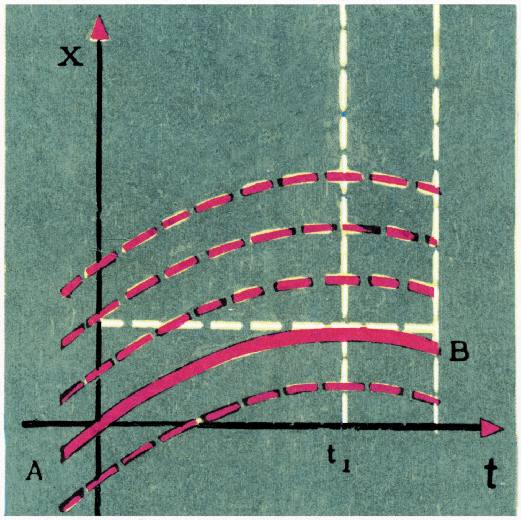
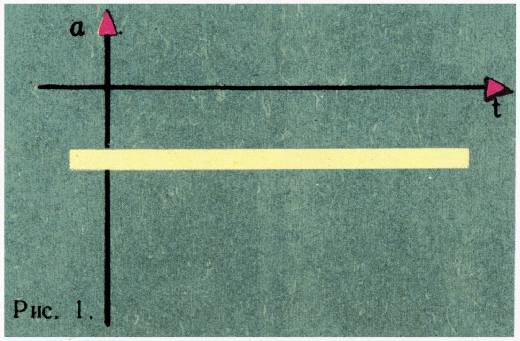
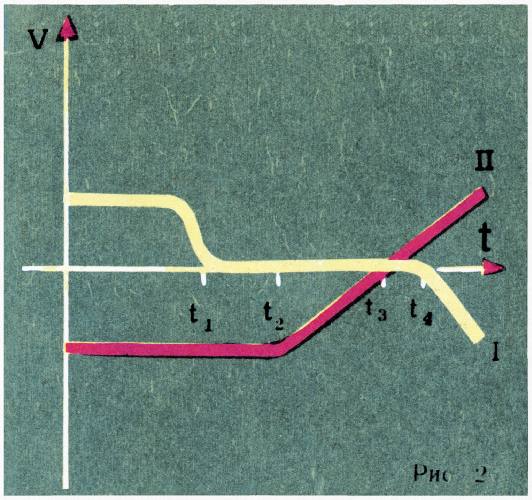
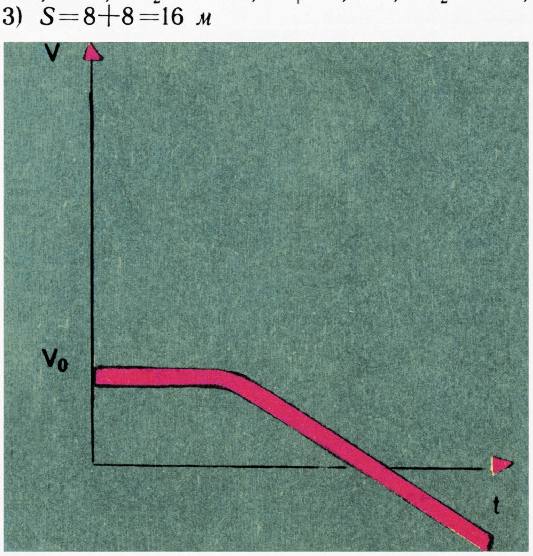
Fig. 1.
62
-
- The desired line at figure 6 is the speed graph of the first haircut, and the red line is the second one. sec from the moment of departure of the first hairdresser, m;
- m/sec; 3) m.
- The speeds at the end of the movement are the same. This follows from the law of conservation of energy. The time of movement of the second ball is shorter (it moves on average at a higher speed).
63
Approximate graphs of the speeds of movement of the balls are shown on figure 7. Since the balls travel the same paths, the areas of the figures under the speed graphs should be the same. To do this, must be greater than .
Answers to questions posted in the “Sweep” section
- The number has the form , where or 13. Therefore, the square of the number has the form or . The fourth degree (in both cases) is .
Therefore, the remainder when is divided by 480 is 1.
- If the price of a notebook is kopecks. (it is clear that ), then
Hence ,
is divisible by 101. . For we get - this is impossible (149 is not divisible by 3), for we have: , . (System
has an obvious solution , .
To the problem “Divisibility test by 7”
Right. The difference between the numbers under consideration is divided by 7, because
In each digit the set number 7 is taken out.