Rough automatic draft, low quality: expect mistakes and awkward wording. It will be replaced by a better translation. Original →
20
COMPARISON
DIFFERENT MEDIUMS
TWO POSITIVE
NUMBERS
- A. Skopets
It is well known that two positive numbers and or two segments of lengths and are associated with their arithmetic mean and geometric mean , with (the equality holds only for ). The algebraic proof of this inequality is extremely simple:
The geometric proof is based on one metric relationship between the elements of a right triangle: the height of a right triangle, lowered to the hypotenuse, is the geometric mean of the projections of the legs onto the hypotenuse. This height does not exceed the radius of the circle circumscribed about the triangle, while the arithmetic mean of the segments of the hypotenuse is exactly equal to the radius of this circle.
In addition to the indicated two interseno means, two more frequently occurring means are considered: the quadratic mean and the harmonic mean .
Let us give an algebraic and then a geometric proof that
and in all cases the equal sign holds if and only if . Let us denote the averages written out in (1) alternately by the letters . We have already checked the inequality . It remains to prove that 1) ; 2) .
that is, , and only for ;
that is, , and at .
The validity of inequalities (1) has been proven *).
We will now look at the geometric proof of these inequalities, which may turn out to be
*) These inequalities have already been discussed in the article by A. P. Savin “Maximum, minimum and the theorem on averages” («Kvant» No. 11, 1970).
21
Useful in solving geometric problems.
Let the given two segments be and . If , then by checking we are convinced of the validity of inequalities (1). Assume and construct a trapezoid with bases and equal to the correspondence of and (Fig. 1). Let us draw a secant line so that it is parallel to the bases of the trapezoid and cuts it into two equal trapezoids and . Let us calculate the length of the segment , which we denote by . From the equivalence of trapezoids and it follows that , or
(2) where is the height of trapezoid , and is the height of trapezoid . From the similarity of triangles and it follows that
(3) Comparing (2) and (3), we obtain
where is that from, and finally
So, it has been proven that
Considering (2), we have , so the segment lies closer to the larger base of the trapezoid than its midline , which is equal to . The length of the segment , parallel to the bases of the trapezoid, the ends of which lie on the lateral sides of the trapezoid, is enclosed between the lengths of its bases (this follows from the properties of similarity). So, at we have . This inequality remains in force for (it is enough to change the notations: to and to ). Therefore, for any and we have
Let’s move on to the comparison of and . To do this, we draw a secant line so that it cuts the given trapezoid into two similar (homothetic) trapezoids and (Fig. 2). Let us denote the length of the segment by . From the similarity of trapezoids and it follows that , or
Therefore, . From the similarity of trapezoids (taking into account (4)) it also follows that
This means that line is further from the base of the trapezoid,
22
Than the middle line is , and therefore . So, for any and we have
Finally, let us draw a line through the intersection point of the diagonals of this trapezoid, parallel to its bases and intersecting the lateral sides at points and (Fig. 3). Obviously .
But , because . Therefore, taking into account (5), we conclude that the segment is close to the smaller base of the trapezoid than the segment , and therefore . On the other side,
This means . Next,
From this it follows that , and therefore . So, if . Similarly, it is proved that if . Therefore, for any and we have
This correctly proves inequality (1).
So all four are average
below the two segments and received a geometric origin: if these two segments serve as the bases of a trapezoid, then close to the larger base of the trapezoid is the quadratic mean, followed by the arthmetic mean, then comes the geometric mean and, finally, the harmonic mean (Fig. 4). Obviously, the lengths of these segments do not depend on the shape of the trapezoid - for all trapezoids with given lengths and bases, the indicated averages of the corresponding ones are equal. When , the trapezoid turns into a parallelogram and all four middle ones coincide and become equal to .
It remains to construct these four averages over the given segments and . We give such constructions so that one can be convinced of the truth of inequalities (1) in another way.
Let us plot on the straight line on one side of the point the segments , , where . Let be the midpoint of the segment (Fig. 5). Then
23
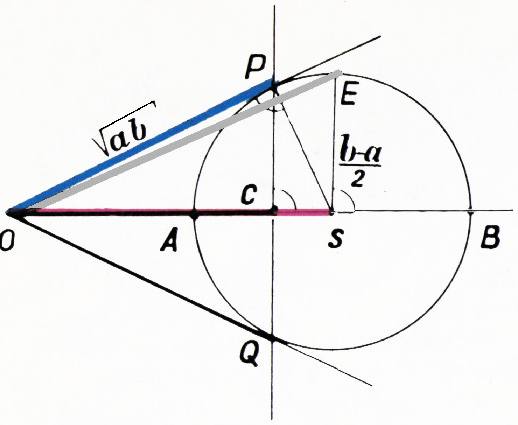
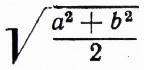
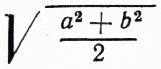
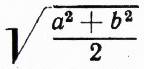
Fig. 5.
Let us construct a circle on the segment , as on a diameter, and draw tangents and ( are points of tangency) to it from point . Let us use the relationship between the secant and tangent segments drawn from the point to the circle:
Therefore, , and . Next, let intersect at . Then and
and .
Finally, we construct the radius perpendicular to . We have
and . So, if , then .
Exercises
- On a straight line on one side of the point , the segments are laid out and a circle of diameter with center is constructed. Next, with a center of radius and with a diameter are constructed.
Prove that if the line passing through intersects part of the lines and located inside at points , and the circle at points and , then
-
Find even ratios connecting each three averages of two numbers and :
-
Prove the truth of the following inequalities:
a)
b)
b) -
A circle with center on the x-axis of the right angular coordinate system intersects the axis at points and . A secant line passing through the origin intersects the circle at points and . Write an equation of the lines to which those points on the secants belong, for which
-
On the continuation of side of triangle beyond point there is a bottom point , through which a line is drawn intersecting and corresponding at points and . Through the intersection point of lines and , a line is drawn, intersecting at point . Prove that , where .
-
Given a parallelogram and a midline of a triangle parallel to . A straight line is drawn through vertex ; intersecting the lines of the corresponding one at points . Prove that , where ; point is located on one side of ( is the harmonic mean of the segment ).
How does the stated equality change if the points do not lie on the same side of ?