Written exam in mathematics at the Faculty of Mechanics and Mathematics of Moscow State University in 1970
Rough automatic draft, low quality: expect mistakes and awkward wording. It will be replaced by a better translation. Original →
45
WRITTEN EXAM
IN MATHEMATICS
AT MSU MEKHMAT IN 1970
N. N. Kolesnikov
In «Kvant» No. 2 for 1970, an article by N. S. Bakhvalov and N. N. Kuznetsov about the written exam in mathematics at the mexmate of Moscow State University in 1969 was published. Without repeating the comments made there about the nature of this exam, I would like to emphasize some of its features in 1970.
The tasks proposed to applicants once again confirm the position that their successful solution was achieved by any applicant, according to the conditions of the school program, and not just by a graduate of mathematics schools. You will see that these problems do not contain “pitfalls” or “traps”, but require a clear understanding of the main sections of the mathematics program for applicants to universities and certain skills in technical calculations and solving simple equations, inequalities and geometric problems.
Naturally, such “standardization” of problems implies increased requirements for the evaluation of their solutions, requirements for the ability to bring a solution to the end, and not limit oneself to hints at a solution. A satisfactory mark (tri) was given in 1970 for completing the correct solution of any two or three problems, good (four) for any four problems, excellent (five) for five problems. 4 astronomical hours were allotted to solve the problem (a set of five problems - variants).
Let’s move on to analyzing one of the options for the written exam in mathematics, briefly focusing on the most typical errors encountered in the works of those admitted to the Faculty of Mechanics and Mathematics.
Option 1
-
Solve inequality
-
Find all valid solutions of the system
-
Three racers A, B and C, starting at the same time, move at constant speeds in one direction along a ring road. At the start, racer B is in front of racer A at a distance of the length of the highway, and racer C is in front of racer B at the same distance. Racer A first caught up with B at the moment when B finished his first lap, and 10 minutes later A caught up with racer C for the first time. Racer B spends 2.5 minutes less per lap than C. How much time does racer A spend on a lap?
-
On the diagonal AC of the convex plane ABCD there is the center of a circle of radius r tangent to sides AB, AD and BC. On the diagonal BD is the center of a circle of the same radius r, touching sides BC, CD and AD. Find the area of four (circle ABCD), knowing that the indicated circles touch each other externally.
-
A ball of radius r touches plane P at point A. Line l forms with plane P
47
includes the product of unknowns module, consider two cases.
a) Let . In this case, the conditions of the system have the form
Multiplying the first equation by 4 and adding it with the second, we get , which is only possible for real . But these values of unknowns to the system under consideration are unsatisfactory.
b) Let now . The original system will take the form
Multiplying the first equation again by 4 and subtracting it from the second, we get , that is, . Now from the first equation it is easy to find , hence .
According to assumption . Taking this into account, we find the answer:
or
The check confirms that both pairs of numbers are roots.
This example also does not contain any tricks or tricks. It is designed for schoolchildren with a normal mathematical background. The mistakes made when solving this example were associated with a unclear idea of the absolute value (modulus) of a function and the inability to correctly write down the answer. In this case, either two cases were not considered, and the equation with the model was simply replaced by one or another equation without it, or the resulting set of values and did not agree with the conditions , and unnecessary answers appeared.
- This problem can be solved in different ways by introducing certain unknowns.
Let and be the times that racers , and spend on a lap, respectively (we take the length of the path to be one). Then the speeds of each of them will be .
Note that at any but identical absolute speeds, the distance between the riders would remain unchanged throughout the entire movement. The distance between the racers is reduced due to the excess speed of one over the speed of the other. The speed of the racer relative to is , relative to is , and the speed of relative to is .
Now it is easy to translate the conditions of the problem into equation language. Since the rider first agreed to when the latter completed his first lap, then agreed to in hours. But for this to cover of the circle with a relative speed of , this gives the equation
The initial distance between racers and was , racer covered it at a relative speed of in hours; we got the second equation:
In addition, it is known that
From equation (1) it immediately follows that , and from equation (3) . Excluding now from
48
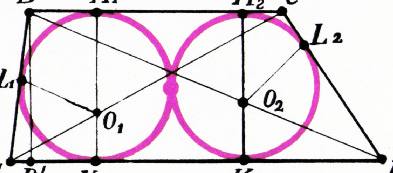
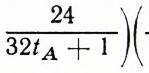
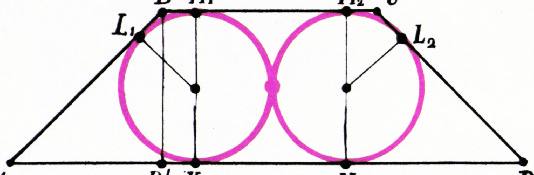
Fig. 2.
equation (2) and , we obtain an equation containing only :
or
Discarding the negative solution of the quadratic equation (4), which is unsuitable for the purpose of the problem, we obtain the answer: .
Most of the applicants who did not fully solve this problem did not show decent skills in solving logical problems: they either made mistakes when composing the equation, or could not accurately solve the resulting system.
- Let (Fig. 2) be the given quadrilateral, and the centers of the indicated circles lying on the diagonals and . Points are the tangent points of the circle centered at from the side , respectively, and are the tangent points of the circle centered at from the side . Let be the base of the height dropped from to .
According to the conditions, the circles are equal and touch each other, which implies the parallelism of their common tangents: and . Now we replace that , as crosswise angles, and , since is a bisector ( and are tangents, and passes through the center of the circle). Therefore, is demanding, is equilateral and .
So, our quadrilateral has , therefore, it is either a trapezoid, and an equilateral one, or a parallelogram.
The parallelogram is not suitable, since the centers and must lie on the midline of the quadrilateral, but in a parallelogram the diagonals, intersecting each other, are divided in half, that is, the centers of the circles would have to coincide, which contradicts the conditions. We follow the new figure (Fig. 3).
Let . Then . But , as segments of tangents drawn to a circle from one point, and then .
By construction, , therefore, , the triangle is equilateral and right-angled, that is
Now it’s easy to get the answer. Required area
A typical mistake made when solving this problem was
49
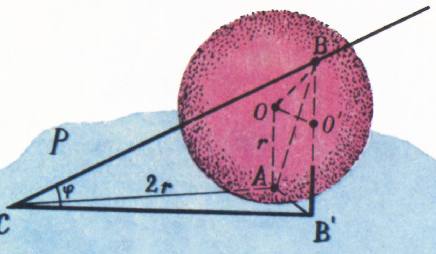
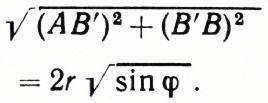
Fig. 4.
low excessive enthusiasm for the “obviousness” of some logical expressions, carelessness in intermediate reasoning. Thus, many wrote without any evidence that is an equilateral trapezoid; other possibilities were not explored. There have been cases when the proof that can only be a trapezoid was … a drawing and words that to fulfill the conditions of the problem, a quadrilateral cannot be drawn in any other way.
- Let be the base of the perpendicular dropped from the point to the plane (Fig. 4). According to the conditions
Finding the length of the segment can be found, for example, from the right triangle , the sides of which are easy to calculate. Note that are segments of tangents to the ball drawn from one point. It follows that
Side of triangle is equal to the perpendicular dropped from to (, as perpendiculars to one plane; since lies in the plane , perpendicular to ; by construction; therefore is straight). is from right triangle :
Finally, is found from triangle :
We are now convinced that the difficulties in solving this stereometric problem (as well as others proposed in 1970) do not exceed those encountered in solving school problems. However, every year a lot of applicants for the written exam in mathematics simply do not attend to solving stereometric problems, apparently believing that they are inherently impossible to solve.
Among the errors encountered in the work of the applicants, it should be noted that it is not clear what an angle of a straight line with a plane is. Thus, in the problem analyzed, this angle is often taken to be .
It is also common when deciding to use the conditions that is direct, although in the general case this is not at all true.
In conclusion, we offer readers of the magazine, for their own decision, another version of a written work in mathematics, proposing the mechanism of Moscow State University in 1970.