Problem M71—M75; F83—F87
Rough automatic draft, low quality: expect mistakes and awkward wording. It will be replaced by a better translation. Original →
30
TASKS
M71. A rectangular table of rows and columns is filled with numbers. Let’s rearrange the numbers in each line in ascending order. Prove that if you then rearrange the numbers in each column in ascending order, then in each row they will still appear in ascending order.
Think about what will happen if you act in a different order: in the original table, first rearrange the numbers in ascending order in the columns, and then in the rows: will the result be the same table as in the first case, or a different one?
M72. Solve the equation
where is an arbitrary real number.
Yu. I. Ionin
M73. On a game ticket you need to mark 8 cells out of 64. What is the probability that after a drawing in which 8 of some cells out of 64 are also chosen (and we consider all such possibilities to be equally probable), it turns out that exactly 4 cells were guessed? 5 cells?…all 8 cells?
M74. The polynomial has the following property: for some number
Prove that can be represented as a polynomial in . For example, if , then obviously and, as is not difficult to check,
where .
M75. a) Prove that in any convex polyhedron the sum of the lengths of all edges is greater than triple the diameter. (The diameter of a polyhedron is the longest of the lengths of all possible segments with ends at the vertices of the polyhedron.)
- Prove that for any two vertices and the convex polyhedron will find three broken lines, each of which goes along the edges of the polyhedron from to and no two go along the same edge.
b) Prove that if two edges are cut in a convex polyhedron, then for any two of its vertices and there is a broken line going from to along the remaining edges.
d) Prove that in problem 6) it is possible to choose three broken lines that pairwise do not have common vertices, with the exception of the ends and .
A. G. Kushinirenko
F83. A board of mass and length lies on a horizontal floor. The friction coefficient of the board on the floor is . How much work must be done in order to rotate the board in a horizontal plane through a small angle around one of its ends?
F84. A “black box” (a box with an unknown circuit inside) has two pairs of terminals. If voltage is applied to terminals I, then
31
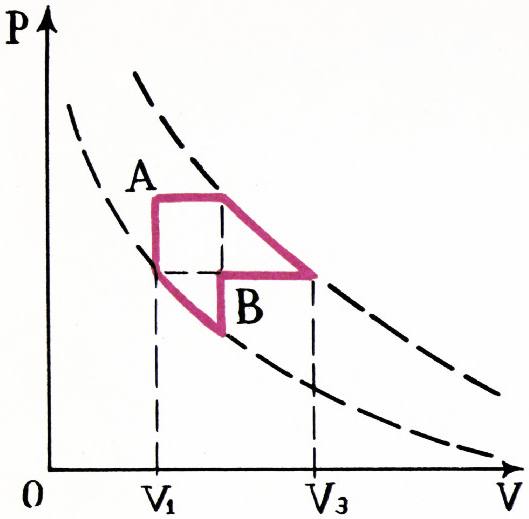

Fig. 1.
a voltmeter with very high internal resistance connected to terminals II will show a voltage of . If you apply voltage to terminals II, then the voltmeter connected to terminals I will show . What electrical circuit is in the “box”?
S. G. Semenchinsky
F85. Is it possible to test a closed process (cycle) with an ideal gas so that points and (Fig. 1) lie on the same isotherm?
The temperatures and , which correspond to the isotherms drawn at Fig. 1, the volume (or ) are given.
B. B. Bukhovtsev
F86. In Millikan’s experiment, the position of a droplet weighing e is determined by a microscope with an accuracy of 10 μm. What is the uncertainty in determining its speed?
F87. The source of spherical waves moves along the surface of the water with a speed of . Draw pictures of a wave on the surface of the water when the wave speed is higher and lower than the speed of the source.
L. G. Aslamaov