Rough automatic draft, low quality: expect mistakes and awkward wording. It will be replaced by a better translation. Original →
50
Problems of this type are often given in university application exams, and it is useful for applicants to become familiar with some methods for solving them.
A few words about the laws themselves. They can be formulated in different ways, and not in this case. The main thing is the concept of their physical content. Let’s remember the most important thing.
Newton’s first law states that a body has no acceleration (stands still or moves straight and uniformly) if no forces act on it or their total effect is zero. In other words, the acceleration and the speed are constant if .
The vector meaning of the law is important. It is the vector sum of forces that must be equal to zero (Fig. 1), it is the velocity vector that remains constant in this case: the speed is unchanged in magnitude and direction.
If the resultant of all forces applied to the body is different from zero, then an acceleration proportional to this resultant and inversely proportional to the mass of the body inevitably arises.
This is Newton’s second law. And again, its vector character is very significant: the vector equality means that the total acceleration is not only proportional to the resultant forces applied to the body, but also coincides with it in direction. You can, of course, think like this: each force causes its own acceleration, coinciding with it in direction, and the total acceleration is equal to the vector sum of these accelerations (Fig. 2).
It should be remembered that the direction of the force coincides with the acceleration, and not the speed, which, generally speaking, can be directed as an angular direction, depending on how the body moved previously. So, for example, during the flight of a stone thrown at an angle to the horizon, its speed continuously changes its magnitude and direction, while the one causing these changes
51
the force of gravity and the acceleration of free fall are practically unchanged (Fig. 3).
The third law states that all forces in mechanics are forces of interaction between bodies, equal in magnitude, opposite in direction and applied to different bodies (Fig. 4). The latter is sometimes forgotten by asserting, for example, that a body standing on the ground is balanced according to Newton’s third law by the forces acting on it: the force of gravity and the reaction force of the support (Fig. 5). In fact, the equality of these forces has nothing to do with Newton’s third law and, as we will soon see, may not be satisfied at all.
Which of these forces, however, in accordance with Newton’s third law, has its own “pair”, equal in magnitude, opposite in direction and applied to another body, in our case - to the earth: support reaction force - force of pressure of the body on the ground force of attraction of the body to the earth - force , pulling the earth towards the body (Fig.6).
Let us now consider how to solve problems. Newton’s laws are usually used when calculating forces and acceleration. To solve these problems (as, indeed, any others) there are no universal sieves; you just need to have a good understanding of the applied laws, correctly understand the physical system of the processes discussed in the problem, and know the most general ways of approaching its solution. You can, for example, propose the following, of course not at all obligatory, sequence of actions:
first, depict on a diagram moving bodies and the forces acting on them;
second, to determine the direction and nature of the movement (sometimes, however, this can only be done at the end);
third, for each movement of the body, select two axes (usually along the expected direction of movement and perpendicular to it) and distribute the forces acting on the body along these axes (project them onto them);
fourth, write down Newton’s second law for each body, separately for each axis. In this case, the projections of forces and accelerations
52
on the axis are considered positive if their directions coincide with the positive direction of the axis, and negative if they are directed oppositely (Fig. 7);
five - having solved the compiled equations, find the unknowns.
Let’s look at a few examples.
- Find the tension of the threads and the acceleration of the loads in the system shown in Fig. 8. The thread is considered inextensible, the resistance forces, the mass of the block and the thread are not taken into account.
Let us first consider what forces act on each of the loads. Firstly, this is the gravity force . If we accept , then .
Secondly, the tension force of the threads acts on each of the weights: - on the first and second weights and - on the second and third.
Note, by the way, that the force is the same for the first and second loads only in the case when the mass of the block and thread can be neglected. If the mass of the thread were not small, then the acceleration of each section of the thread would be imparted by the difference in the tension forces of the threads. Therefore, the tension forces of the threads acting on different loads could not be the same.
The same is true for a block: it can be set in motion, strictly speaking, only if the thread is pulled stronger on one side than on the other.
Having depicted on the diagram the forces acting on the loads (Fig. 9), we will try to determine the direction and nature of the movement.
The right side of the system is heavier, so the weights and will begin to fall, and the weight will rise. The movement will be uniformly accelerated with the same acceleration for all loads, or the predominance of the weight of the right side in the absence of resistance forces and inextensibility of the threads is equivalent to the action of a constant resultant force on the system as a whole, which, according to Newton’s second law, should cause constant acceleration.
We can also estimate the magnitude of the pushing forces. It is clear, for example, that , or for the first load the acceleration, and therefore the resulting force, must be directed upward. Likewise , and (Fig. 9).
The choice of axes is appreciated: for the first load, it is convenient to direct one axle upward, for the second and third - downward (along the movement). As for the second (perpendicular) axis, then in this
53
task, it is simply not needed: none of the forces are projected onto it—all of them are directed either up or down and therefore are projected entirely only onto the first axis.
Now you can easily write the equation of motion (the equation of Newton’s second law) for each of the three groups:
We have obtained three equations, from which we can easily find three unknowns ( and ).
Substituting, for example, and from (1) and (3) into (2), we obtain
Substituting this result into equation (1) and (3), we find
The axes, of course, could be directed differently, for example, for the first load not up, but down. Then instead of we would write , which would not affect the final result at all.
- Find the acceleration, the pressure of the body on the inclined plane and the friction force (Fig. 10). Friction coefficient . The force is directed vertically upward.
Four forces act on the body: force - up, force of gravity - down, reaction of support - perpendicular to the inclined plane and friction force , the direction of which can be found out only by determining the direction of movement of the body. In such cases, they usually estimate where the body would move without friction under the influence of all other forces, in our case - under the influence of forces and (Fig. 11a). The force of friction, it is very clear, is not able to change the direction of movement, but can only reduce its speed or even completely slow down the body.
It can be suggested that the body will slide along the inclined plane up or down. To determine the direction of movement, we choose two axes: the axis is directed along the inclined plane, the axis is directed perpendicular to it (Fig. 11b). Having expanded the forces and along these axes), we see
*) Let us note by the way that, having expanded the force along the axes, it is necessary to remember that it has already been replaced by others, and therefore it can either be crossed out at figure so as not to be considered as acting again. Or create a new figure with one “decomposed” force
54
Let us assume that the body can only move downwards along the plane, since of the two forces acting along it, is greater than . The friction force, therefore, can only be directed upward along the inclined plane.
In our example, we must, however, allow for one more possibility: the force may be so great that the body will not slide along the plane at all, but will turn away from it. However, comparing the “pressing” force and force we see that the first is greater than the second, and therefore the body cannot be torn off the plane.
It must be said that the difference between these forces gives the desired pressure force of the body on the plane and the support reaction , equal in magnitude to it.
Let us now write Newton’s second law, remembering that forces directed opposite to the positive direction of the axis are considered negative. For the axis we obtain.
(1)
(there is no acceleration in this direction, therefore the sum of forces is zero). And for the axis we get:
(2)
In problems of this type, mistakes are sometimes made when determining the magnitude of the friction force. To get used to problems with horizontal moving bodies, they often, without thinking twice, calculate the friction force as the product of the friction coefficient and the weight of the body.
In fact, , where is the normal pressure force (support reaction), that is, the force acting on the body perpendicular to the sliding plane (or equal in magnitude and opposite in direction to the force of pressure of the body on the plane).
In our problem, we need to take into account both the angle of inclination of the plane and the force , which somewhat reduces the force of normal pressure:
Now from equation (2) it is easy to find the acceleration of the body:
- The rocket is equipped with a spring scale on which a block rests. Before departure the scales show 10 . In flight, the scales first show 30 , then 10 , 5 , 0 . What can be said about the acceleration and direction of the rocket’s motion at these moments in time?
Let’s look at the strength first.
Two forces act on the block: gravity and support reaction (Fig. 12). When the rocket has no vertical acceleration (for example, before takeoff), these forces are equal. In our case .
If the rocket (and therefore the block) moves accelerated, upward, to the right, then these equal forces must be directed upward (). If the acceleration is directed downward, then .
What do the scales show? Of course, not gravity, as is sometimes thought. They all record the force with which the block presses on them. This force is applied to the scales and, in accordance with Newton’s third law, is equal in magnitude and opposite in direction to the reaction of the support applied to the block
55
From the conditions of the problem it is clear that the support reaction force and the force of pressure on the support, or weight, equal to it in magnitude, then change during the flight and, generally speaking, are not equal to the gravitational force , which practically can be considered constant (if we pretend to change it with height). Let’s write down Newton’s second law for motion along an axis directed upward:
Substituting here , , , we get: . The acceleration is positive and is therefore directed upward.
For we get , for , for . In the last two cases, the acceleration is negative, which means it is directed downward, or in our equation we considered and to be directed equally (both positive).
As for the direction of movement, one should caution against the latter conclusions. It is erroneous, for example, to say that the rocket first moved upward (), then stopped (), began to accelerate downwards () and, finally, went into free fall (). In fact, the rocket could move in other ways, for example, all the time upward: accelerated (), at a constant speed (), slowly (). Acceleration equal to the acceleration of gravity only means that the resultant of all forces acting on the rocket is equal to the force of gravity; At the same time, it can move upward - with the engine turned off, if you do not take into account the resistance forces, or when it is working in such a way that these forces overcome the traction forces. All bodies in the rocket in this case will be in a state of improbability, that is, their pressure on the support and the reaction of the latter will be equal to zero.
The whole point is that we found only acceleration, and not speed and not direction of movement, about which, in the conditions of our task, unfortunately, it is impossible to say anything.
- A ball of mass hanging on a thread of length is moved to the side to a horizontal position and released (Fig. 13). Determine the tension in the thread and the acceleration of the ball when the thread is at an angle of to the horizontal. Find the law of change in the tension forces of the thread, speed and acceleration of the ball depending on the angle . Claim the forces of resistance.
To solve, we will use the same method as before: we will arrange the forces on figure, estimate what the direction and nature of the movement could be, select the axes and, having distributed the forces along them, write the equation of motion.
Two forces act on the ball: the gravitational force and the tension force of the thread (Fig. 14). It will move, very indo, along an arc of radius .
We will direct one of the axes tangentially to the trajectory, the second perpendicular to it - along the radius. Having expanded the forces along them, we see that the force acts along the axis, and the and forces act along the axis.
The force causes the so-called tangential, or tangential, acceleration , which changes the speed in magnitude.
56
is a vector directed like tangentially to the trajectory of the ball (Fig. 15).
The resultant forces , impart centripetal (normal) acceleration to the ball, changing the speed in direction (Fig. 16.).
Having written Newton’s second law, for motion along the and axes we obtain:
From equation (1) we immediately find the tangential acceleration and the law of its change:
The centripetal acceleration that occurs during any curved movement is also a vector. It is always directed inside the trajectory along the radius and is caused by the algebraic sum of the radial projections of all forces acting on the body. The magnitude of centripetal acceleration, as is known, is calculated by the formula . is known, and we will find the speed by writing the law of conservation of energy:
where (Fig. 17). Hence and . Velocity and centripetal acceleration are zero in the upper position () and maximum in the lower position (, ).
Tangential acceleration , on the contrary, is most significant at the beginning of the movement at the top () and is equal to zero when the thread is vertical
57
(with ). After the ball passes the lowest point of the trajectory, becomes negative (from ). It is directed against the speed (Fig. 18) and reduces it (by the way, this is clear from the law of conservation of energy - in formula (3) kills).
We found the values of speed, tangential and centripetal acceleration for an arbitrary angle , as well as the law of their change depending on the change in this angle. Their directions are also known for any moment in time ( and - along the tangent, - along the radius). Terri, we can also determine the total acceleration equal to the vector sum of the tangential and centripetal acceleration () (Fig. 19).
The tension force of the thread and the law of its change depending on the angle are not difficult to find from equation (2): .
Substituting here instead of the found value , we get , or .
The thread tension is maximum when the ball passes the bottom position (sin has the highest value of 1).
Try to solve the following problems yourself.
-
Consider example 2 for the case when the force is directed not upward, but at an angle to the inclined plane (Fig. 20) and is equal to: , , (the calculation is carried out for all three cases).
-
Continue solving Example 4 by determining how, when the ball moves, the directions of the equal forces applied to the ball and the total acceleration change.
-
Find the thread tension, acceleration and friction force of the load on the inclined plane (Fig. 21) for the friction coefficient and for . The thread is considered indestructible, the mass of the block and thread is not taken into account.
-
Solve a problem similar to the third one, but with the following changes: instead of the load , there are two weights and , connected by a thread (Fig. 22); friction coefficient for the second load is , for the third one . Additionally, it is necessary to determine the thread tension between the second and third weights.
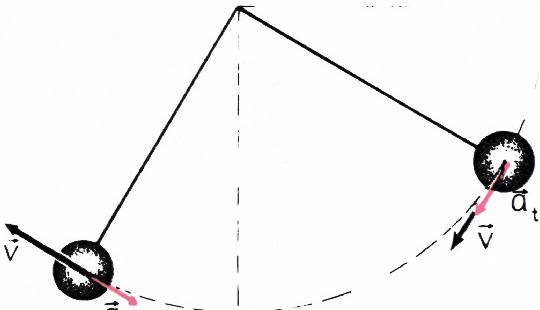
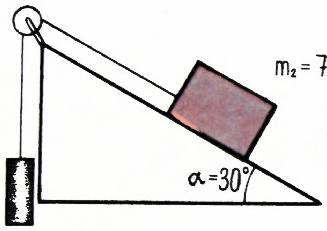
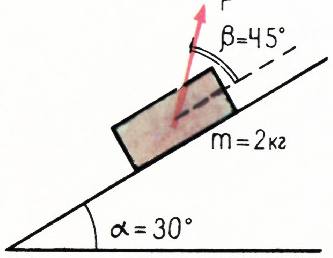
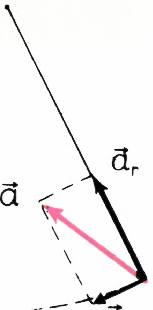
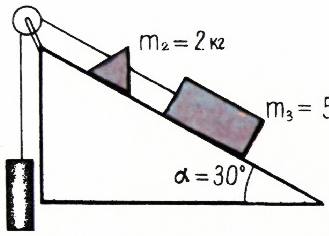
Fig. 20
Fig. 21
Fig. 22