Rough automatic draft, low quality: expect mistakes and awkward wording. It will be replaced by a better translation. Original →
29
FOUR EXPERIENCES WITH VISION
J. Greg
In the 10th and 11th issues «Kvant» over the past year, we have already talked about some experiments with black-and-white and color vision (see articles by G.I. Kosourov “Don’t believe your eyes” and “Orange sky”). Now we will tell you about several more worthy experiments with vision. With them, given at the beginning, the features of our vision are used - the ability to see in the dark and retain the memory of the images seen for some time. The last experiment demonstrates another nice visual illusion. All experiments are taken from the book by James Gregg, which we will talk about on page 60 in the same issue of our magazine. The publication was prepared by V. A. Leshkovtsev.
About test 1. Adaptation to darkness
On a bright sunny day, when you enter an unlit room from the street, it seems to you that it is deep night in the house. But soon you are already perfectly oriented, despite the relatively low light: your eyes have adapted - adaptation to the dark has occurred. As a result of adaptation, the color of the eye to light increases a million times. Under ideal conditions, an eye that is fully adapted to darkness can notice the light from a single candle 20 km away.
Observe the adaptation process very simply: in the evening, go from a well-lit room to a dark one. Notice how long it takes you to read the numbers on a watch with a luminous face or to read a newspaper headline if there is little light coming from a window or a slightly open door.
Very weak light is better seen if you look at a little bit of it. So, a dim star in the sky will seem brighter if you look a little away from it. Check it out when you get a chance.
Let us present a simple experiment using the adaptation of the eye to darkness.
Take a piece of black cardboard measuring 20x25 (cm). On both sides of the center at a distance of 5 cm, glue a white circle and square to the cardboard. Hold the cardboard like a book while reading (Fig. 1).
Have your partner suddenly turn off the lights. Your eyes are gradually
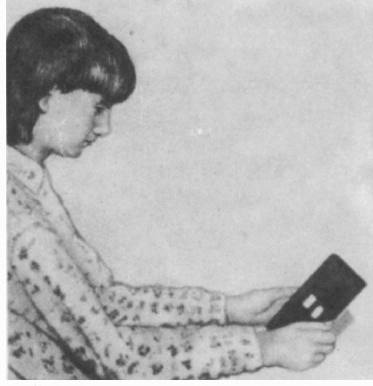
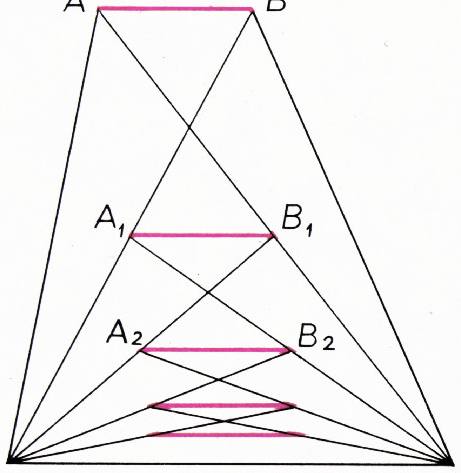
Fig. 1.
30
will adapt to the dark and you will see white spots (on invisible cardboard). Calculate how much time will pass from the moment the lights are turned off until the moment you can distinguish between a white circle and a square. Take the cardboard in your hands (before the lights go out), but turn it away from you and rotate it further so that you don’t know where the white circle and square are located; when the light is turned off, turn the cardboard towards you to the side where the figures should be. Please note that the circle is visible better if you look at the square rather than at it. Can you oblige, why?
If you have carefully read the beginning of the description of this experiment, then you can correctly interpret its results.
O torture 2. Followers
The number of successors you can observe is endless. The term “after-time” means that the image remains after the discharger that caused it ceases to act. A sequence is called positive when it contains the same distribution of bright and dark areas as the discharger itself, and imprinted when the distribution of bright and dark areas is the opposite.
Nanomore interesting are the induced afterproducts. The induction effect is caused by something additional to the main discharger, such as the background against which the view is viewed successively; this background can be either a pattern, a gray field, or a colored field. First, it always shows the main discharger - figure, color. Then watch looking at some background. It is easiest to detect the induced sequence on a neutral gray background. figure2 shows figures with which you can get a good follow-up. Such figures should be glued onto gray cardboard. Leave only one figure in your field of vision and look at it for 30-60 seconds. Then look at the gray background. There should not be too much light in the room (dark lighting). You may see a bird flying on the ceiling, on the wall, on your palm, or your eye projects simultaneously onto any surface that you are looking at.
Cut out any images from colored paper. Experiment with shapes of different colors. Look at such a figure, move your gaze to the gray background - and you will see an additional color to the original one. Thus, you will become acquainted with one of the basic principles of forming induced sequences.
Take a background of the same color as the first discharger. Look at the bright red square for a minute, and then move your gaze to a piece of red paper. What does one after the other look like?
Leave the same main discharger, but take the background green-blue, that is, the color complementary to red. How does the current sequence differ from the previous one and from the one that turned out on a gray background? Try different colors and different combinations for the main discharger and for the background.
A pattern consisting of concentric circles (Fig. 3) is a very strong discharger, easily causing a sequence. When looking at it, effective movements and rolling appear. Such effectiveness is observed in his consistent manner. Follow this figure with a diameter of 30-50 cm. Install in a hundred
31
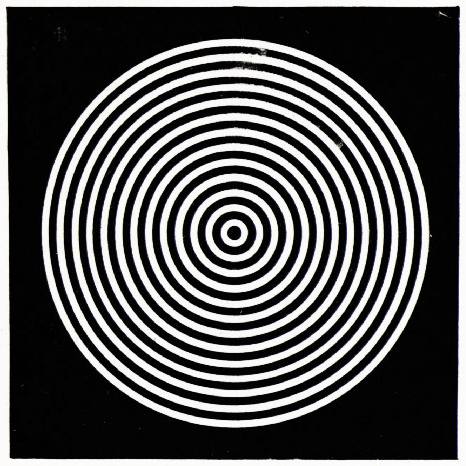
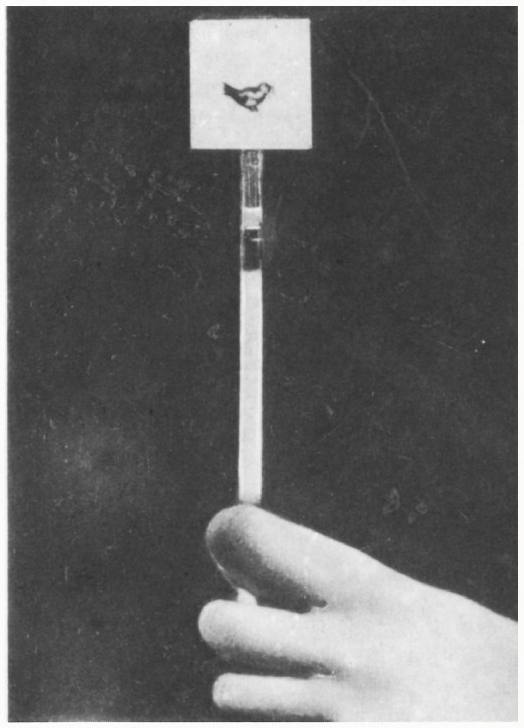
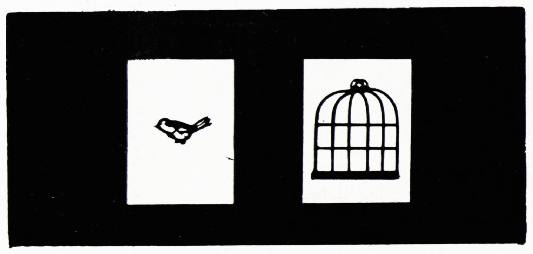
Fig. 3.
there is a large gray screen for deconstructing the afterimage. If your figure is colored, the effect will be especially impressive.
Experience 3. Inertia of vision
The horse running on the movie screen, of course, is in no way dead. She is not dead on the television screen either. And in general, the “moving” objects in the frame are motionless - the frames themselves move, but at such a speed that the human eye does not replace their change. You can see movement on the screen because human vision has a certain inertia. In other words, any visual sensation persists for some time after the image that caused it disappears. Therefore, if the images change often enough, the visible image of the previous image smoothly passes into the subsequent image, and under certain conditions they can be seen simultaneously.
figure 4 shows a tattoo trope—a device that, by rotating it, can demonstrate the inertia of vision. If you rotate the tattoo trope quickly enough, figure on one side will align with figure on the opposite side. On one side of the cardboard square, glue figure birds, and on the other side - figure cells (Fig. 5). Bottom needle one end into the edge of the cardboard -
32
Place the end of the ruler in the same position where you placed the sheet of paper. Moving the ruler slightly, find such a distance from the projector that any part of the image is clearly focused on the white end of the ruler. Now get started: quickly move the ruler up and down, up and down.
Observe that those standing behind the projector see the full image of the color figure in the air at the place where you move the ruler. This happens because individual pieces of the image, directly visible only at those moments when they are projected onto the ruler, are retained by the eye for some time, enough for you to have time to move the ruler to show the next piece of the frame.
In the same way, a television picture is obtained. Only there is not a ruler, but an electron beam showing horizontal lines of the image one after another. And the whole picture is obtained thanks to the inertia of vision.
About torture 4. Upside-down cube
Using 12 wires or round sticks, make a cube frame as shown in figure 6. The effect will be better if all the material is shown
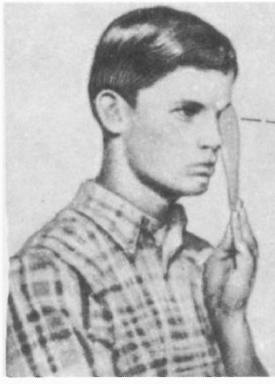
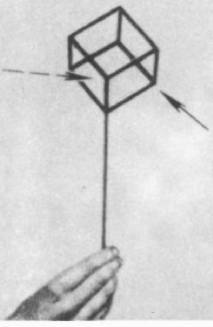
Fig. 6.
in matte black color. First make two quadrangular sides of the frame, and then fasten them with four sticks. Attach a longer stick - a holder - to one of the corners. Everything can be done with glue and then reinforced with black thread.
Hold the cube in front of you so that its far corner (at figure 6 is a solid arrow) is visible approximately in the middle of one of the sides of the cube (the line of sight at figure 6 is shown by a dotted arrow). Close your other eye.
Look, without looking away, at the far corner of the cube. Suddenly you will see how the cube “turns inside out” so that the far corner appears to be facing forward, the closest one. When the stick is rotated slowly, the cube “flips” in the direction opposite to the direction of rotation. Move the stick back and forth, and you will see how strange the upside-down cube behaves.
Get lost first to learn to see everything properly. It is better to conduct the experiment against the backdrop of a peephole wall. If this doesn’t work, try changing the background to rotate the cube, tilt it, or slightly deform it.
With a little fiddling, you will observe the effect of a complete absence of ivo. Remember that it only works when you look with one eye.
This effect is called the von Horibostl cube irony. When both eyes work together, they see depth so well that they cannot be fooled by this cube, but one eye will definitely make a mistake in determining which part of the cube is closer. This iriznyaya is one of the most interesting.
Some people have the effect of receiving it when observing it with their eyes. The main thing is to fix your gaze with both eyes on one (far) corner of the cube.