Rough automatic draft, low quality: expect mistakes and awkward wording. It will be replaced by a better translation. Original →
51
In science fiction, almost anything is possible. For example, in Conan Doyle’s “Maracot’s Abyss” he uses a nice hypothesis that water at any depth does not exert any pressure, and nothing - it turned out to be an excellent novel with science, love, the ancient Greeks, and so on.
Unlike science fiction, every developed science prohibits more than it allows; but if she has already resolved something, then that’s for sure.
Much has been said about cosmic cold by both science fiction writers and engineers:
“…Clenching her teeth, closing her eyes, Svetlana furiously wounded her hand (the spaceship’s flywheel)… she didn’t have time to scream or move her hand. Death from cosmic cold was faster than thought" (B. Fradkin, The Astronomer’s Secret 117-03, Molotov, 1956).
“…The cold of the world space turns out to be rather useful, … since there is no need to take cooling substances and devices with you” (M. Valle, Flight into the world space, ONTI, 1936).
So, is it cold in space?
What does “cold” mean? Let’s clarify this concept. Let’s assume that when it’s “cold,” a lot of tel is lost from us per unit time, for example, Q joules per second (rain/sec). And since one of us may be small in stature, others may be giants, it is better to see how much tella is consumed in a unit of time with a unit of area. As a measure of “coldness,” a tell per second per square meter of the surface of our body is used:
On Earth, we have learned to hardly think about why we are not, in fact, very hot; rather, living in a moderate order, we think about not being cold (we take care of fur coats, hats, etc.). And when it gets hot, we have ice cream, the depths of the sea, deep whirlpools, and the wind in our faces. The movement of water, air, ice - all this immediately and effectively provides a sufficient value of q. Molecules of the environment collide with the surface of any heated body and carry away the body. (With some ingenuity, we can even form a column of shivering air above us, like a marai above the horizon on a hot day.) What if it gets hot in space? In a vacuum there is no air, no water, it’s a shame to throw everything overboard the ship. There is only one thing left: radiation
52
Chat tello. This process is also noticeable on Earth: they emit an electric furnace, a Pyuner fire (it’s easy to verify this by shielding yourself with your goods). But on Earth, this process is successfully competed with by thermal conductivity (transfer of a body in the presence of a temperature difference between stationary bodies in contact) and convection (carrying away a body along with the moving mass). In space, radiation is the only way to cool. It is clear that for large radiation it is necessary to “get hot”. This paradox - in order to cool quickly, you need to overheat - is associated with the well-known Stefan-Boltzmann law.
Here is a physical constant, the value of which can be found in the reference book: . The equal sign occurs only for those that cool quickly and need to be overheated - it is associated with the well-known Stefan-Boltzmann law.
From law (1) it is clear how quickly the heat conductor grows with increasing temperature of the radiating body: will increase three times - will increase times (almost this time!). We just need to remember that temperature is expressed on the Kelvin scale.
And then, to be sure of something, you need to count.
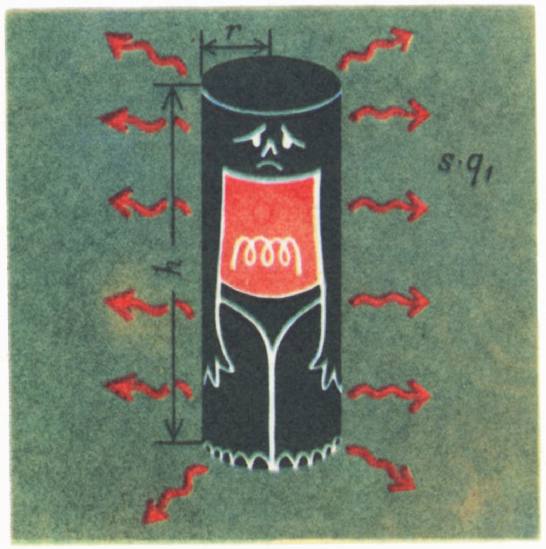
Fig. 1.
It should be noted that cooling can also be caused by the evaporation of water contained in the body from the open surface of the body. We will not consider this effect here, assuming, for example, that the body we are considering is placed in a tightly fitting, ideally transparent polytylene bag.
In a living organism, processes occur that lead to the release of the body ( cal/sec). It has been established that, along with food, a scientist needs to consume 3000 kcal per day, a loader 5000 kcal. Since in space, we increase, it gives both of them, use as a rational diet 4000 kcal/day, of which empty turns into muscle energy, and , that is, 3000 kcal/day, remains in the form of a body , subject to radiation. Let’s convert to SI units:
Next, let’s estimate the surface of our body . How to do this? You can imagine yourself as a cylinder with a height equal to your height (empty for a schoolchild m), and choose the radius of the cylinder so that the volume of the body is (Fig. 1). This volume, if expressed in liters, is numerically equal to the body mass in kilograms (remember that when we enter we float, when we exit we sink, which means that the specific gravity of the body is close to the specific gravity of water). Then for kcal we get m, m. (Of course, a person is much more complex, but for physical assessments this is good.)
Let now this model man be a water cylinder with a normal temperature with a constant heat release , it is necessary to find himself in perfect open space, and he is not exposed to radiation from stars, crying or other bodies (obviously, this
53
“coldest” case). How will it cool then? In one second, energy will be emitted from its surface. This loss is partially compensated by internal heat release , so that the total heat loss is . I wonder how long it will take for its average temperature to drop, for example, by ? The heat capacity of a human water cylinder is . Assuming constant heat loss by radiation, we obtain
And this is only when cooling from 37 to ! Thus, instant (“faster than thought”) transformation into “super-frozen ice” is still very far away, even in this “coldest” case. (Try to calculate the steady-state temperature at .) Now let’s assume that we are in space in the Earth’s orbit around the Sun. Let’s find the equilibrium temperature of our body, when it should radiate not only that released by internal heat, but also that heat , which is absorbed in one second by placing our body facing the Sun (the amount of solar radiation flux in the Earth’s orbit, the so-called solar constant, is approximately ). We have the equation
from which
This is much more than the doctors can allow us. Of course, you can make the half of the body that is irradiated by the Sun mirrored (but then it will not emit anything), and the other half, from which the internal heat of the organization should be removed, can be made completely black (Fig. 2) *), but this motley harlequin bone will indicate more likely the fear of frying than of freezing in the recognized kingdom of terrible eternal cold.
Here it is appropriate to remember that a “piece of space” (however, a rather shallow vacuum) is used in a regular thermok vessel as the best thermal gilding; its walls are made shiny, reflective, so as not to absorb or emit anything. Thus, the almost complete absence of matter in a vacuum is in itself the best coat.
Well, what if you need to cool not your own body with a pathetic internal stove, but a huge ship for flights in the solar system with a powerful nuclear reactor? Let’s say you have a reactor that produces warm energy on the order of ten million kilowatts () per second. Frequent (~10%) you will convert jet scab, light bulbs, radio waves and other useful substances into energy. Why not all of it? This prohibits an important law called Carnot’s theorem: if you want to get a useful
*) Find the average steady-state body temperature in this case at .
54
operation due to random thermal energy, it is necessary to ensure not only the “hot end” of the heat engine (reactor temperature), but also the “cold” . And then, in the best case, the efficiency of this machine will be equal to
(This is similar, for example, to water falling from a height to a height ; then the relative change in energy will be . Carnot himself used this analogy, but we must remember that this is only an analogy.)
In order for a heat engine to work (that is, the condition is fulfilled), a temperature difference between the heater and the “refrigerator” is necessary. It would be nice to bring closer to zero or to infinity; then the efficiency would be close to unity, and this is an ancient dream technically. But cannot be too large, it is limited at least by the melting of materials. And it is especially impossible to reduce , because for intensive cooling you need to increase , on the contrary. The compromise solution gives .
Let, for example, K. (Metals such as tungsten do not float.) Then from formula (2) we obtain that K. Next, from (1) we find the maximum radiation flux W/m.
Then, to emit the useless energy of the reactor an area of no less than
One and a half hectares of area, heated to K and exposed to impacts of meteorites, flows of molecules and particles! And all these hectares - this whole mass of tubes, molten metal or hot gas flowing in them - coolant, washing the reactor - is needed only in order not to overheat, and only because there is no cosmic cold.
(See page 16 for a start.)
from the first columns and in any of the top rows, that is, it can occupy positions.
Similarly, it can be shown that the number of squares with placements is equal to and so on.
The number of possible squares is equal to
It turns out that it is also possible to count the number of possible rectangles for the same given initial sheet of checkered paper; it is equal to .
Try to prove it.
- How many triangles?
On a sheet of checkered paper, all nine of its nodes are highlighted by placing . Each node can serve as a vertex of a non-degenerate triangle (a triangle whose three vertices do not lie on the same straight line).
figure shows seven such triangles,
Moreover, they are not equal; they cannot be combined by superposition. Are there any other non-degenerate triangles, not equal to those shown here, whose vertices can be placed at the nodes of our sheet of paper?