Rough automatic draft, low quality: expect mistakes and awkward wording. It will be replaced by a better translation. Original →
10
Diffusion is a very common phenomenon in nature and is of great practical importance. We are posting here an article by B. Culliti, prepared by the Nauka publishing house for the next issue of the collection “What Physicists Are Thinking About.” The article was published in Scientific American. Translation by V.K. Fedyanin.
Soviet scientists made significant contributions to the study of diffusion. Those who wish to become more familiar with this phenomenon can find a lot of interesting information in the popular science book by Ya. E. Geguzin “Essays on Diffusion in Crystals,” published by the Nauka publishing house in 1970.
The smell of perfume is known to exist at quite a distance. This is explained by the fact that perfume vapor diffuses very easily in the air. Drops of liquid dye in water diffuse easily throughout the vessel. Diffusion in a solid is much more difficult to observe. For this reason, the study of diffusion in solids has become one of the most interesting studies in physics today.
As in many other areas of a person, it reduces effectiveness; in this case, it reduces the precedence of knowledge. For centuries, workers welded metals and produced steel by heating solid iron in a carbon atmosphere, without having the slightest idea of the diffusion processes taking place. Only in 1896 did scientific study of the problem begin.
The English metallurgist Sir William Roberts-Austin measured the diffusion of gold in lead in a simple experiment. He placed a thin disk of gold on the end of an inch-long cylinder of pure lead, placed this cylinder in a furnace where the temperature was maintained at about 200°C, and kept it in the furnace for 10 days. He then cut the cylinder into thin disks and measured the amount of gold that diffused into each lead medium. It turned out that by the “clean” end a completely measurable amount of gold had passed through the entire cylinder; lead diffused in the opposite direction into the depths of the gold disk (Fig. 1). Roberts-Austin discovered that heated metal diffuses into another when they are pressed closely together.
From the point of view of the atomic structure of matter, the permeability of solids is not a country. Nowadays we have a good idea that even the densest solid body is only quite weakly
*) Inch≈2.5 cm.
11
connected set of atoms. In the crystals that form a metal, the atoms are arranged in a fixed lattice in certain positions from which they are quite difficult to dislodge.
However, ideal and fully built-up crystal lattices do not exist. They always contain a certain amount of vacancies, or “holes”, in which diffusing atoms can “jump”. When it jumps into a certain vacancy, the atom leaves behind a new vacancy.
A neighboring atom can move into this vacancy; intact, by continuous movements of atoms in the lattice, atom can pass through the crystal (Fig.2).
What makes an atom leave its place in the lattice and “scan” into a vacancy? The fact is that in fact, atoms in lattices are not in fixed positions in an array. As a result of thermal motion, atoms continuously vibrate relative to a certain average or, more precisely, upsaverage position over various possible locations of their location. The amplitude of these vibrations can vary from atom to atom and over time. From time to time, an atom is so far from its equilibrium position that it can jump to an adjacent vacant location. The tendency to this, of course, increases sharply if we heat the body, thereby causing the atoms to vibrate more strongly. Thus, the rate of diffusion increases very quickly with increasing temperature. For example, zinc diffuses into copper at 300°C almost 100 million times faster than at room temperature.
In the Roberts-Austin experiment, gold atoms at 200°C are energetically removed from the sausage to begin jumping into lattice vacancies (the same is the case for lead atoms). After all, if the experiment had been carried out for a long time, the gold atoms would have been evenly distributed throughout the lead cylinder. A simple analysis can be carried out. If you put several black balls into a box of white balls and shake the box for a long time, then the black balls turn out to be evenly distributed among the white ones.
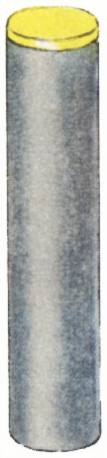
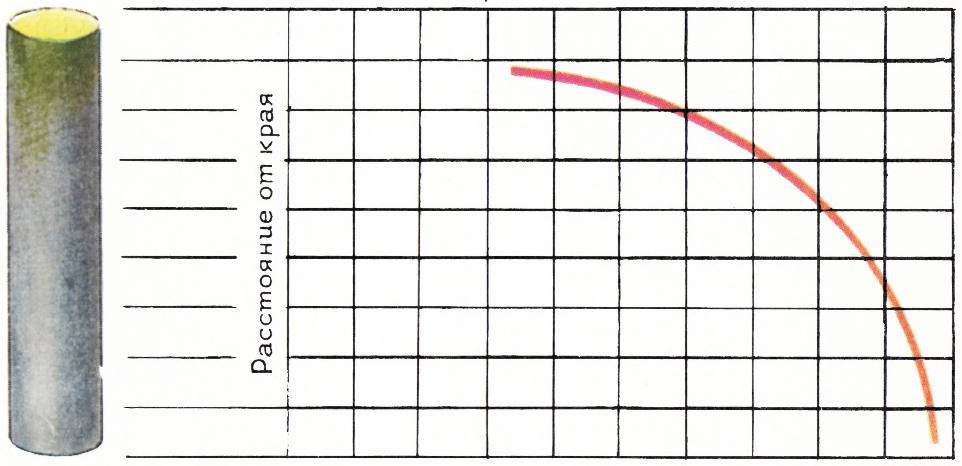
Fig. 1. Figure will encroach on the first Roberts-Austin diffuse experiments. Gold was placed on pure lead (gray cylinder on the left) and the sample was heated. On the right is the same cylinder after diffusion of gold into lead and lead into gold has occurred. This cylinder was cut into thin disks to measure the amount of product-founding gold they contained. The curve shown in the graph on the right shows the change in gold concentration depending on the distance from the top edge of the right cylinder.
12
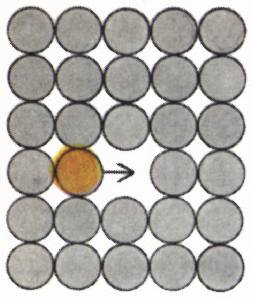
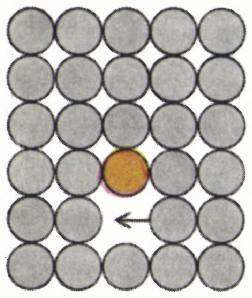
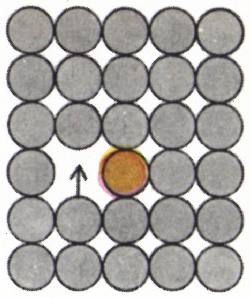
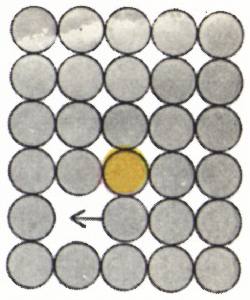
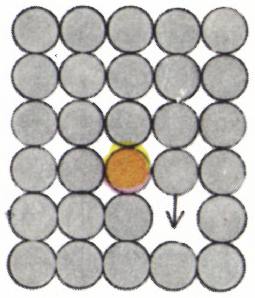
Fig. 2. There may be vacancies in the atomic planes of the crystal. This figure is used in how gold (yellow circle) can diffuse in a lead crystal. The transition of gold atom to the position shown in the lower right figure is possible if there is only one vacancy in the lead lattice.
The diffusion of atoms in a pure metal (called “self-diffusion”) can be altered by using a minute fraction of the element’s radioactive atoms. Let’s say, in order to change the rate of self-diffusion in copper, it is necessary to electron-deposit a small amount of a radioactive isotope of copper onto the end of a cylinder of ordinary copper and heat this cylinder to a certain temperature. After enough time has passed for diffusion to occur, the sample is cut into thin slices and a Geiger counter is used to change the radioactivity of each successive medium. These data allow the diffusion rate to be calculated.
A metal can diffuse into another metal only if there is a vacancy in the crystal lattices, since the atoms of even two different metals have sizes of approximately the same order.
However, atoms of a nonmetallic element, whose dimensions are much smaller than those of a metal atom, can hang between the atoms in a nonmetallic crystal. In this case, diffusion does not depend on the vacancy, therefore, it occurs much faster. However, the most important example of such a case is the diffusion of carbon into iron.
In its directional form, steel is an alloy of carbon and iron. The properties of steel vary depending on the carbon content of the alloy. Steel with a small carbon content (say, on the order of one-quarter percent) is not very strong and does not forge well. Increasing the carbon content makes it stronger but more brittle. A machine part such as a transmission mechanism must have a hard surface to resist wear, and be sufficiently elastic in its internal parts,
13
So as not to break due to external impacts. These properties are acquired through a process called surface hardening. A piece of metal is heated and kept in a carbon-rich gas, such as methane. Carbon atoms from the gas diffuse slowly into the steel (Fig. 3). After a few hours they will penetrate to a depth of about one-twelfth of an inch. The surface or “shell” of this piece of steel after this treatment contains about 1.2 percent carbon, while the interior contains only a quarter of a percent (Fig.4).
Knowledge of the processes that occur during the diffusion of atoms into a metal can help us in studying the internal structure of the metal. Generally speaking, a piece of metal is made up of small crystals, or “grains.” The internal structure of an individual grain is highly regular - it is an almost ideal lattice with a certain number of vacancies or other minor deviations from ideality. But taken together, the grains do not form an ordered structure. Their relative position is purely accidental. Very rarely, one grain is adjusted by its edge to another so that the regular arrangement
the atoms in it were, as it were, a continuation of the arrangement of atoms of another grain. Obviously, these grains form a certain skew angle, called the “divergence angle.” Atoms located in the program area between the grains are nestled between crystals and eventually end up inside one of them. As a result, a greater destruction of atoms is created in this area than in grains. Diffusing atoms pass through such region programs much faster than through the regular lattice of the grain itself. It is well known that metal atoms diffuse much faster in a fine-grained metal, which is literally riddled with grain boundaries, than in a metal built from large crystals.
M. Akhter and R. Smoluchowski conducted an experiment to determine the effect of the divergence angle between grains on the diffusion rate. They prepared a cylinder of copper, consisting of large filamentary crystals arranged in such a way that the planes of the lattices made filament angles with each other. An alloy of copper and silver was welded to the end of the copper sample and the whole thing was heated to a temperature of 675 ° C. After 10 days they prepared
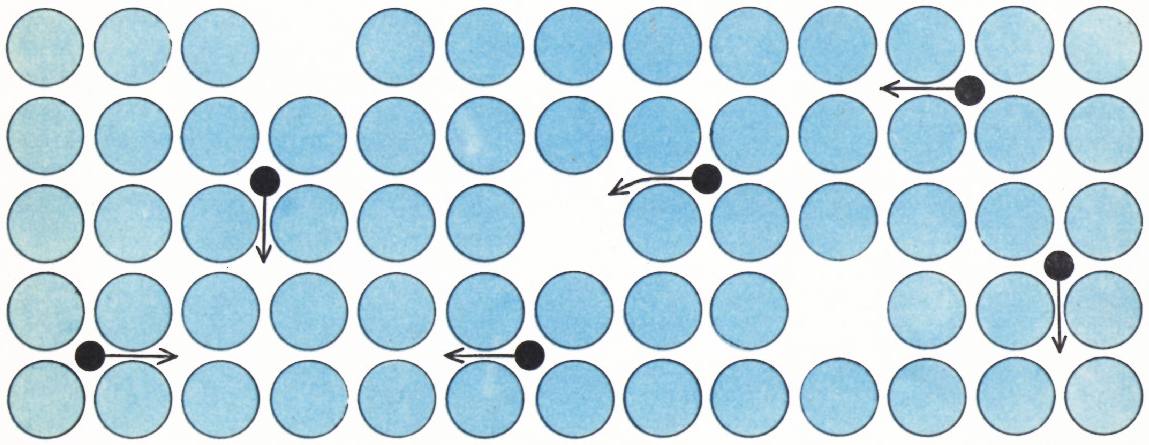
Fig. 3. The diffusion of carbon in iron does not depend on the presence of a vacancy. The carbon atoms (black circles) are small enough to fit between the iron atoms (blue circles).
14
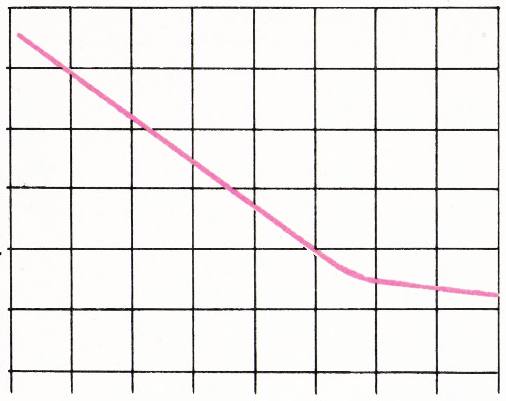
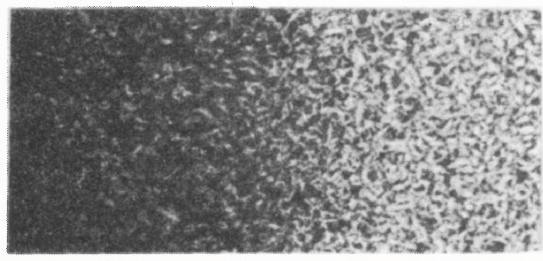
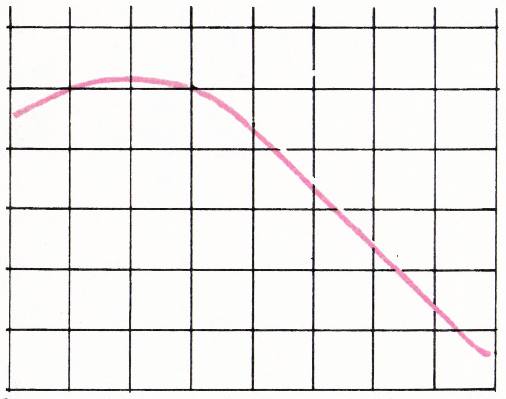
Fig. 4. Surface hardening of steel occurs as a result of the specific diffusion of carbon atoms into it. The middle part figure shows a micrograph, or structuring, of the distribution of carbon in a piece of steel, the surface of which is in contact with hydrocarbon. The top curve gives the percentage of carbon as a function of the distance to the surface of the piece of steel. The lower curve characterizes the strength of steel in different parts of the piece.
Fig. 4. Surface hardening of steel occurs as a result of the specific diffusion of carbon atoms into it. The middle part figure shows a micrograph, or structuring, of the distribution of carbon in a piece of steel, the surface of which is in contact with hydrocarbon. The top curve gives the percentage of carbon as a function of the distance to the surface of the piece of steel. The lower curve characterizes the strength of steel in different parts of the piece.
15
as an experimental error. In order to convince doubters, Kirkendile, in collaboration with A. Smigelax, conducted a new series of experiments. They applied only a layer of copper on opposite sides of the brass stubble, and between the copper and brass on both sides of the brass stubble they placed molybdenum wire so that it would fix the boundary between the copper and brass. After this, the sample was heated to a high temperature. If copper atoms entered the brass rod as quickly as zinc atoms exited it, then the original size of the brass rod would not change. This would be indicated by the stationary position of the molybdenum wire. But in fact the molybdenum wire had shifted, and its dislocation indicated that the brass rod had contracted; that is, zinc atoms came out of stubble faster than copper atoms entered it. Under a microscope, it was possible to smooth out fairly large pores that had formed in the surface as a result of the appearance of a large number of vacancies arising where zinc atoms quickly escaped from the pores.
These results were published in 1947, and what is now called the “Kirkendyle effect” created a real sensation among metallurgists and all researchers who studied the properties of solids.
Old experiments were tested and new ones were carried out.
Since the Kirkendile effect was immediately discovered in many alloys, there was no doubt that it actually existed.
Undoubtedly, the study of diffusion will deepen our understanding of the properties of solids and all those engineering processes in which diffusion plays a major role.