Problem M106—M110; F118—F122
Rough automatic draft, low quality: expect mistakes and awkward wording. It will be replaced by a better translation. Original →
33
TASKS
In this issue, “Problem Book «Kvant»” is compiled from problems proposed at the final exams of the first All-Union Olympiad in Mathematics and Physics.
M106. Prove that if the numbers satisfy the inequality
then square trinomials
and
have real roots and between two roots of each of them lies the root of the other.
I. F. Sharyn
M107. a) Given a convex polygon . (Fig. 1). On side points and are taken, on side - points and , …, on side points and so that if we construct parallelograms then straight will intersect at one point. Prove that
.
- Prove that the converse statement is also true for a triangle: let points and be chosen on side , points and on side , points and on side so that if we construct parallelograms then the lines will intersect at one point.
V. L. Gutemacher
M108. a) Prove that the line dividing the given triangle into two polygons of equal area and perimeter passes through the center of the circle inscribed in the triangle.
- Prove a similar statement for an arbitrary polygon in which a circle can be inscribed.
Yu. I. Ionin
M109. a) At the vertex of the regular 12-gon there is a minus sign, and at the rest there are plots. It is allowed to simultaneously change the sign to the opposite one at any six consecutive vertices of the polygon. Prove that in several such operations it is impossible to achieve that at the vertex
not turned out to be a minus sign, and in the remaining vertices there were plots.
- Prove the same statement if it is allowed to simultaneously change signs not at six, but at four consecutive vertices of the polygon.
c) Prove the same statement if it is allowed to simultaneously change signs at three consecutive vertices of a polygon.
M110. On an endless sheet of glued paper, grids are painted black. Prove that a finite number of squares can be cut from a leaf so that two conditions are satisfied:
- all the black squares will lie in the cut out squares;
- in any cut square the area of black cells is at least and no more than of the area .
G. A. Rosenblom
F118. A mass of hydrogen and the amount of oxygen required for complete combustion enter the combustion chamber of a jet engine per second. Nozzle output . The pressure in this section is , the absolute temperature is . Determine the traction force of the engine. (9-10 grades)
G. L. Komkin
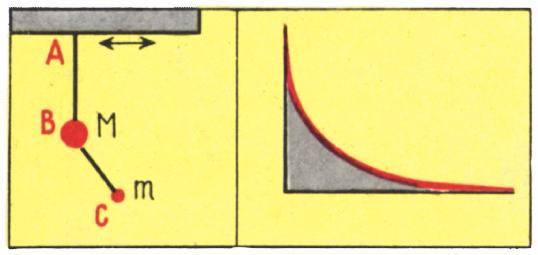

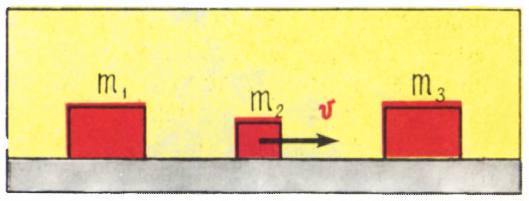
Fig. 2. Fig. 3.
F119. A matchbox with a ball of mass is suspended from a matchbox with a ball of mass (Fig. 2). Point oscillates in the horizontal direction with a period of . Find the length of thread if it is known that thread remains vertical all the time. (10 grades)
G. L. Komkin
F120. A speed skater on an icy road tries to make a turn as close to the inside edge as possible. A cyclist on a cycle track takes a turn as far as possible from the inner edge. How to enforce this difference in the movement of a skater and a cyclist on a turn? The track profile is shown on figure 3. (8 cells)
M. M. Balatsov
F121. In a hermetically sealed vessel, a piece of ice of mass floats in water, in which a lead pellet of mass is frozen. How much heat does it take to make the pellet sink? The density of lead is , the density of ice is , the heat of fusion of ice is . The temperature of the water in the vessel is . (8 grades)
F122. Three bodies with masses , and can slide along a horizontal plane without friction (Fig. 4), and and . Determine the maximum velocities that two extreme bodies can acquire if at the initial moment of time
Fig. 4.
neither they accumulated, but the average body had a speed of . The impacts are considered to be absolutely elastic. (9 grades)
E. Kuznetsov
36
It remains to solve the following problem: find a point M on line l for which angle PMQ is the simplest: a circle passing through points P, Q and M touches line l. To construct a point M, you need (if the segment PQ is not parallel to the line l) from the point C of the intersection of PQ and l on the line l, plot the segments CM₁ = CM₂ = √(CP·CQ), and then from the resulting points M₁ and M₂ select the one for which the angle MᵢCP is acute (or straight). The proof that it is for this point that the angle PMQ is maximum is almost obvious and is left to the reader *) (Fig. 2).
Oddly enough, many readers who sent us letters thought about one of the possibilities 1) and 2). The greatest solution was sent by O. Kim, G. Levin, A. Pukhalsky, V. Luzzin, Yu. Obolonkov, A. Kostyurin.
M65
a) Let E, F, G be points on sides AB, BC and CA of triangle ABC for which , where 0 < k < 1.
Find the ratio of the area of triangle KLM formed by lines AF, BG and CE to the area of triangle ABC (Fig. 3a).
- Cut the triangle with the sixth straight line into pieces from which seven equal triangles can be folded.
a) Let us denote the area of the triangle with vertices X, Y, Z by s(XYZ). Using the fact that the ratio of triangles with the same heights (or with the same bases) is equal to the ratio of the bases (corresponding to the ratio of the heights), it is not difficult to prove that
In the same way it can be proven that
Pozny
- Note that for k = this ratio is equal to and each of the three segments AF, BG, CE is divided by two others in the ratio 3:3:1, so that if points M, K, L are drawn, three more lines corresponding to parallel to these segments, then each of the sides of the triangle ABC will be divided in the ratio 2:1:1:2.
*). For more information about this, see the book by N. B. Vasiliev and V. L. Gutenmacher “Straights and Curves”, series “Library of the Physics and Mathematics School”. “Science”, 1969, pp. 76-78.
Now it is not difficult to assemble 7 equal triangles from the 13 pieces into which triangle ABC is cut (one of them consists of a single piece KLM; Fig. 36).
A similar solution to the problem of adding A. Alekseev from Leningrad, A. Alyaev from the Penza region, E. Turkevich, A. Chernyak, Yu. Obolenkov.
M66
Here are some examples where the sum of the squares of consecutive natural numbers is equal to the sum of the squares of the following natural numbers:
Find a general formula covering all such cases.
Let us prove that for every natural number there is exactly one natural number such that
(Note that on the right side of the equality is a summand, and on the left side there is ). Equality (1) is equivalent to the following:
Thus, the stated statement is proven: equality (1) for natural and is satisfied if and only if . (When moving from (3) to (4), we took advantage of the fact that the sum of the terms of the arithmetic progression is equal to . Thus, we obtained an exclusion formula. It can be written, for example, like this:
where is an arbitrary natural number. The examples given in the conditions are obtained from it with equal to 2, 4 and 5.
This formula (or others equivalent to it) has been found by a lot of people - most of them either give a proof close to ours, or use the formula for the sum of squares of natural numbers in their calculations (see Lemma 1, on page 17).
M67
The jeweler was ordered a gold ring of width , which has the shape of a body, the bounded surface of a ball with center and the surface of a cylinder of radius , the axis of which passes through the point (Fig. 4). The master made such a ring, but chose too small. How much gold should be added if needs to be increased times, but the width remains the same?
It is not difficult to prove that the volume of a spherical ring - the body obtained by expressing the segment around the diameter , which does not intersect this segment - is equal to where is the projection of the chord onto the diameter . This formula is given, for example, in the book of J. Adam “Elementary Geometry”, part II, chapter. IV, 500.
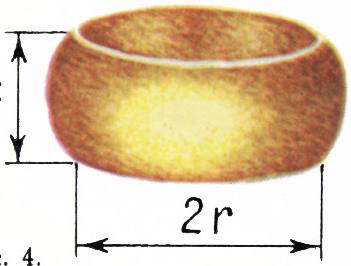
Fig. 4.
38
The volume of the ring is equal to , that is, it does not depend on the radius , so gold is added to the master.
M68
The grid of lines depicted on figure 5 (see also the cover of “Kvat” No. 2, 1971) consists of concentric circles of radii 1, 2, 3, 4, … with a center at the point , a line passing through the point , and all possible tangents to the circle parallel to the line . The entire plane is divided by these lines into cells, which are colored in a checkerboard pattern. In the chain of pink dots shown in figure, every two adjacent dots are opposite vertices of a dark cell. Prove that all points of such an infinite chain lie on the same parabola (the pose weight figure is, as it were, woven from yellow and dark parabolas).
Taking the straight line as the axis , and the point as the origin of coordinates of the rectilinear system, as shown in figure 5. The scale unit is already specified in the conditions. The grid of lines discussed in the conditions is composed of circles of radius with center (the equation of such a circle ) and straight lines , where and are all possible integers; . Thus, each point of intersection (or tangency) of these lines—each “node” of our grid—corresponds to a certain pair of values and . Note that when we move from one of the pink dots to the adjacent pink dot, both and change by one, so their difference remains constant; this difference for all pink dots is 6.
The equation is equivalent to the following: ; . Thus, all pink points lie on the parabola .
In another similar chain of points, which we drew with the head color, when moving from a point to the neighboring one, and change by one so that their sum remains constant: . This equation, after transforming the points, becomes the equation of the parabola .
In the same way, it can be shown that any infinite chain of points in which neighboring points are opposite vertices of the same cell (or one segment) lies on the parabola , where is some non-zero integer. Conversely, any of these parabolas contains such an infinite chain of points (these are the points of intersection of the parabola with all possible lines ).
39
Note that if , that is, if the branches of parabolaOLS go upward, then if is even, the parabola goes along the dark cells, and if is odd, along the yellow ones; if , then vice versa. Moreover, through each intersection of lines and circles of our grid (excluding tangent points lying on line ), two parabolas pass; one goes along the yellow cells, the other goes along the dark ones; one is directed with branches up, the other - down.
The solution to this problem is the addition of many honors. Some people use the following geometric definition of parabola in their solution: a parabola is a set of points equally distant from a given point and a given line. Essentially, the solution to problem M68 is very close to proving the equivalence of this definition of parabola and the one known from the school course (a parabola is the graph of a square triangle). If we choose a coordinate system so that a given point is the nacal coordinate, and a given line is the equation , then the condition that the point is equally distant from the given point and the given line is written by the equation , which is equivalent to the equation .
M69
The number 76 has this curious property: the last two digits of the number give the number 76 again.
a) Are there any other two-digit numbers like this?
b) Find all three-digit numbers such that the last three digits of make up the number .
b) Is there an infinite sequence of digits such that for any the square of the number “” is “…”? (The quotation marks here denote the decimal notation of the number. We exclude the obvious answer for all .)
The answer to this problem follows: for any there are exactly two such -digit numbers , the square of which is (not counting the very long ones: 0 … 0000 and 0 … 0001), - for these are 76 and 25, for - 376 and 625, with - 9376 and 0625, with - 09376 and 90625, etc., so there are two infinite sequences of numbers discussed in point c): one starting with the numbers 6, 7, 3, 9, 0, 1, …, the other - with the numbers 5, 2, 6, 0, 9, 8, …*).
Let’s start with task a). The easiest way to find the two-digit numbers we need, which indicate pluralities, is as follows. If turns out to be the same two digits as , then (A - 1) is divisible by 100 = 25 4, and since the numbers and are coprime (do not have common factors greater than 1), then one of them must be divisible by 25, and the other by 4. Let’s try to see if each of the numbers is suitable 25, 50 and 75 for role or for role (both of these numbers are double digits). To do this, you just need to check which of its neighboring numbers are divisible by 4. This will only be 76 and 24, so can only equal 25 and 76.
Problem 6 can be solved similarly), but we must immediately understand: if the square of the number turns out to be the digits “… ”, then it is possible, in a unique way, to choose the digit so that the square of the number turns out to be “… ”.
Let . Then
where is the last digit of the number . We must choose so that equals , that is, so that is divisible by 10. Obviously, this can be done in a unique way. In the functions and that interest us, the functions that we must indicate are especially simple: if , then , and if , then with and with .
This approach to solving problem M68 is discussed in more detail in the book by Ya. I. Perel - on “Entertaining Algebra”, pp. 81-85.
*) We do not exclude from consideration the numbers “”, in which the first digit (or several first digits) is equal to zero. Readers who have not considered such numbers should naturally only go up to the four-digit number 9376 and the three-digit number 625.
41
A heavy hoop with lightweight knitting needles is located in a vertical plane and can be rotated around a horizontal axis passing through the center. A small ball is fixed in the thickness of its rim, having the same mass as the hoop itself. What will be the period of the wheel hoop around the axis? How will it change if: a) this hoop is moved to the Moon? b) place it in a liquid in which he will marvel without tremium?
Will engage in analogies. Readers can get acquainted with him by reading the article by Ya. A. Smorodinsky “Similar movements” in the magazine for this year. Let’s use the analogy with a mathematical matrix of length .
If the maximum angle of deviation of the matrix and the ball attached to the hoop is (Fig. 7), then they are at a height of from the equilibrium position. At the deflection angle , the kinetic energy of the matrix (and the hoop with the ball) is equal to the difference between the potential energies at angle and angle . For the mathematical matrix we get
Therefore the speed matrix
Just like the matrix, the potential energy of the hoop with the ball changes. The potential energy of the hoop itself does not change, but the kinetic energy in this case is equal to the sum of the kinetic energies of the ball and the hoop (for the kinetic energy of the hoop, see the article by A.K. Kikon “Rotational motion of bodies”, «Kvant» No. 1, 1971). Therefore, in the case of a hoop with a ball, it follows from the law of conservation of energy that
and ball speed
At any angle of deviation from the equilibrium position, the speed of the ball is times less than the speed of the mathematical matrix. Hence,
42
and the period of oscillation of the hoop with a ball is times greater than the period of oscillation of the matrix and is equal to
You can approach the solution of this problem anyway. If the mathematical matrix is deviated from the equilibrium position by an angle , then it is returned to the equilibrium position by the component of the gravity force, tangent to the trajectory of the matrix (Fig. 8):
Since the angle is small, then , where is the displacement of the matrix from the equilibrium position. From here
Therefore, for the tangential component of the matrix acceleration we can write the equation
or
where is some constant coefficient for a given matrix. The matrix oscillation period is equal to , that is, .
We will obtain a similar result for a weight attached to a circle and oscillating along a horizontal plane. The equation of motion of such a weight is , and the period of oscillation is .
In our case, the force returning the ball to the equilibrium position is equal, as in the case of the mathematical matrix, , and the acceleration is imparted to both the ball and the hoop, that is, mass . Therefore ; this means and the period of oscillation of the system is .
If a hoop with a ball is moved to the Moon or placed in a vessel with liquid, then its period of oscillation will change in exactly the same way as the period of oscillation of a mathematical matrix: in the first case it will increase by times () due to a change in the acceleration of free fall, and in the second case it will decrease by times ( - the density of water and - the density ball materials) due to the influence of the Archimedean buoyancy force.
The correct solution was sent by S. Ivanov (Moscow), G. Zaitsev (Gagra), A. Proskuryakov (Moscow).
F77
A rectangular block, the height of which significantly exceeds its length and width, stands on a horizontal surface. How to determine the coefficient of friction between the block and the surface, having only one measuring device - a ruler?
Having made a loop from the thread, we throw it over the block and pull it in the horizontal direction (Fig. 9). If the thread is draped over a block close to the surface
43
If necessary, the block will slide. If we lift the thread along the block, then when it is at a certain height from the surface, the block will no longer slide, but will begin to turn over. In this case, the force with which we pull the block is equal to the friction force:
and the moment of force relative to the axis passing through the point is equal to the moment of gravitational force:
where is the side of the square at the base of the block.
Solving these two equations together, we find
By measuring and using a ruler, we find the coefficient of friction of the block on the surface.
This solution was added by I. Sidorov (Moscow), A. Petrov (Asbest of the Sverdlovsk Region), M. Rozov (Minsk), S. Yudin (Volgograd), D. Shapiro (Chelyabinsk), A. Alexandrov (Glazov Udm. Autonomous Soviet Socialist Republic), G. Simonenko (Kaunas).
An interesting solution by A. Kalik from Baku and S. Sobolev from Moscow. Here it is.
Having tilted the block and holding it at a certain angle to the vertical, we apply a certain force to the block, directed along the block (Fig. 10). In this case, the reaction force and the friction force will also act on the block. If the friction force does not reach the maximum value equal to , then the end of the block will not slide. In this case, the friction force is equal to . Thus, the end of the bar does not slip when
that is, when
It is easy to see that at the block cannot be made to move, no matter how large the force . Let us find the angle at which the block begins. Using a ruler, measure the height from the horizontal plane to the edge of the tilted block and the width of the block and calculate , we find the friction coefficient .
44
20 helium contained in a cylinder under the piston is very slowly transferred from state I ( amm, l) to state II ( amm, l). Each gas with the highest temperature access is simpler if the graph of pressure versus volume is a straight line (Fig. !i)?
Let us plot the isotherm grid on the graph—hyperbola . The higher the gas temperature, the farther the vertex of the hyperbola is from the origin. Therefore, it is clear that during process I-II the gas reaches such a high temperature at which the corresponding hyperbola does not intersect the line I-II, but only touches it.
Since the point with coordinates and , corresponding to the maximum temperature, lies on both the hyperbola and the straight line, its coordinates must satisfy two equations: the equation of the hyperbola
and the equation of the line
(α and β are constants. We will define them a little later). Substituting from the second equation into the first, we obtain a quadratic equation for :
Since a hyperbola and a straight line must have only one common point, this equation can only have one root, that is, its determinate must be equal to zero:
Solving the last equation for , we find
In this expression you need to substitute the values of the coefficients and . Since points I and II belong to the same line , then and . Solving this system of equations, we find
Pozny
Substituting the numerical values of the quantities included in this expression, we obtain
The correct solution with additives M. Preger (Tomsk), V. Rudko (Kyiv), N. Fedin (Omsk), G. Zaitsev (Gagra), L. Knizherman (Moscow), O. Maslyuk (Novomirgorod, Kirovograd region), V. Trunkov (Gomel), E. Rozov (Minsk), A. Petrov (Asbest Sverdlovsk region), L. Tsiferblam (Lvov), I. Vidorovich (Simferopol), V. Tyryshkin (Kuibyshev), V. Martivov (Ioshkar-Ola), V. Klimov (Solnechnogorsk, Moscow region), A. Tovbi (Odessa), G. Fast (Karaganda), M. Glikman (Chisinau), A. Zisman (Pskov), A. Esin (Liggul Tashkent region), A. Tarnopolsky (Nikolaev), M. Sarkisyan (village of Agaran, Megri district of the Armenian USSR).
I. Sh. Slovodechkiy