Rough automatic draft, low quality: expect mistakes and awkward wording. It will be replaced by a better translation. Original →
18
Molecular models
A. I. KITAIGORODSKY
It is useful to remember that words are made by man.
Words that are used in life are often blurry in nature. Not all concepts are the same - the words cilia and beauty, energy and tension. And “good” weather is different for different people.
In science, this state of affairs does not exist, or at least it should not exist. Particularly intolerant is the imprecise use of words in physics.
The simplest physical concepts of nature were used to describe the properties and behavior of objects and bodies among which our life goes, in short, for “large” bodies or, as we also say, for macro-nutritional bodies.
What concepts from the macrocosm can be applied to molecules? All or some? The truth lies in the middle.
What about geometric and mechanical concepts?
Is it possible to talk about the shape of the molecule, its elasticity, the model of bending and torsion, and finally, the laminarity of molecules? Whether and what sense the concept of intramolecular and mechanical concepts make is not only possible, but also advisable.
This phrase means the following.
In some cases, a ULE molecule can be spoken of as a large body.
A body that can be compared to a given molecule is called a mechanical model of the molecule.
Our task is to explain how this model is constructed and how to use it to solve various physical problems.
The mechanical model of the molecule has recently become widespread due to interest in the huge (compared to an atom) molecules from which synthetic polymers are built - nylon, nylon, polystylene (these names are now known as home), as well as substances that are most important for the life of animals and plants - proteins, nucleic acids, and so on.
Any “image” of a molecule must be composed of a description of the relative position of atomic nuclei and the characteristics of electrons moving around these nuclei.
Chemical experience allows you to establish the atomic structure of a molecule (build its atomic model), that is, indicate which atoms the molecule is made of and how they are connected to each other. Some electrons are required to be associated with certain atoms, while others are “generalized.” Chemists say about these electrons that “they carry out a chemical bond.”
18
20
with a carbon atom. (This group of atoms is called methyl.) Now, please connect a carbon atom of this group with a valence line to the second carbon atom. This second atom, in addition, must be connected to a pair of hydrogen atoms, and draw the fourth line (there are four lines from one atom, which means it is tetravalent) to the oxygen atom. The remaining hydrogen atom should be attached to an oxygen atom.
The physicist will immediately ask a question. And at what distance are the atoms, at what angles do the valence lines go to each other? Answers to such questions can be obtained by physical research. Let us leave aside for now the question of how the geometry of a molecule is established physically by experiments. Extensive data is collected in only reference books. In them you can find information about the distances at which chemically bonded atoms are located and what angles (they are called bond angles) form “rods” between each other, symbolizing chemical valence forces. If you don’t get too caught up in the subtle differences, it turns out that the distances between one-orth atoms are quite universal, although bond angles are more variable. Therefore, predicting the structure of a molecule is not always easy. But we will talk about this later.
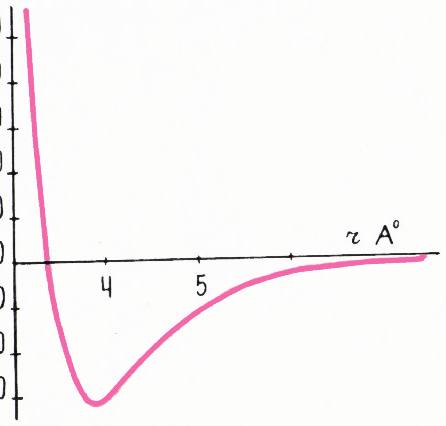
Fig. 2.
We can now turn to the problem of mechanical forces.
That forces operate between molecules is evident from the most elementary messages. The vapor of any substance under suitable conditions follows into a drop. If so, then the molecules will undoubtedly be accepted. The substance resists the rampant. This means that being at short distances, molecules repel each other. If there is acceptance at large distances, and repulsion at small distances, then there is an equilibrium distance when these forces are balanced.
Instead of interaction forces, it is much more convenient to talk about interaction energy ). The energy of interaction is easier to measure, and the concept is simpler and clearer than force*). The energy of interaction between molecules (or atoms, or any other particles or bodies) is called the work that must be done in order to move the particles away from each other—so that the interaction stops. The mathematician will say - give it to an infinitely large distance. The closer the particles are, the more work is required to pull them apart. This work reaches its maximum value when the particles are at an equilibrium distance from each other. This work is called binding energy. If the particles collide and repel, that is, if they are at a distance less than the equilibrium one, then the work of discontinuity becomes, of course, less.
A typical interaction energy curve is shown in figure 2. All curves have this character. But for specific purposes, you need to know the parameters of the curve. First of all it is important
*) See the article by G. Ya. Myakishev “Interaction of atoms and molecules”, «Kvant» No. 11, 1971.
**) From the interaction energy curve you can also find the force: sleep is numerically equal to the tangent of the angle of inclination of the tangent to the interaction energy curve.
22
hydrogen - hydrogen and carbon - hydrogen.
Where can I get information about these curves? Unfortunately, there are no theoretical ways to derive them. Energy curves have to be determined from experience. Since the selection of the necessary curves is a weight operation typical for many areas of physics, we will describe this interesting work in more detail.
When researching, starting from scratch, one must first of all estimate, at least roughly, the parameters of the curves. From experience we know the close distances at which atoms of neighboring molecules approach each other. Looking carefully at these data, we find out that two hydrogen atoms are not closer to each other than at a distance of 2-3 angstroms, two carbon atoms of different molecules are not closer to each other than 3-4 angstroms, etc. These data are taken from studies of solids. molecules in a solid have several slopes of slimy interactions. Therefore, we think that the equilibrium distances on the corresponding atom-atom interaction curves should be somewhat larger than the above figures. Based on a number of indirect reports, it is clear that this excess should be ten percent. Therefore, to begin with, you can select the abscissa of the minima on the curves, which we are discussing as an example, at points 2.6 and 3.8 angstroms.
Information about the binding energy, that is, about the depth of the well of the energy curve, must be “extracted” from the data on the heats of evaporation. For example, that at low pressures a solid substance evaporates. The heat of this phase transformation can be measured quite accurately. The heat expended on the evaporation of the crystal was used to disperse its molecules over a long distance. With some corrections, which we will not dwell on, the measurement of the heat of evaporation leads us to the value of the interaction energy of all molecules.
Of course, the state of affairs is not very simple - the total value changes, but it is necessary to judge the weaker ones. Hydrocarbon substances, consisting of molecules containing 10-20 atoms, have a heat of evaporation of 10-20 kcal/mol. If we assume that the interaction of connecting molecules plays a major role, then this figure adds up to thousands of atom-atom interactions. This means that the depth of the well of the curve should be of the order of 0.01 kcal/mol.
Thus, one arrives at approximate estimates of the parameters of the energy curves of atom-atom interaction and, with their help, constructs first-approximation curves; Then they calculate (this is where computers are needed) the properties of a large number of substances and compare the calculation results with experience. It becomes very necessary to make certain amendments. Actions are sequential, trial and error (physicists say so - work by trial and error), in the end we come to the optimal atom-atom interaction curves for many pairs of atoms.
In general, the calculation is cumbersome and the aditivity hypothesis has only recently been studied. The result turned out to be positive. It turned out that the assumption is fulfilled with good accuracy.
In advance it is not very clear that the work will be successful. If the hypothesis were unfair, if propipeditivity did not work, if atoms of the same chemical type contained in different molecules did not behave the same way, then the computer would tell us that it cannot select the curves so that they give numbers, at least in ways that coincide with experience. For example, successful work on fitting curves shows that the hypotheses underlying the calculation are valid.
Having proved the validity of the additive representation of the interaction energy of molecules, we provide a basis for the concept of molecular forms.
Having built the “skeleton” of a molecule based on experimental data, we can “dress” it