Rough automatic draft, low quality: expect mistakes and awkward wording. It will be replaced by a better translation. Original →
67
About Polya’s book “Mathematical Discovery”
Readers in our country have known the author of this book for a long time. Back in 1937-1938. Together with G. Szege, he published the two-volume “Problems and Theorems from Analysis”, in 1957 - “Mathematics and Plausible Reasoning”, in 1961 - “How to Solve a Problem”.
In the preface to the last book, D. Poya wrote: “A major scientific discovery provides a solution to a major problem, but in solving any problem there are grains of discovery.” And further: “The author sometimes puts himself in the position of a student, sometimes in the position of a student… the author argues from the point of view of a person who is neither a teacher nor a student, but is simply interested in solving the problem facing him.” This “third person” is, of course, the author himself, a famous scientist and mathematician. As for his “part-time” performance of the other two mentioned roles, it seems to be not just a successful literary and pedagogical find. Such “part-time work” is the most important component of György Pólya’s creative credo, which he professes with rare constancy.
In his book “Mathematical Discovery,” Pólya continues and develops the thoughts expressed in earlier books (although none of them requires prior knowledge of the others - this is where the author’s pedagogical skill comes into play). True to his principles, Polya doesn’t so much talk about solving problems as he shows how it’s done. And, of course, he invites you to follow him. And then on a separate path. “Problem solving is a practical art, like swimming, skating, or playing the piano; You can learn it only by good imitation and constant practice. And in this book you will not find a magic key that opens all the doors, it will not teach you how to solve all the problems, but it will give you many good role models and opportunities for receiving and opportunities for receiving and opportunities for receiving.”
But remember: if you want to learn how to swim, then boldly enter the water, and if you want to learn how to solve problems, then solve them! The book is literally written with interesting problems and no less interesting approaches to solving them. It would be tempting, needless to say, to try to give in the solution at least some idea of these problems. But such an attempt would immediately spoil the book and thereby distort the idea of the entire book as a whole. After the session, the content of a novel, even a very long one, can be retold in five, well, ten pages. What about a collection of thousands of small poems? Bring the entire ten best? Two tens? What if everything is fine? And who can guarantee the objectivity of the choice?
For now, we will limit ourselves to reprinting, without any changes, without any abbreviations and without any comments, one paragraph from Polya’s book. We do not claim that this is the best paragraph. Or the most typical one, perhaps. We just really like him. And he really wants the reader to pursue him. And if he himself later finds something in the book that he likes better, it doesn’t matter. In any case, the last thing Polia himself would like to do is take advantage of his unanimous and uniform tastes. There is nothing good in this.
Understanding full well that a simple enumeration of the names of Polya’s chapter can familiarize the reader even more than its intuitive title, we nevertheless (and perhaps precisely for this reason) will not deny ourselves this satisfaction: “The method of two geometric places”, “Descartes’ method”, “Recursion”, “Super retail”, “About problems”, “Expanding the scope of the method”, “Geometric representation of the solution process”, “Plan and program”, “Problems inside problems”, “Generation of an idea”, “Mental work”, “Discipline of the mind”, “Laws of discovery”, “On learning, teaching and learning to teach”, “Conjecture and the scientific method”.
Well, isn’t everything clear here? Never mind, this means it’s time for you to accept it as a “Mathematical Discovery.” (Don’t forget to stock up on paper and pencils!) And if you don’t have this book yet, read at least the next postcard from it first.
I will allow myself to be excited and try to do a little experiment on the reader. I am summing up about
68
a simple but not too hackneyed geometric problem, and then I will try to recreate the sequence of ideas leading to its proof. I intend to move forward slowly, very slowly, giving out successive secrets one after another, and not giving out each of these secrets immediately, but gradually. I hope that before the story is fully completed, the reader will be able to grasp the main idea, unless, of course, something interferes with it, and since this idea will be somewhat unexpected, he will be able to experience the satisfaction of his little discovery.
A. If a circle of the same radius passes through one point, then the circle passing through the other three points of their intersection also has the same radius.
This is the theorem that we need to prove. The statement of the theorem is short and clear, but it seems to lack details. Having made a drawing (Fig. 1) and introduced suitable notations, we arrive at the following, more detailed version of the problem:
B. Three circles of the same radius pass through the point . Circles and intersect at point , and at point , and at point . We need to prove that the radius of the circle passing through the points , and is also .
On figure 1 four four circles and and four of their intersections are depicted. However, this figure may seem unsatisfactory, because it is not so simple and at the same time incomplete; an appearance is created that something is missing from it; it seems that something essential has not been taken into account.
We are now dealing with circles. What is a circle? Any circle is determined by the location of its center and the size of its radius:
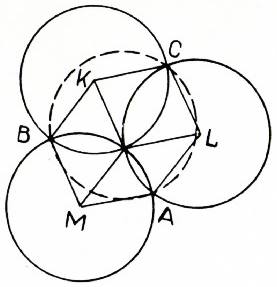
Fig. 1.
Let us connect the posmota, please, of each of the three centers with all three points of intersection belonging to the corresponding circle: with , and , and so on.
The receiving piece (Fig. 2) is disconcertingly overloaded. There are so many lines on it—straight and curved—that it must be properly “taken in by the eye”; it “does not want to stand still.” This figure can fill some figure, familiar to us from ancient magazines, - such a figure is filled with the indefinite: if you look at it as usual, then a figure is visible on it; if you turn the magazine, giving it a specially chosen position, and consider the following: all points of the circle are at the same (and equal to the radius) distance from the center. But we took into consideration this radius , common to all four circles; thus, we did not take into account the existing condition. Let us therefore first of all denote the centers of our circles: for circle , for circle and for circle . What is the best place now to draw the radius ? Apparently, there is no point in giving preference to any one of the three given circles , and or to any one of the three points of their intersection , and .
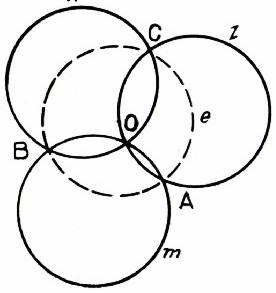
Fig. 2.
sunk at a certain angle, then suddenly another figure appears, ordering you as a more or less witty commentary on the first. Can you recognize in our confused figure, overloaded with lines and circles, some other figure that may be useful for our figures?
We can either attack this figure we need, hiding behind the interweaving of lines of our overloaded figure with details, or recognize it gradually. We can be led to the desired figure by the conditions that we undertake to solve the proposed problem, or by some secondary, insignificant circumstance. So, for example, when we were busy redrawing our imperfect figure, we could notice that the entire figure is entirely determined by its “rectilinear” (composed of segments) part (Fig. 3).
The last circumstance of each is important to us. It greatly simplifies the geometry of figure and perhaps clarifies the logical structure of della. And it leads to the following modified formulation of our theorem:
B. If which of the nine segments
paesen , then there is a point maxim, which of the segments?
REZKOV
EA, EB, EC
will also be equal to r.
The last statement draws our attention to figure 3. This figure is somewhat remarkable; it reminds us of something familiar. (What exactly?)
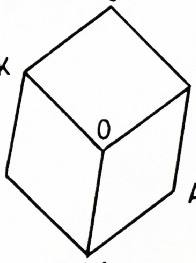
Fig. 3.
Of course, for any of the quadrilaterals depicted in figure 3, for example, the OLAM quadrilateral, all four sides are equal to each other, that is, these quadrilaterals are rhommes.
The rhombus is a familiar figure to us; by mentally highlighting it on our figure, we can “see” the entire figure better. (What does this figure remind you of as a whole?)
Opposite sides of a rhombus are parallel. Based on this circumstance, it is possible to divide the 9 segments from which the figure depicted in figure 3 is composed into three groups,
each of which includes only segments parallel to each other; for example, into one of such segment groups AL, MO and BK. (What can this figure remind us of now?)
We must not forget the goal we are striving for. Let us assume that the conclusion of our theorem is true. By plotting on figure the center E of the circle e and its three radii, which end up at points A, B and C (Fig. 4), we (presumably) obtain new rhombuses, new parallel segments. (What does the whole figure remind us of now?)
Well, of course, figure 4 represents the projection
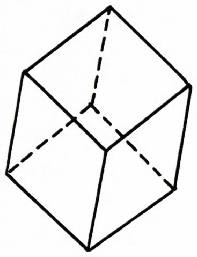
Fig. 4.
12 edges of a paralleliped arranged in such a way that all these projections have the same length.

Figure 3 is the projection of an “opaque paralleliped”: we see only 3 of its faces, 7 vertices and 9 edges, while 3 faces, 1 vertex and 3 edges on figure are not visible. This figure is part of figure 4, but such a part that defines the entire figure that interests us. If the paralleliped and the direction of projection are worked out in such a way that the projections of the nine edges shown in figure 3 are equal to r (i.e., what they should be according to the conditions of the problem), then the projections of the three remaining edges should also be equal to r. Three segments of length r emanate from the projection E of the eighth, invisible vertex, and this projection itself is the center of a circle passing through points A, B and C, the radius of which is equal to r.
Our theorem is proven, and it is proven with the help of an unexpected ingenious idea, which consists in the fact that we consider a flat figure as a projection of a spatial figure.
(This proof uses stereometric concepts. It seems to me that the problem here is not great, especially since it can be easily corrected. In fact, since we now know that the position of the center E can be characterized by the weight of the prime, the lengths of the segments EA, EB and EC can be reduced to distance without resorting to any stereometry. However, we will not insist on this point of view here.)
M. L. Smolyansky,
Yu. A. Gastev