[Problem M6—M10; F7—F11]
Rough automatic draft, low quality: expect mistakes and awkward wording. It will be replaced by a better translation. Original →
47
In this section, continuing from issue to issue, we place several tasks, usually quite difficult. The best solutions to these problems, submitted by readers, will be published in the journal in a few months.
In mathematics
M6. There is a clock in front of you. How many hand positions are there that cannot be used to determine the time unless you know which hand is the hour hand and which hand is the minute hand?
(It is believed that the position of each of the arrows can be determined accurately, but following how the arrows move cannot.)
M7. a, b, c are the sides of the triangle. Prove that
S. Berkolaiko
M8. Two people play this game. From a pile of 25 matches, everyone takes one, two or three matches in turn. The winner is the one who, at the end of the game - after all the matches have been sorted out - turns out to have only matches.
Who wins when played correctly - the starter or his partner? How should he play to win? How will the answer change if we assume that the one who takes an odd number of matches wins?
Explore this game in the general case when there are 2n+1 matches and you are allowed to take any number of matches from 1 to m.
M9. Consider the following properties of a tetrahedron (we call an arbitrary triangular paramid a tetrahedron):
a) all faces are equal in size;
b) each edge is equal to the opposite one;
b) all faces are equal;
d) the centers of the circumscribed and inscribed sphere coincide;
d) the sums of plane angles at each vertex of the tetrahedron are equal.
Prove that all these properties are equivalent.
Try to find other equivalent properties of the tetrahedron.
M10. Four circles, the centers of which are the vertices of a convex quadrilateral, completely cover this quadrilateral. Prove that from them it is possible to choose three circles that cover a triangle with vertices at the centers of these circles.
G. Galperin
48
F7. A horizontal rod of length rotates around a vertical axis (see Fig. 1). A wheel of radius is mounted on the axis attached to the end of the rod . The wheel axis is horizontal and makes an angle with the rod . The wheel rotates on an axle without friction and rolls along the ground. There is more friction between the wheel and the soil. How many revolutions will the wheel make when the rod makes one revolution around the vertical axis?
G. Komkin
F8. A long rod with a threaded hole at the end is screwed onto a vertical screw (see Fig. 2). The rod is released. The friction between the screw and the rod is negligible. How will the rod move after it comes off the screw?
Physics and Mathematics Olympiad MIEM
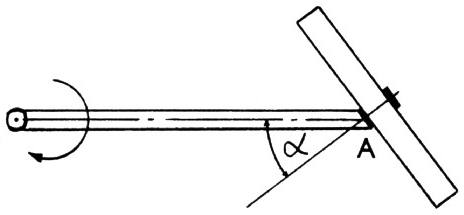
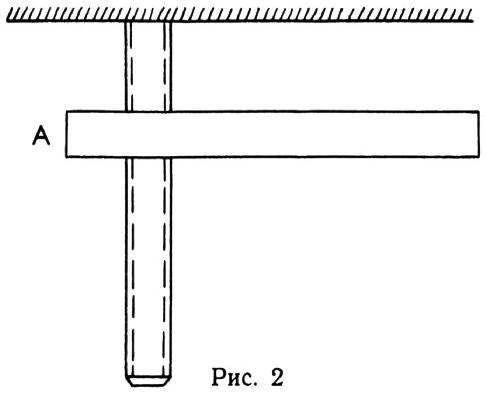
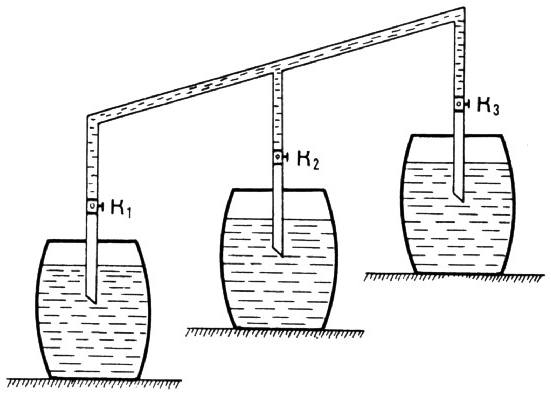
Fig. 1
Fig. 2
F9. On the horizontal table there is a weight attached to the table using a long spring. At first the spring was not stretched. The weight is then moved 20 cm from its equilibrium position and released. The weight began to oscillate along the spring. Due to friction, the amplitude of its oscillations per period decreases by 7%. How many oscillations will the weight make before stopping? At what distance from the equilibrium position will it stop?
Weighty correspondence physics and mathematics Olympiad 1967
F10. How to construct a heater of the highest possible power from four thin wire spirals with resistances of 10 ohms, 20 ohms, 30 ohms and 40 ohms, designed to produce a power of no more than 2 W each, if there is a current source with e. d.c. 20 V and internal resistance 20 ohms? B. Bukhovtsev
F11. Three open barrels are filled with water and installed at different heights (see Fig. 3). From each barrel, rough pieces are carried upward and connected together. The weights are also filled with water. Where will the water flow through the pipes if taps , and are opened at the same time?