Rough automatic draft, low quality: expect mistakes and awkward wording. It will be replaced by a better translation. Original →
61
and certain shortcomings. Not all instructions can be considered successful; Some of them are not advice on how to look for solutions, but a condensed plan of the entire solution, and if the plan is clear, then all that remains is to carry out very extensive calculations. In many cases, it would be more appropriate to ask the reader a leading question rather than immediately recommending “consider this” or “do this.”
In the preface, the authors write that the theoretical introductions that are presented to the chapters of the problem book “must either be read from beginning to end, or not read at all.” Unfortunately, in many cases it is better to recommend the second second to another reader. The introduction to some chapters (for example, 7, 9, 23) is completely unsuccessful, or it contains fragmentary information, often debatable and not corresponding to the material of stable textbooks.
A number of other defects can be noted. The solutions to some problems are not the best. For example, read problem 6.10 “head-on”, following the rules for multiplying a multi-digit number by a single-digit number; the solution to Problem 13.13 is greatly reduced if we analyze its conditions and note that for all admissible x the inequality cos x>0 must hold. There are inaccuracies and typos in the book. So, the answer to problem 18.13 should be: 120+90√2 km; in the driving solution of problem 2.9, it is essential that the points A and C around which the rotation is made are the vertices of the acute angles of the triangle (we strongly recommend that the reader figure out where in the solution this is implicitly used!), the condition of problem 12.7 is not precisely formulated - it is necessary to additionally suggest that aB+bA≠0.
However, it hardly makes sense to give here a complete list of individual shortcomings. The young reader, we hope, understands that creating a book is a very complex matter, and it is not always possible, despite the successful authors, to do everything perfectly in the first edition.
The overwhelming majority of the problems included in the book were taken by the authors from versions of written works offered in different years of the advanced exams in mathematics at Moscow University, as well as in a number of other universities in Moscow. It is very good that these problems, equipped with instructions and solutions, become accessible to the broad masses of mathematics lovers and are included in school practice. But at the same time, it would be appropriate to accurately indicate the source of knowledge, since these tasks are the fruit of the collective creativity of the examination commissions. Anyone who has ever been involved in composing a problem knows how much work and how long it takes to create a new original problem. By the way, these links would also be useful to the reader - he could get an idea from them about the level of requirements for applicants to various universities).
The famous American mathematician D. Polya, in his book “How to Solve a Problem,” dedicated to the general methodology for solving mathematical problems, wrote: “If he (the mathematics teacher) awakens the curiosity of students, offering them problems that challenge their knowledge, and with his leading questions helps them solve these problems, then he will be able to instill in them a taste for independent thinking and develop the necessary abilities for this.” It is a pleasure to present and recommend to the reader a book of just this nature, a book that has its own purpose not only to show how to solve problems, but also to suggest (where necessary) how to solve them.
N. Kh. Rozov
RELEASED BY THE MSU PUBLISHING HOUSE, the book “Introduction to Electronics” by candidate of physical and mathematical sciences A. M. Khazen is addressed to schoolchildren who are interested in physics, mathematics and especially electronics and radio engineering.
The book is intended for the general reader and at the same time written on a good physical level. The clarity of the presentation and the original examples given are combined with sufficient rigor. It can be said with certainty that for a schoolchild who reads this book carefully, many of the understandings of electronics will become clear.
Young readers will be interested to know that a fundamental vacuum diode can be used to create an electric current generator operating from an external source of the body, how a linear electron accelerator and a traveling wave tube are similar and different, what an explosive magnetic generator is, etc.
The book highlights key issues for various classes of electronic devices. Despite the large number of specific devices described in the book, it is not overloaded with examples.
The books can be recommended as a guide for schoolchildren who have chosen technical disciplines or physics as their future specialization.
62
ANSWERS, INSTRUCTIONS, SOLUTIONS
By the way
“What is function graphics”
-
- ; 2) ; 3) .
- .
- 6, of which 2 are reversed.
- All points of the graph lie on two segments , , and , , and they are located on each of these segments “densely everywhere” (i.e., for any point segments and for any number there is a graph point at a distance less than from the point ).
- See Fig. 1.
- a) (rotation relative to the origin counterclockwise by angle );
- a) (rotation relative to the origin counterclockwise by angle );
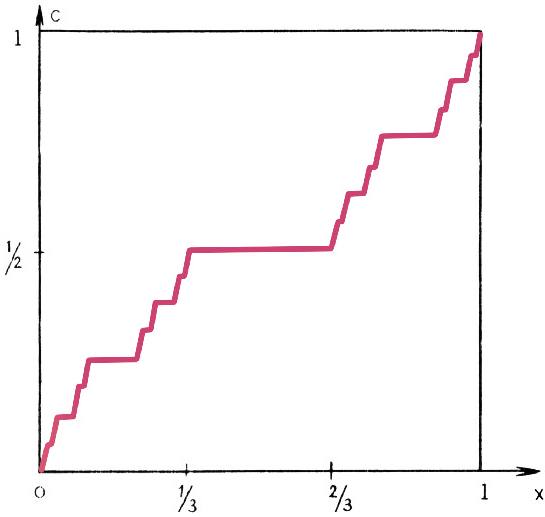
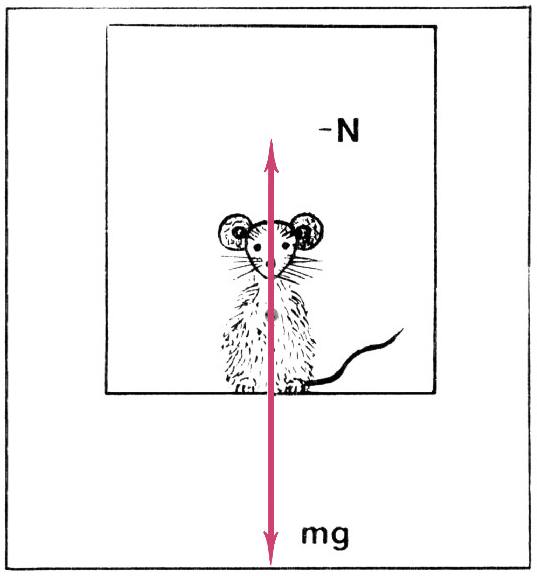
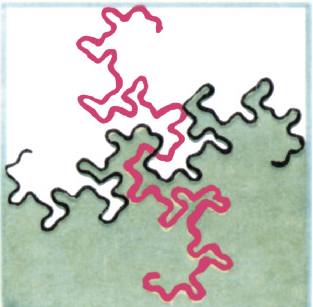
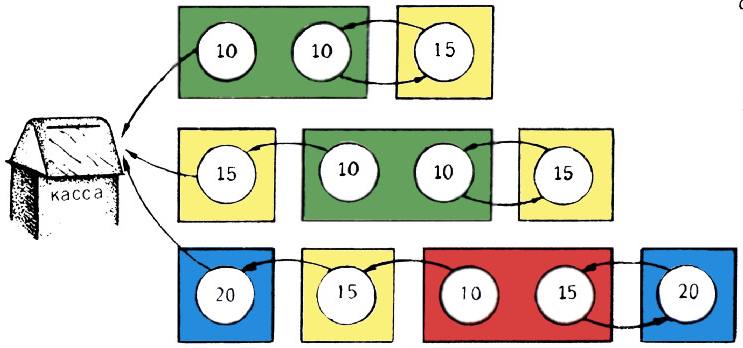
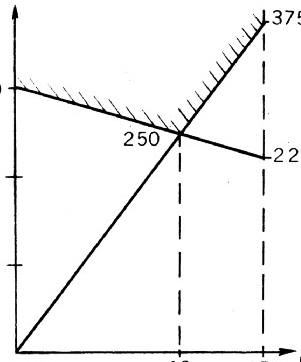

Fig. 1
- transformation symmetrical about the axis;
e) parallel translation to a distance in the direction of the bisector of the angle , if , and in the opposite direction, if .
- Parallel transfer to a vector with start at point and end at point (or, what is the same, to a vector with start and end at ).
- Flip the point symmetrically about the bisector.
- Prove that if in the triangle there is imputation and , then , derive from the condition the equality .
By the way
“As if an atom is weighed”
- 5.55 km.
- ,
,
. - 11.1 km; 16.65 km. It is convenient to use the result of problem 1. Pressure is proportional to air density.
To the “Logical task”
A person cannot sleep and eat at the same time. Therefore, the period of seven days after sleep and after eating occurs at different times. A person must do what he did a week ago: sleep or eat.
Answers to questions about physics
-
Due to its high specific heat, water warms up more slowly than air. Therefore it is colder than air. When you get out of the water, the droplets of water remaining on your body will evaporate. Absorbing a lot of heat, they take it away not only from the surrounding air, but also from the body. The body cools and the air begins to seem colder than the water.
-
Most products contain water. As it evaporates, it freezes on the coldest part of the refrigerator - the evaporator. Therefore, the evaporator is covered with a thick snow coat, which has low thermal conductivity. This leads to a decrease in heat flow from the chamber, and the temperature in the refrigerator does not drop enough.
63
-
During the entire movement of the box after the throw. Indeed, let us assume that the mouse presses on the box with a force . Then a force acts on the mouse from the side of the box - (peak of the box). Since the box, and with it the mouse, moves with the acceleration of free fall , the equation of motion (Newton’s second law) is written for the mouse as follows: . From this equation, which is valid, naturally, for the entire time of movement of the box, we find that , that is, the mouse is in a state of weightlessness.
-
At the same time, since the amount of heat that needs to be supplied in both cases is the same.
4a. In the one where there was more water at the beginning.
To the article “Crooked fights”
-
Menysh: , and the Moon is approximately 384,000 km away.
-
The broken line will be replaced by the mirror one symmetrically. In the recording of your word, each letter will change to the opposite: to , and to .
-
- (at ). Wed. with problem 5, d, e)
-
Tcherezakha will read the words that are obtained from the original word by writing its letters in reverse order, and then place on and on throughout. This statement is true for any broken line. For broken dragons, creating a new word from an old one is quite simple - you just need to replace the middle letter in the original word with the opposite one (see problem 5).
-
Use Theorems 1, 2 and Problem 3.
-
Generally speaking, others (for example, for the broken line ).
-
Use Theorem 2.
-
You can check the induction by (the rank of the broken line), proving with the help of Problem 8 that the breakers achieved according to Theorem 2 cannot be arranged as shown in Fig. 1.
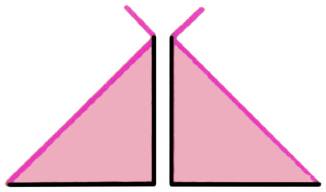
Fig. 2
To the article “About the written exam” at the international Moscow State University
Option 2.
-
30 min;
-
;
-
;
-
.
Fig. 1
-
The fact that two adjacent broken lines (obtained from each other by rotating by ) do not have a common segment follows from Theorem 1 and Problem 9. To strictly prove that two broken lines that are symmetrical to each other cannot have a common segment, you can use Jordan’s theorem: “a closed non-self-intersecting line divides the plane into two such regions (internal and external) that any line, one end of which lies in the outer region, and the other in the inner region, intersects this line *); At the same time, since our dragon curves come to some vertices twice, it is more convenient to go to dragon curves (Fig. 2).
-
a) Check to use Theorem 1 (induction on ).
- Wed. with task 7.
*) About Jordan’s theorem, see, for example, in the book: P. Courant and G. Robbins, “What is mathematics,” Prosveshchenie Publishing House, 1967, p. 275.
64
Study on the way to school
-
On foot
When deciding: 1) nine houses from No. 29 to No. 45; 2) three houses from No. 109 to No. 113; 3) one house No. 333. -
On the bus
It is easy to tell how two, three or four passengers can pay off (some options are shown in Fig. 1) and, using this, construct many different examples of how 15 passengers could pay off. -
Please note that with each payment method, at least 5 coins are put into the cash register and at least 15 remain with passengers. It is not difficult to construct an example when the total number of coins for all passengers is 20.
Fig. 1
Fig. 2
- Prove that if among 15 people there are those who have only one 15 kopeck coin, then the total amount of money, firstly, is not less than kopecks and,
one coin for each full or incomplete four passengers; 3) 15 coins each and another 5 kopecks. each has a full or incomplete train of passengers.
Amendment.
In No. 1 on page 7, the signature under figure reads as follows:
The value must also be inserted as an argument into the spectral function.