Rough automatic draft, low quality: expect mistakes and awkward wording. It will be replaced by a better translation. Original →
56
CYLINDRICAL CHESS
A. P. Savin
The main advantages of chess, which determine the class of the game, are its imagination and chess erudition, which consists of the value of theory and experience of practical play. And very often in chess matches the more erudite player wins.
If you are on the losing side, but are convinced by your imagination, invite your partner to play cylinder chess. What is it? Very simple!
Roll the chessboard into a tube and glue the sides of the board together as shown in figure 1. Of course, if the board is wooden, then this trick will not work. It’s easier with a cardboard board, but how will the figures stick to it? Now, if the board were rubber, then we could stretch it across the table as shown in figure 2. Such a board can be specialized, but it is not very pleasant to play on: its fields are very different in size, and the diagonals are twisted in a spiral.
The easiest way is to take a common chessboard and imagine (after all, you have a rich imagination) that its sides are glued together. The pieces on the board are placed in the same way as usual, moving according to the general rules, but now their movement will not look entirely normal. On figure 3 colored arrows show which squares the bishop can move from square d3, and purple crosses mark the squares that the knight can move to from square h5, and the white pawn on h3 is a check to the black king located on square a4. You will quickly master the remaining features of playing on a cylindrical board yourself.
Your partner is disarmed! The developed openings are no longer suitable, new possibilities are discovered in positions, and the endgame changes significantly. Come on, answer me
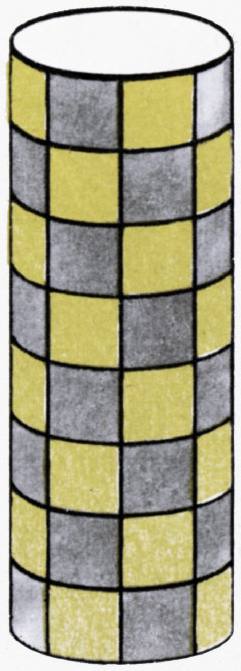
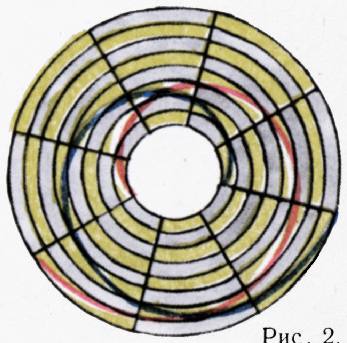
Fig. 1
Fig. 2
57
Can a king and rook checkmate the opponent’s “naked” king?
So, the polymath is deprived of his trump card. Now you can beat him!
The attentive reader will undoubtedly note that we are somewhat inconsistent in gluing together only the sides of the chessboard. It’s crap, it’s so crap! You can also glue the bases of our cylinder. As a result, we get the figure depicted in figure 4, which is called a torus by mathematicians, and in common parlance a donut.
Is it possible to play chess on this board? It’s possible, but not right away. It is easy to see that in the initial position the kings are on adjacent squares, which means that you need to come up with a different initial position of the pieces. The main advantage of a torid board is the complete equality of all its fields, since this board is limitless, but, of course, finite - it still has the same 64 squares as before.
It is interesting to note that there are several different types of torid boards. For example, you can glue it together as shown in figure 5. What scope is opened here for rooks and bishops, not to mention the queen, who can
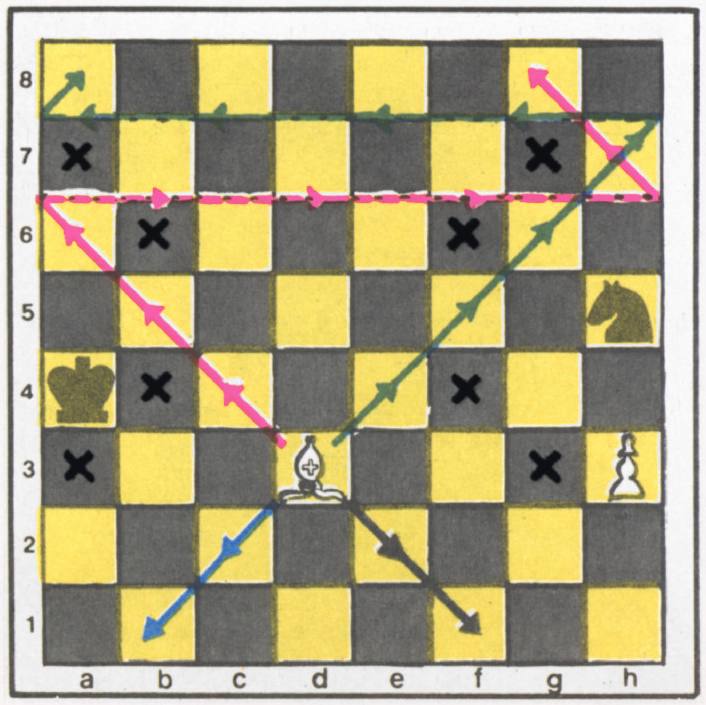
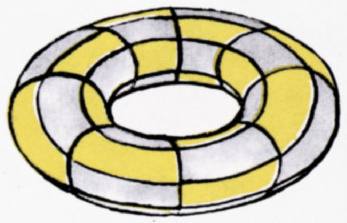
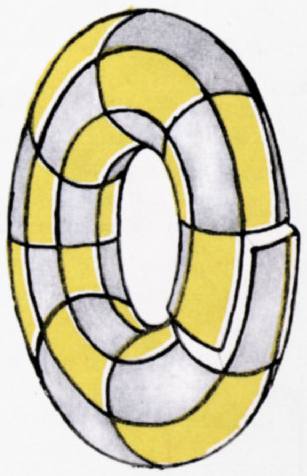
Fig. 4
There are plots on almost all the squares of the board (check it!). But we’ll talk about this next time.
Fig. 5