Burnt Rainbow
Rough automatic draft, low quality: expect mistakes and awkward wording. It will be replaced by a better translation. Original →
55
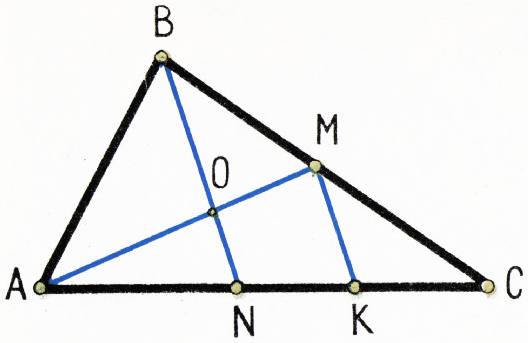
Fig. 4.
From the similarity of triangles AON and AMK we find an exception:
and similarly
Exercises
-
The edge of regular triangle ABCD is . Find the radius of the sphere passing through the vertices , the center of the face ACD and the middle of the edge BC.
-
On the base AC of equilateral triangle ABC, point D is located so that AD=a, CD=b. The circles written in triangles ABD and BCD touch line BD at points M and N, respectively. Find the length MN.
-
Triangle ABC is inscribed in a circle. The distances from points A and C to the line tangent to the circle at point B are and respectively. Find the altitude of triangle ABC drawn from vertex B.
-
In an acute triangle, the two heights are equal to 3 cm and cm, respectively, and the point of their intersection divides the triangular height in a ratio of 5:1, counting from the vertex of the triangle. Find the area of the triangle.
-
At the base of a right triangular sign lies a right triangle, the legs of which are equal to and . Some plane intersects all the side edges of the plane so that in cross-section a regular triangle is obtained. Determine the side of this triangle.
-
In a regular quadrangular pyramid SABCD, the height is equal to the diagonal of the base ABCD. A plane is drawn through vertex A parallel to line BD and tangent to the ball inscribed in the pyramid. Find the ratio of the cross-sectional area to the area of the base of the pyramid.