Written exam in mathematics at the Faculty of Chemistry of Moscow State University in 1970
Rough automatic draft, low quality: expect mistakes and awkward wording. It will be replaced by a better translation. Original →
56
Written exam
in mathematics at the Faculty of Chemistry of Moscow State University in 1970
N. N. Kolesnikov, V. M. Tikhomirov
In 1970, at the Faculty of Chemistry of Moscow State University, only a written exam was held in mathematics.
Each version of the written work contained five problems covering all the main sections of the school mathematics course - algebra, geometry and trigonometry.
Having analyzed the four problems of one of the options, we will see that solving them does not require any knowledge beyond the scope of the mathematics program for building a university.
In this regard, I would like to emphasize once again that applicants often have weak skills of sound logical reasoning and that they are given clearly insufficient attention to geometric problems and theorems.
Along with these two fundamental shortcomings, which I would like to draw the teachers’ attention to, great harm is caused to applicants by negligence and lack of composure when completing and preparing written work, and the inability to complete the solution of problems and examples. A problem in which an idea for a solution is outlined, but not brought to an answer with the necessary intermediate reasoning, cannot be considered completely solved. Carelessness also leads to various errors and clerical errors that distort the course of the decision and the results; sometimes the conditions of the task are misunderstood, but the task with changed conditions is not considered by the examination committee, even if it turns out to be more difficult.
Option
-
From point A to point B I left automatically and at the same time I left from point B to point A by magnitude. After the meeting they continued on their way. The car, having reached point B, immediately turned back and caught up with the left station two hours after the moment of the first meeting. How long after the first meeting did Velicidict travel to point A, if it is known that by the time of the second meeting he had traveled the entire distance from B to A? (Speeds are automatically and magnitude dict plotted.)
-
Solve the equation
-
Find all values lying in the interval and satisfying
-
The chord subtends another chord equal to . Point lies on this arc, and point lies on chord . In this case, , , . Find the area of triangle .
-
Given a straight triangular line ( are lateral edges), which has and . Through the vertex there is a plane intersecting the edges and corresponding at points and . Find in what ratio this plane divides the volume, if it is known that and are bissertis of the angle .
57
- In this problem we indicate only the main points of the solution.
Let be the distance between points and , the speed of the car, the speed of the bicycle, the time (in hours) from the start of the movement to the first meeting. For the four entered quantities (), three equations can be created:
It is impossible to find the values of all unknowns, but this is not required; you need to find the values , which are a combination of unknowns. For the third equation to the second, we get that .
Substituting this correspondence into the first equation and eliminating from it and the second equation, we find hours. From the second equation it turns out that hours, and the exclusive time is equal to hours, that is, 8 hours 45 minutes.
Note that this problem (like all the first problems in the versions given at the Faculty of Chemistry) is essentially arithmetic and allows solutions based on the simplest reasoning.
At the same time (before the second meeting), the value is simple , and the automatic value is always a path. This means that the ratio of their speeds is 2:7. Then, by the time of the first meeting, the value is simple , and the automatic value is always on the way. But, after spending another two hours, the simple value is always the way. Therefore, in an hour he covers hours of the entire journey. paths that still had to be covered prime value prime value prime value . Only a quarter of all solvers were able to correctly write down the solution to the inequality with the addition
59
- Let (Fig. 3). According to conditions . Since is the bisector of angle , using known trigonometric formulas it is easy to find that
Let us denote in triangle by . Now it is easy to write the volume of this prism as follows:
The plane passing through the points and cuts off the paramid from the prism, whose lateral face is perpendicular to the base, since the prism is straight (by condition). The base is a trapezoid, the plane sides and are parallel. From equalities
we find: (BC is perpendicular to and and is the height of the trapezoid). The volume of the paramid is , therefore equal to
The volume of the other part cut off by the plane from the prism is the difference between the volumes of the prism and paramid: . From here
In this problem, it was not necessary to find the numerical values of the volumes of the parts of the prism that interest us; the plane only needed their ratio. To get the answer, it was enough to express them through the same, although unknown to us, quantities and . However, this very circumstance was not understood by some of the applicants who are trying hard.
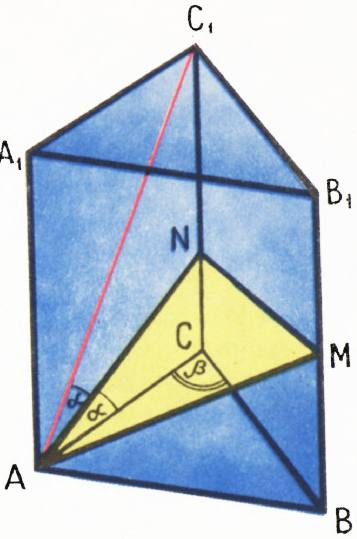
Fig. 3. .
We tried to find the numerical values of the required volumes and, of course, were not successful (compare with the situation in the first problem, where it was also enough to find the relation of the unknowns to obtain the answer).
Try to solve the following option yourself.
- Two tractors plow a field divided into two equal parts. Both tractors started at the same time and each is plowing its half. 5 hours after the moment when they jointly plowed half of the entire field, they found out that the first tractor had part of its plot left to plow, and the second - of its plot. How long will it take the second tractor to plow the entire field alone?
- Solve the equation
-
Find all values of lying in the interval and satisfying the inequality .
-
In triangle , angle is , and the radius of the circle circumscribed around this triangle is . On the side the point is taken so that , and at the same time . Find the area of triangle .
-
Given a triangular prism ( and are the side edges). The plane intersects the edges and of the corresponding one at points . Find in what ratio this plane divides the volume of the prism, if it is known that and .