Rough automatic draft, low quality: expect mistakes and awkward wording. It will be replaced by a better translation. Original →
48
Traffic
IN TASKS
ON UNIFORM
PROCESSES
B. A. Kordemsky
Mathematics entrance exams offer a wide variety of equation problems. Many of them fall into the category of tasks that describe uniform processes: moving at a constant speed, supplying water through a pipe with a constant throughput, performing work at constant labor productivity, paying for a process at a constant rate, and others.
Often, such problems are easiest to solve geometrically, by constructing a graph of the relationship between the quantities discussed in the conditions of the problem.
On the graph, a uniform process is depicted by a straight line (Fig. 1); in this case, the dependent and independent variables and are interconnected by correspondence
Each point of the graph depicts a certain “state” of the uniform process under consideration: abscissa and ordinata points tell about the magnitude values characterizing the process.
For example, when a body moves uniformly along a straight line, taken as the coordinate axis, the graph of its coordinate versus time is represented as a straight line **).
At figure 2 the abscissa and ordinate of the point show that someone, having traveled 3.5 km (OA km) by taxi, paid 45 kopecks (OB kopeck) for the journey.
At figure 3 straight line is a graph of the length of the arc of a uniformly burning candle. Line segment (taken on the scale of axis )
*) In general, a straight line can also be specified by a correspondence (y is arbitrary), but such equations usually do not arise in problems, since in this case does not depend on .
**) See article by Yu. V. Zaichkov “Motion Graphs”, «Kvant» No. 6, 1970, pp. 39-45.
49
means the initial length of the candle; segment BM (taken on the same scale) is the length of the cinder after t time units (t=OB on the scale of the Ox axis). In turn, the segment MC tells us about the length of the burnt part of the candle at the same moment of time t, and the segment OD gives us the time after which the candle burns completely. Obviously, the ratio characterizes the speed with which the candle.
Note that straight line AD on figure 3 can also be considered as a graph of the length of the burnt part of the candle, if the axis on which the length of the burnt part of the candle is plotted is considered straight AO (A is the origin, AA’ is the time axis).
This example is useful when constructing graphs of counter movements or “counter” work on the same drawing (when two people perform one task, the pool is filled with two pipes).
When solving problems involving uniform processes, it is important to learn how to translate the algebraic condition of the problem into the geometric language of graphs. In this case, there is no need to draw up an equation of a straight line depicting a uniform process. To construct it in accordance with a direct coordinate system, it is enough to know any two “states” of this process.
At figure 4 a geometric model of the following problem is presented (the text of the condition is commented on with substitutions about the correspondence of the geometric interpretation).
Problem 1. The steamship began to be loaded by 4 cranes of equal power. (Let the segment OA produce–
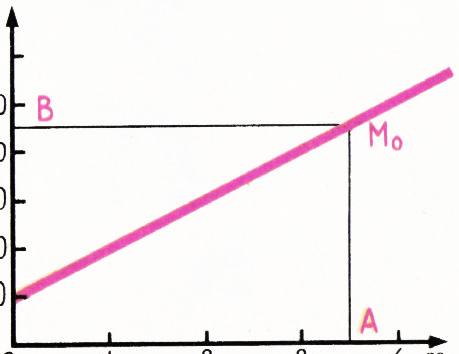
Fig. 2. Taxi fare graph.
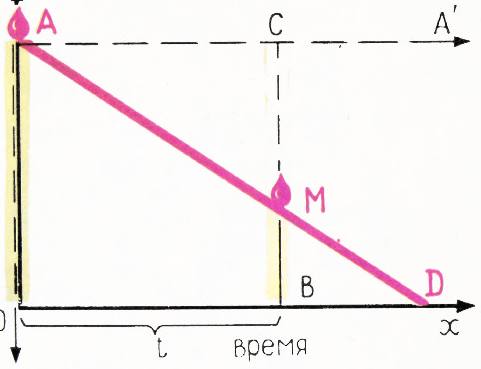
Fig. 3. Graph of the length of the candle stub.
wave length - the volume of all work, OA’ - the estimated work schedule of these four cranes.) After they worked for 2 hours (OB = AB’ = 2 hours), they were joined by 2 more cranes of lower power (broken line AB’C - the graph of the “counter” work of these two cranes, relative to the system of axes AA’ and AO; the scales on these axes are the same as on the axes Ox and Oy), and after that the cutting was finished in 3 hours (BE=3 hours; DE and DE’ - the amount of work performed by the corresponding and two cranes when they act together).
If all the cranes started working at the same time (the new schedule for the two cranes is direct AF, with AF || B’C), then the cutting would be completed in 4.5 hours (segment ON = 4.5 hours).
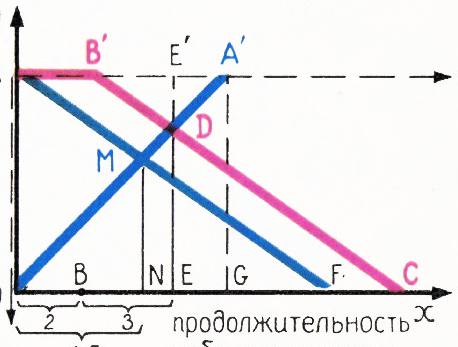
Fig. 4. Crane operating schedules.
50
Determine how many hours it will take us to finish one crane less power.
Of course, this problem can be solved in the usual way: introduce unknowns and create a system of two equations, and then solve it *). But the use of graphs greatly facilitates the rational choice of unknowns and finding connections between given quantities and the desired ones. In this case, the solution turns out to be shorter and more clear, since a perfect law appears and it becomes possible to use geometric properties, for example, the similarity of triangles.
Solution. Two low-power cranes complete the entire job (OA) in OF hours; Let’s find the length of this segment. To do this, consider two pairs of similar triangles:
from where
from where
or Hence the finding OF = 18. Since 18 hours is the operating time of two low-power cranes, one such crane will complete the movement in 36 hours.
Reasoning using graphic interpretation can be successfully used to solve problems involving alloys or mixtures of two substances.
Problem 2. There are two alloys of gold and silver; in one the amount of these metals is in the ratio 2:3, in the other - in the ratio 3:7. How much should be taken from each alloy to obtain 8 kg of a new alloy in which gold and silver would be in a ratio of 5:11?
Solution. We will solve the problem of the shares of gold in alloys. Gold constitutes of the first alloy, of the second and of the desired one; leading to general
*) See N. P. Antonov, M. Ya. Vygodsky, V. V. Nikitin, A. I. Sanik, “Collection of problems in elementary mathematics”, M., “Nauka”, 1960, problem No. 462.
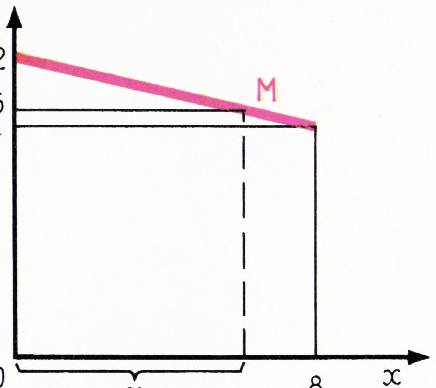
Fig. 5. Graph of the mass of gold in alloy No. 3.
denominator, we get the fractions
Let us take x kg of alloy No. 2 and 8 - x kg of alloy No. 1. It is clear that the mass of gold in alloy No. 2 is proportional to the mass x of this alloy, and the mass of gold in alloy No. 1 is proportional to the mass 8 - x of this alloy, that is, it depends linearly on x. Therefore, the mass of gold in alloy No. 3, composed of alloys No. 1 and No. 2, also depends linearly on x. Let’s construct a graph of this dependence in a coordinate system with axes: Ox - “mass of alloy No. 2 in 8 kg of alloy No. 3” and Oy - “ mass of gold in 8 kg of alloy No. 3”; you will get a straight line (Fig. 5).
This line can be constructed from its two points: (8, 24) and (0, 32). They arise from the boundary values for x: if the required alloy consists of kg of alloy No. 2 (and 0 kg of alloy No. 1), then, very indo, ; if alloy No. 3 consists of 8 kg of alloy No. 1 (that is, ), then . Now we need to find the abscissa x of point M (red line) with ordination y=25; from the similarity of triangles we get
whence x=7 (kg).
52
at a distance of the length of the highway, azonchik - in front of the end to the maximum distance. Gontsik donated for the first time. B at the moment when finished his first line, and after another 10 minutes donated the end of for the first time. Gonzik will arrive on the edge 2.5 minutes less than . How long will it take for the tip to arrive?
It is not surprising to get confused in this network of intertwining movements, if therefore, in the “habitual” scheme of composing a control system*. But this entire network becomes transparent and leads to only one equation if we use graphs.
Solution i.e. Let be the time axis, the distance axis (Fig. 7), the length of the ring highway, the second “turn” of the same highway. The points , and are such that
Straight line is the expected movement schedule of the messenger . Let’s construct a straight line and mark the point of its intersection with ; according to the condition, is the movement schedule of the messenger . Let be the abscissa of the point ; Let’s mark a point on the axis such that , and draw a straight line to the intersection with at point . Then, by condition, is the movement schedule of the messenger .
From figure we find
in addition, according to the condition,
Let’s build ; it is clear that the difference between the paths of the messengers and in time (min.) is . We get the equation
Solving it, we find (min.). During this time, the messenger makes a circle
*) See the article by N. N. Kolesikov “Written exam in mathematics at MSU mexmate in 1970”, «Kvant» No. 3, 1971, pp. 45-50.
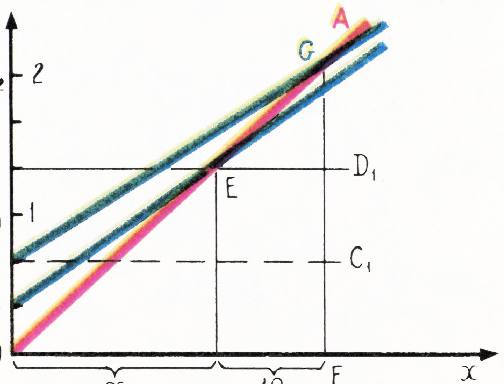
Fig. 7. Movement schedules of messengers starting at the same time.
53
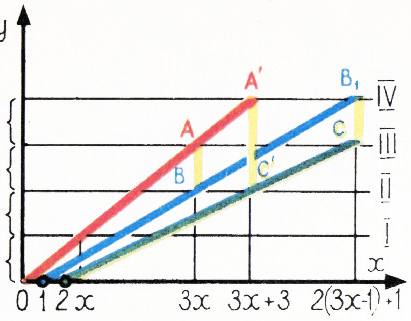
Fig. 8. Graphs of the movement of racers starting from one point.
line II and point 3 x on the Ox axis. Straight 1 B - graph of racer B’s movement (every overtaking when moving around a circle and when overtaking took one lap more than the one being overtaken).
Similarly, at the point B₁ of the intersection of lines 1B and IV, we find point C on line III, determine its abscissa 2(3x-1)+1 and construct a graph—line 2C—of the movements of racer C.
The length of the ring highway can be taken as one and the speeds of the racers can be found (tangents of the slope angles of the graphs, determined from the corresponding right triangles):
According to the conditions of the problem, at the moment 3x+3, the second overtaking of driver A by driver C will occur, therefore, the difference in the distances traveled by them (segment A’C’) is equal to 2. We create the equation:
or
Of its two roots, only x=3 (min.) satisfies the condition.
Exercises
-
The watermelons brought to the base are intended for two matagazins. The first matagazin immediately began transporting watermelons and transported them daily in equal weight portions. The second store arrived at the transportation of watermelons a days later and also transported them in identical, but different weight portions than the first store. Under these conditions, after b days from the start of transportation operations, half of the first initial quantity of watermelons remained at the base. How many days did it take for all the watermelons to be transported from the base if the stores finished transporting at the same time and the weight of the watermelons received by the first store is equal to the weight of the watermelons received by the second store?
-
(MSU, Faculty of Biology, 1968). The tank is filled with water using several pumps. First, three pumps of the same capacity were turned on, and 2.5 hours after the start of their operation, two more pumps of a different, but also identical capacity, were connected. As a result, 1 hour after connecting the two pumps, the water in the tank was 15 m³ short of its full volume, and the tank was still full. One of the two subclavian pumps could fill the tank in 40 hours. Find the volume of the tank.
-
(MSU, Faculty of Chemistry, 1970). An automatic vehicle went from point A to point B, and at the same time a velocipedict left from point B to point A. After the meeting they continued on their way. The car, having reached point B, immediately turned back and caught up with the vehicle two hours after the first meeting. How much time after the first meeting did the egal bicycle travel to point A, if it is known that by the time of the second meeting he had covered 2/3 of the entire path from B to A?
-
Two athletes run out simultaneously (the first from A to B, the second from B to A) and meet at a distance of a m from A. Having run the path AB to the end, each of them turns back, and they meet again at a distance of b m from B. Find the length of the path *).
-
(MSU, mechanics, 1970). Two runners start from one point on the standard ring road, and the third runner starts simultaneously with him in the same direction from a diametrically opposite point. After running 3 laps, the third runner for the first time since the start of the road. 2.5 minutes after this first, the runner reached third for the first time. How many laps per minute does the second runner run if the first one overtakes him once every 6 minutes?
*) This is problem No. 190 from N. S. book 3 of the algorithm “Competition problems in mathematics”. Kyiv, 1964. The use of graphs will suggest the complete condition for the existence of a solution to this problem: 3a>2b, which eludes the external author of the book (he only indicates the condition 3a>b, which is not sufficient).