Rough automatic draft, low quality: expect mistakes and awkward wording. It will be replaced by a better translation. Original →
18
V. N. Berezin
The fate of other theorems and problems is peculiar…How to declare, for example, the exclusive attention of mathematicians and mathematics lovers to the Pythagorean theorem? Why were many of them not content with already known evidence, but found their own, bringing the five relatively obvious quantities to several hundred?
When it comes to the Pythagorean theorem, the non-educational begins already with its name. It is believed that it was not Pythagoras who first formulated it. It is also believed that he gave proof of it. If Pythagoras is a real person (some even doubt this!), then he most likely lived in the 6th-5th centuries. BC e. He himself did not write anything, called himself a philosopher, which means, in his understanding, “striving for wisdom,” and founded the Pythograean Union, whose members studied music, hypnastics, mathematics, physics and astronomy. Apparently, he was also a magnificent organ, as evidenced by the following legend relating to his stay in the city of Croton: “Pythagoras’s first appearance before the people in Croton began with a speech to the young men, in which he so strictly, but at the same time so captivatingly outlined the designations of the young men that the elders in the city asked not to leave them without honor. In this second speech he pointed to legality and purity of rights as the foundations of the family; in the next two he addressed children and women. The consequence of the last days of speech, in which he especially condemned Russia, was that thousands of precious dresses were delivered to the temple of Hera, or not a single bridegroom dared to show them on the street anymore…” However, even in the second century of our era, that is, 700 years later, real people lived and worked in the field, outstanding scientists who were clearly under the influence of the Pythogrean Union and treat with great respect to the fact that, according to legend, Pythagoras is created.
There is also no doubt that interest in the theorem is caused both by the fact that it occupies one of the central places in mathematics, and by the satisfaction of the authors of the proof, who overcame difficulties, about which the Roman poet Quite Horace Flask, who lived before our era, well said: “It is difficult to express well-known facts well.”
Initially, the theorem established a correspondence between the areas of squares built on the hypotenuse and legs of a right triangle: a square built on the hypotenuse is equal to the sum of squares built on the comets. This theorem is proved in this formulation using the drawings shown on the first page of the cover. Here, in the upper left figure, a right triangle is highlighted with dashed lines, on the legs and hypotenuse of which squares are constructed, on the hypotenuse
19
tenuze - outward, on the legs - internal of the triangle. The sides of these squares are continued wherever one of the squares overlaps the other. In this case, several triangles, trapezoids and one head square were formed. Equal figures are painted the same color. The fact that the triangle formed from the red trapezoid and the yellow triangle is equal in size (moreover, symmetrical) to the triangle formed from the purple triangle and the green trapezoid is highlighted by the fragment in the upper right corner.
In the lower part figure on the legs of the right triangle (white) the same squares are constructed externally. Along the way, in one of them the violet-green triangle is replaced by an equal-sized red-yellow one. It is not at all difficult for Telery to show that a figure composed of two squares built on the sides of a right triangle is equal in size to a square built on the hypotenuse of this triangle. To do this, let us once again replace the green trapezoid together with the purple triangle with a red trapezoid with a flat triangle and replace that the resulting figure turns out to be equilateral with the square built on the hypotenuse of this right triangle. This also proved the Pythagorean theorem.
Here’s another proof using equivalence. At figure 1, the segment colored green is equal to one of the quadets of the right triangle located at the bottom of the drawing, and the red triangle is equilateral and right. Having proven that the angle between the two cuts - on the left and below - is straight, we see how from the parts of this figure, which is the union of a square and an equilateral right triangle, we can add either two squares or one. Moreover, in the second case, the side of the square is equal to the hypotenuse of this very private triangle. The hinge mount at figure 2 shows that the right triangle representing half of the red has been cut off and rotated 135° relative to the “hinge” point. On figure 3 uses figure 1. Again near the hinge points, the separated triangles are rotated 135° each.
How to carry out the proof of the theorem in the case when the smaller of the quadets is more than half of the larger one, you can easily determine for yourself.
Modern geometry prefers the arithmetic formulation of the Pythagorean theorem, namely: if the sides of a right triangle are changed by the same
20
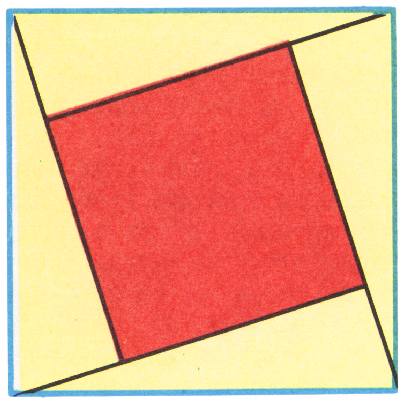
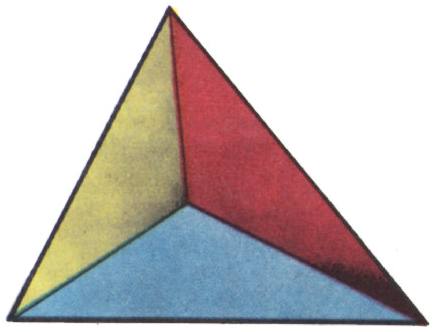
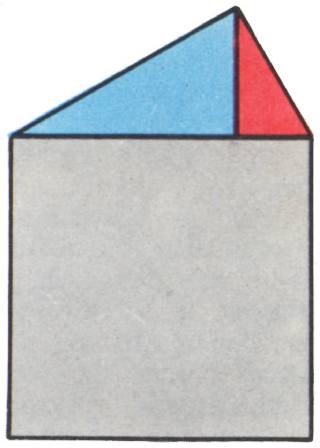
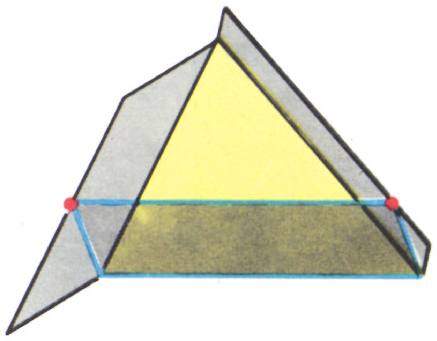
Fig. 4.
scale, then the square of the number expressing the hypotenуzy is equal to the sum of the squares of the numbers expressing the legs. Briefly: the square of the hypotenуzy is equal to the sum of the squares of the catats. We will now carry out two proofs that also use the formulation.
figure 4 shows a square with four equal right triangles highlighted on it. It was from this figure that the Indian mathematician Bhaska-Acharna based his proof in the 12th century.
Let the side of the large square (also the hypotenуza of the right triangle, colored here in yellow) be equal to . Let also two of its katat be equal to and , respectively. Then, in accordance with the drawing, , that is, . Consequently, if the triangle is right-angled, then the sum of the squares of its real catatas is equal to the square of the hypotenуzy.
At figure 5 one of the three given right-angled triangles is enclosing. All three triangles are pairwise similar. This is the key to the proof, either the areas of similar figures, built respectively on the catatas and hypotenуze of a given right triangle, are in the same ratio as the areas of the squares built on these catatas and hypotenуze. In other words, with the help of figure we obtain the equality , where and are the catata of the enclosing triangle, is its hypotenуza, is a number equal to the ratio of the area of the enclosing triangle to the area of the square built on its hypotenуze. Reducing both sides of the equality by , we obtain, as a consequence, the Pythagorean theorem.
Fig. 6.
Fig. 7.