Rough automatic draft, low quality: expect mistakes and awkward wording. It will be replaced by a better translation. Original →
58
PULSE.
LAW OF CONSERVATION
IMPULSE
I. A. Zaitsev
This article is devoted to problems on one of the most important topics in the school physics course - the law of conservation of momentum. Such problems can often be found in exam papers. The article uses problems proposed at the entrance exams in physics at the Moscow Institute of Physics and Technology, at the physics departments of Moscow State University, Novosibirsk State University and a number of other universities.
The impulse (or number of movements) of a material point is the product of its mass and speed. Since velocity is a vector, and mass is a scalar quantity, implus is also a vector quantity. the direction of the impulse vector coincides with the direction of the velocity vector.
If we have several point or particle materials, then we can talk about an implus system of point materials. It is equal to the vector sum of the impulses of individual points. So, for example, if we have two point materials, one of which has mass and speed , and the second has mass and speed , then the implus p of the system of these point materials is equal to the sum (Fig. 1). It is important not to forget that particle impulses are added vectorially, that is, geometrically (according to the rules of a triangle or according to the rule of a parallelogram). In the case when the particle velocities are directed along one straight line, the impulses can be added algebraically. In this case, the impulses of particles moving in opposite directions should have opposite signs.
In order to find the implus of a body, different points of which have different velocities, it is mentally divided into small parts (in the limit of infinite smallness) and then the impluses of these parts are added up. Let us find in this way the implus of a homogeneous disk rotating around its axis. It is clear that it is always possible to find two such disk elements with masses , whose linear velocities are equal in abscylite magnitude and oppositely directed (Fig. 2). The sum of the impulses of these elements is very zero. And since the disk can always be divided into pairs of such elements, it follows that the implus of the entire disk is equal to zero.
It’s a different matter if the disk is rolling on a horizontal surface (Fig. 3). Let the speed of the center of the disk be . The speed of any small element of the disk can be represented as the sum of the linear speed of its rotation in the circle of the disk (in the coordinate system
59
associated with the center of the disk) and the speed of its translational motion: . The momentum of the disk is equal to the sum of the impulses of its individual elements, that is
But the first term in this sum is obviously equal to the momentum of the disk in the coordinate system associated with its center. In this coordinate system, the center of the disk is stationary and the momentum of the disk is zero. Therefore, the momentum of a disk rolling along a horizontal plane is . Taking the constant factor outside the sum sign, we find
where is the mass of the disk.
The momentum of a body depends on the coordinate system. Let in the coordinate system a body of mass move with a speed . Its momentum is . Coordinate system moves at speed relative to coordinate system . To find the momentum of a body in the coordinate system , it is necessary to add to —the product of the body mass and the speed of the coordinate system relative to the coordinate system . This rule is a consequence of the fact that the speed of any point in the coordinate system is the sum of the speed of this point in the coordinate system and the speed of the coordinate system relative to the coordinate system (Fig. 4): . From here
Using the concept of “momentum”, Newton’s second law can be written as follows:
If a force acts on a body during a time , then the momentum of the body changes by values . The product of force and the duration of its action is called the impulse of force. And they say that the change in the momentum of a body is equal to the impulse of the force acting on it.
Using this formula for writing Newton’s second law, we find, for example, the average force acting on the plate with which a ball of mass , flying, collides absciltonically elastically
60
at a speed at an angle to the plate (Fig. 5). The time of collision of the ball with the plate is .
Since the collision is absolutely elastic, the ball rebounds from the plate at the same angle at which it approaches it, and with the same speed . It is not difficult to find the change in momentum of the ball upon impact. It is equal
and directed perpendicular to the slab. This means that when a ball collides with a plate, an average force acts on the ball
According to Newton’s third law, exactly the same force, but directed in the opposite direction, acts on the plate.
If the same force acts on two bodies at the same time, then the impulses of these bodies change in the same way, regardless of their initial masses or speed. Let, for example, two particles with masses and move as shown in figure 6, and the first part moves with a speed in a direction perpendicular to the direction of motion of the second particle , whose speed is .
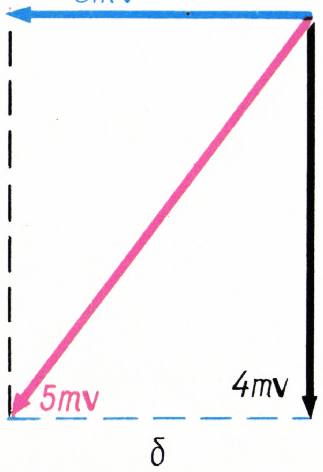
Fig. 6.
At some point in time, identical forces begin to act on the particles, and these forces act on the particles for the same amount of time. After the cessation of the action of forces, a particle of mass moves with a speed in the direction opposite to the direction of its first motion. At what speed and in what direction does the second particle move after the force ceases?
Let’s find the momentum of the force acting on each particle. We must not forget that momentum and change in momentum are vector quantities. The momentum of the first particle changes in direction and magnitude and becomes equal to . The change in momentum of the first particle is (Fig. 6, 6). Since the same force acts on the second particle for the same time, the momentum of the second particle changes by . Adding the initial momentum of the second particle with the change in momentum, we find that the momentum of a particle of mass is and is directed at an angle to the direction of the initial motion of this particle (see Fig. 6, 6). Dividing the momentum of a particle by its mass, we find that the speed of a particle of mass after the cessation of the force is equal to .
Now let’s solve a more complex problem.
A spacecraft having any cross-section and speed falls into a cloud of micrometeors, the density of which is (that is, there is one micrometeor in one cubic meter of space). The mass of each micrometeor is . How much must the propulsion force be generated so that the speed of the ship does not change? The impact of micrometeors on the ship’s hull is considered to be completely inelastic.
During time the ship collides with micrometeors, which at the initial moments were at a distance from it less than (Fig. 7). The mass of all these micrometeors is . Before the collision with the ship, the velocities and impulses of micrometeors were zero, and after the inelastic
62
We can write the law of conservation of momentum:
for pulse components along the axis,
for pulse components along the axis.
From these equations we find
If the system is not isolated and a certain force acts on it, then the total momentum of the system is not conserved. However, the impulse component in the direction perpendicular to the force is preserved. This is the basis for solving a large number of problems. Let’s solve, for example, the following problem.
A gun is mounted on a railway platform moving at speed . The gun barrel is directed towards the movement of the platform and raised above the horizon. The gun fired, after which the speed of the platform decreased by times. Find the speed of the projectile (relative to the ground) if it leaves the barrel at an angle to the horizontal. The mass of the projectile is , the mass of the platform with the gun (without the projectile) is .
The weapon-platform-projectile system is not isolated: it is affected by gravity and the reaction force of the Earth. However, in the horizontal direction, external forces do not act on the platform with the cannon and the projectile. This means that the horizontal component of the system’s impulse should not change during the shot. That’s why
From here
If the system of a part or bodies is isolated and its momentum does not change, then the speed of the center of mass of the system (center of gravity) does not change. In part, if at some moment the system was moving in such a way that the speed of the center of mass was equal to zero, then this speed remains equal to zero all the time. Therefore, the position of the center of mass does not change. Let’s look at an example.
A man of mass is at the stern of a boat of mass , standing in the ore. Boat length . How much will the boat move relative to the shore if a person moves from the stern of the boat to the bow?
Since no forces act in the horizontal direction on the boat-man system, the position of its center of mass must be preserved. But the position of the center of mass of the system is determined by the position of the center of mass of the boat and the person (Fig. 9). Let initially the distance between the center of mass of the system () and the center of mass of the boat () be equal to .