Rough automatic draft, low quality: expect mistakes and awkward wording. It will be replaced by a better translation. Original →
10
Electrical resistance is a quantum phenomenon
D. A. Frank-Kamenetsky
The resistance of a conductor to the flow of electric current is not at all as simple a thing as it seems at first glance. As we will see, we cannot do without quantum here either. Let’s first see what can be done without its help.
Classical theory
We are used to the fact that “classic” is a similar word. They say: Streltsov scored a “classic goal.” Instead of “classic,” you could say “cool” or even “iron” in more modern jargon. A physicist has a completely different attitude towards this word. In modern physics, classical are called theories created by the classes of science of the past, before the emergence of quantum physics and the theory of relativity. Most often, the word “classical” is used by physicists as the opposite of the word “quantum”. The classical theory is different in that it does not involve quanti. Such theories are very simple; to modern physicists they seem somewhat naive. They often bring a big role, but, as a rule, they do not fully resolve the issue. In classical theory, there is always something missing for a modern physicist.
In many books, including textbooks (and even very well), it is written that the electrical resistance of a metal originates from modern electricians,
carrying current, with atoms*) of the crystal lattice. Is this concept of resistance correct?
It is best not to say either “yes” or “no”, but to say that it expresses the classical theory of electrical resistance. Everything we just said about classical theories in general applies to it. But in this case, the classical theory turns out to be very weak: it cannot explain many of the main features of electrical resistance. In the classical theory, one thing is certainly true: resistance comes from the fact that electrons transfer part of their energy and momentum (momentum) to the crystal lattice. But exactly how this transmission originates is not a simple and very interesting question.
Temperature dependence
The resistance of pure metals increases greatly with temperature. For many of them it is applied in proportion to the absolute temperature. At low temperatures, this simple dependence breaks down.
*) It would be more accurate to say - with ponies, but this does not exist for us here. The mechanism of electrical resistance is that electrons hitting the atoms of the crystal lattice cause them to vibrate—electrical energy is converted into thermal energy.
11
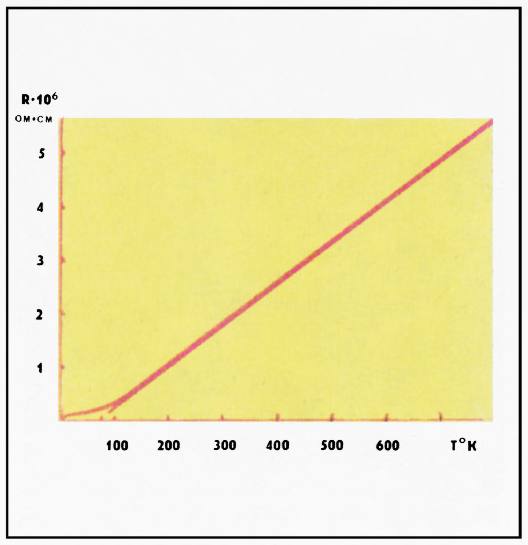
Fig. 1. Graph of the dependence of copper resistivity on absolute temperature.
Yes. This is clearly visible in figure 1, which shows how the resistivity of copper, the most common conductor of electric current, changes with temperature. As can be seen from figure, in the region of high temperatures the dependence is well represented as linear. But if this straight line is continued towards low temperatures (in figure shown with a dotted line), it does not go to absolute zero, but to a slightly higher temperature - for copper about 60 ° K. In fact, at low temperatures the dependence becomes more complex: the resistance changes in proportion to the degree of temperature. When approaching absolute zero, the resistance of pure metals becomes very small. There is a group of metals whose resistance completely disappears at a temperature several degrees above absolute zero. This is a phenomenon called superconductivity, we won’t poop now. Quite a lot of interesting things can be said about simpler things.
If we explain the electrical resistance by collisions of electrons with atoms, then the temperature dependence of the resistance of pure metals remains completely unclear.
clear. After all, the situation is as if electrons collided only with atoms performing thermal motion, but freely flying mismo motionless ones. Sometimes they say this (as if it is easier for an electron to get into a moving atom), but this is a mistake. This is the same as thinking that, when shooting without aiming, it is easier to hit a swinging magnet than a stationary one. So, the classical theory is not able to explain the dependence of resistance on temperature.
Residual resistance
When the resistance of pure metals is changed at very low temperatures, a remarkable thing is discovered. Continuing the curve figure 1 to absolute zero, we get the resistance that should remain if it were possible to reach absolute zero in the experiment. This is called residual resistance. It turns out that it varies greatly from sample to sample. The remaining resistance is extremely sensitive to insignificant impurities and to mechanical and thermal treatment. By carefully cleaning the metal, shaping it so as to achieve a perfect crystalline structure, the residual resistance can be reduced, and there is no limit to this decrease. So, experience leads to an amazing conclusion: an ideal crystal at a temperature of absolute zero should have no electrical resistance. In other words: the electrical resistance of pure metals occurs only from disturbances in the crystal structure, which are caused by thermal movements, impurities and defects (irregularities) of the crystal solution.
Nuclear corridors
If electrons moved according to the laws of classical mechanics, they should collide with atoms, regardless of whether the atoms are arranged in a strict order or
12
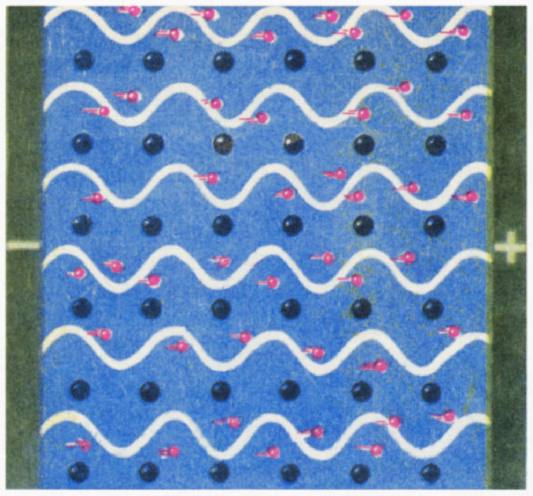
Fig. 2. The movement of electrons and the propagation of electron waves in a regular (ideal) crystal.
No. Of course, there are some sort of corridors (Fig.2) between regular rows of atoms, but to direct an electron along such a corridor would require precise orientation of the crystal in relation to the applied electrical voltage. But usually we are dealing not with one crystal, but with a combination of many small crystals, randomly oriented. However, a single regular crystal is called a single crystal (from the Greek word “mono” - one), and a combination of many crystals is called a polycrystalline aggregate (from the Greek word “poly” - many). So, precise measurements have shown that the resistance of polycrystalline aggregates differs very little from the resistance of single crystals. It is especially important that the resistance of polycrystalline aggregates decreases greatly with decreasing temperature. There is no way to avoid the movement of electrons along atomic corridors according to the laws of classical mechanics. When moving from one crystal to another, the atomic corridor abruptly changes its direction (Fig. 3). The electron should hit the “wall” from flying away. And he is capable of six-way through the atomic labyrinth, like Theseus, who
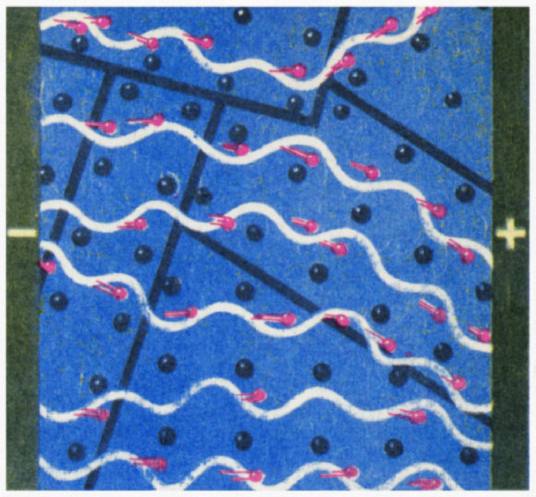
Fig. 3. Scheme of electron movement through an atomic labyrinth in a polycrystalline aggregate. Electrons are shown in red.
Aridna’s thread pointed him in the direction. What the hell is this and how can I explain it?
Miracles without miracles
Even more amazing facts have long been known. Mechanical and thermal treatment significantly affect the electrical resistance of metals. For ease of use in technology, we will use units of resistivity . In these units, the resistivity of total commercial copper at is expressed as 0.0172. After cold drawing, the resistance of copper wiring increases to 0.0177. Further winding the wire around the coil is enough to increase its resistance. If you subject the wiring to annealing, that is, prolonged heating, and then cool it again to , the resistance value returns to normal. Obviously, the resistance is sensitive to small disturbances in the crystal structure (such properties are called structure sensitive). Even more striking is the sensitivity of resistance to insignificant impurities. Thorough cleaning reduces resistivity me-
13
di at a temperature of 20°C to 0.0169 /m. This circumstance is of great importance for technology. After all, if you reduce the resistance of the wires, you will also reduce the useless losses of electrical energy for heating them. Therefore, copper intended for electrical needs is subjected to special purification through electrolysis. This peculiar metallurgical process is somewhat reminiscent of “pouring from empty to empty.” At the anode, the copper is razorized, and at the cathode, copper is deposited, the purity of which varies by “three nines” after the decimal point: 99.999%, that is, impurities in electrical copper make up only a thousandth of a percent. Such thorough cleaning is very important: after it, the resistance, and with it the heat losses, are noticeably reduced.
Let us now look at the amount of impurities in the resistance of copper. It is enough to add 1% manganese to copper so that its resistivity increases to 0.048 /m, that is, almost three times! Meanwhile, the resistivity of pure manganese is 0.05 /m. Thus, 1% manganese in copper is enough for its resistance to become practically equal to the resistance of 100% manganese! This is not solely a matter of chance. Additives of iron, cobalt, iridium and others act in approximately the same way. If the resistance came from new electrons with impurity atoms, these impurities should have a hundred times less influence. From the point of view of classical theory, the exorbitant effect of small impurities is a pure miracle.
In alloys containing large proportions of impurities, the resistance is very high. Metallurgists have developed replacement recipes for high-resistance alloys: nickelin, manganin, constantan, nichrome and others. The resistance of these alloys is several times greater than that of each of the component parts. Thus, CONSTANTan, a state of 60% copper and 40% nickel, has a resistivity of 0.44 /m, while for pure copper it is 0.017, and for nickel 0.072 of the same units *).
The “king” of such alloys can be called the well-known ichrome, the resistivity of which is 1 /m. It is not for nothing that it has found such wide application in heating devices. There are different recipes for ichrome. The simplest of them is 80% nickel and 20% chrome. Such an alloy has a resistivity of 1.05 /m, while for pure nickel it is 0.072 and for chromium 0.131. This alloy is expensive, but you can replace some of the expensive nickel with cheap iron without damage. However, the “record” among similar alloys was held by a medarip made of 65% iron, 30% chromium and 5% aluminum with a resistivity of 1.4 /m.
It is striking that the temperature dependence of the resistance of alloys is completely different than that of pure metals. The resistance of most alloys also increases with temperature, but much weaker. Especially for scientific instruments, where it is desirable to have a constant resistance, the already mentioned CONSTANTan, named means “constant”, was developed. In the temperature range from 0° to 400°C, its resistance varies only from 0.441 to 0.448 /m.
From the point of view of the classical theory of constant resistance of alloys, it is clear that the resistance to temperature is proportional to temperature for pure metals. The resistance of an alloy should, within the meaning of this theory, be added from the resistance of its constituent parts according to a simple mixing rule (such as heat capacity). If we look at everything that is known about
*) All figures here are given for a temperature of 20°C.
14
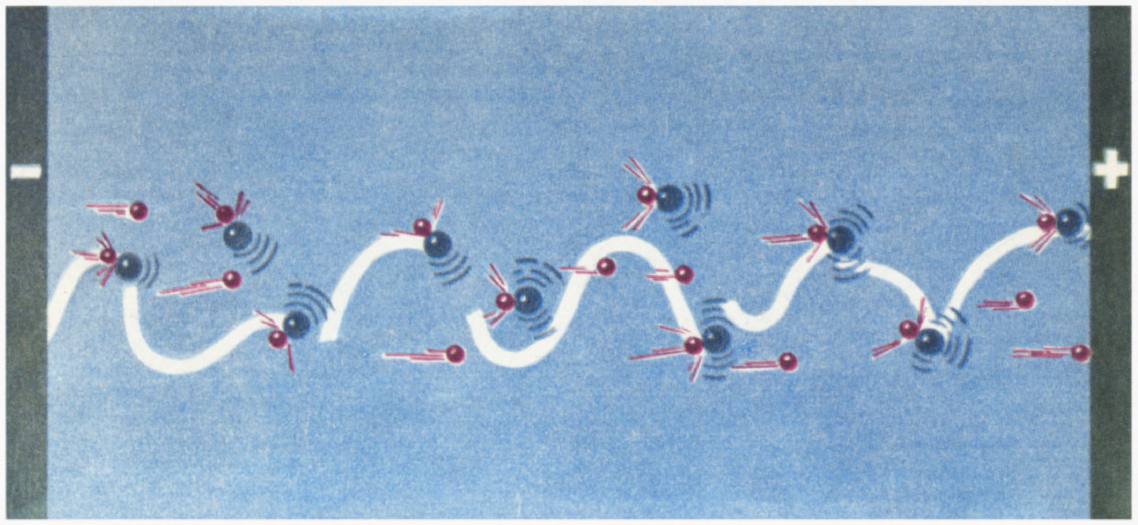
Fig. 4. Violation of the correctness of the atomic waveguide by thermal motion.
electrical resistance, then it will become clear that even this simple phenomenon forces us to turn to quantum for help in order to understand it.
Electron waves and atomic waveguides
Everything falls into place if we remember that, according to the laws of quantum mechanics, an electron has simultaneous properties of a particle and a wave. The width of atomic corridors is close to the wavelength of the electron, and therefore, when moving along such corridors, the wave properties of the electron are fully manifested.
Waveguides are widely used in centimeter wave radio engineering. These are metal tubes of round or rectangular cross-section. The radio waves will propagate along the waveguide, following its entire bends. Light is also electromagnetic waves, and it can be hidden in a light guide - a tube with mirror walls *). Recently, people have been willing to use the thinnest light guides - glass fibers.
You can bend them as you like - the light will still be obedient
*) In practice, there is no need to make the walls mirrored. Typically it uses the phenomenon of total internal reflection, but this is not important for our topic.
follow along the fiber.
The effect of a light guide with mirror walls is easy to understand. Light waves are constantly reflected from the walls and thus remain inside the light guide. Radio waves are also reflected well from main metal surfaces. If the surface is rough, then the wave seems to break up the ozabrins and, as a result, scatters and is absorbed. Its energy turns into heat.
In quantum theory, the flow of electric current through metal is like the propagation of electron waves along atomic corridors, which play the role of waveguides. If atoms are located on a plane in perfect order, at equal distances from each other, then such a plane completely reflects electron waves - like an ideal mirror. Scattering and absorption of electron waves occurs only when the strict order in the arrangement of atoms is violated. This amazing conclusion was first obtained in a rather complex mathematical way from the equation of quantum mechanics. But it could also be done on the basis of the experimentally established properties of electrical resistance, if they were treated more externally.
In an ideal, regular crystal, the waveguides are completely smooth. All-
15
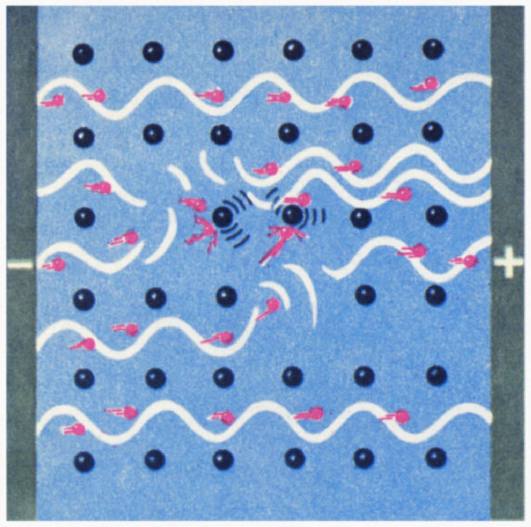
Fig. 5. The first type of crystal lattice defects is vacancies (empty spaces). It is remarkable that electrons are also scattered into vacancies - is there any better proof that they do not collide with lattice atoms at all? The fact is that the vacancy plays the role of a response in the wall of the atomic waveguide, disrupting the right propagation of electron waves.
Some disturbance of atomic order acts as roughness of the walls of the waveguide. Electron waves are scattered by disturbances in the lattice. Part of the electron energy is absorbed and transferred to the body. This is the quantum mechanism of electronic resistance. The regularity of atomic waveguides is disrupted by thermal vibrations, on which electron waves are scattered (Fig. 4). This will give rise to the thermal part of the electronic resistance, which depends on temperature. By cooling the metal, it can be made as small as desired. At the same time, residual or structural resistance is retained, associated with permanent defects (damage) of the crystal structure (Fig. 5 and Fig. 6). Defects exist in every crystal and depend on its “biography” - on the conditions in which it originated, grew and existed. Additional defects arise during cold machining - drawing wires and even winding them onto a reel. This is why resistance increases. For a long
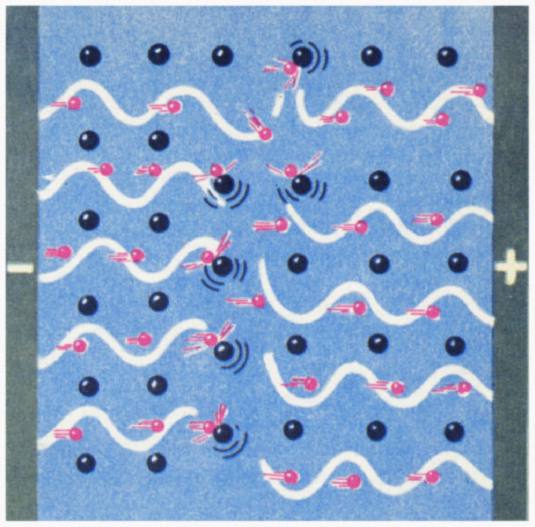
Fig. 6. The second type of crystal lattice defects is dislocations.
With solid heating (annealing), the atoms return to their places and the defects are healed - the resistance drops.
The introduction of foreign atoms causes the crystalline lattice to crack (Fig. 7). In this case, an atom of impurity can be from the place of hundreds of atoms of the “host” crystal. This is why impurities increase resistance. It is noticed that the action
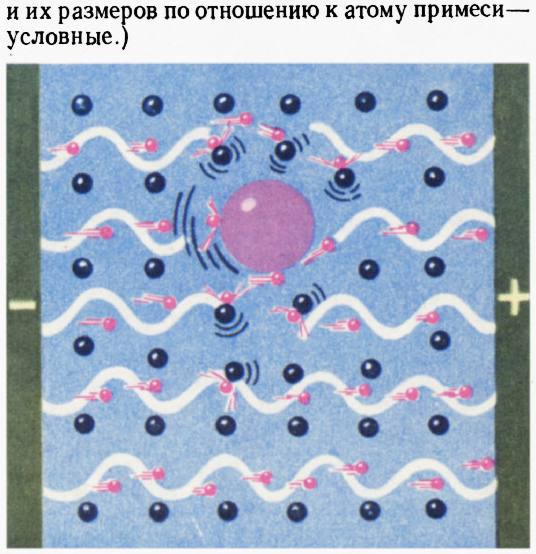
Fig. 7. An impurity atom from the place of a set of lattice atoms. Because of this, the correct movement of not only those electrons that come into contact with the impurity atom itself is disrupted, but also many others. (The ratio of the distances between the atoms of the crystal and their sizes in relation to the impurity atom is conditional.)
16
Wine impurities are stronger, the larger the atoms in size and other factors of difference from the “host” atoms, the more they disrupt the regularity of the crystal lattice.
If you cool the metal, then the thermal (that is, flowing from thermal movement) part of the resistance drops. When it becomes much smaller than the temperature-independent part of the structure, then with further cooling the resistance almost does not change. In alloys with a disordered structure, the structure is part of the resistance of the present surge, which even at high temperatures prevails over the thermal one. These explain the weak dependence of the electrical resistance of alloys on temperature.
Sound quantum - phonon
We became acquainted with some quantum phenomena, but the quantum itself remained in the shadows for now. Now he will come to the fore.
Thermal motion in a solid can be thought of as vibrations of atoms around their equilibrium positions. But particles in a solid cannot vibrate independently. They are all firmly connected with each other and always perform collective oscillations. Not like on a dance floor, where each couple moves independently of the others, but like in the mass system of a large ballet, where everyone performs their parts in harmony.
Collective vibrations of a huge number of parts of matter are the same as sound waves. If you remove any particle from its equilibrium position, it will possibly spread throughout the body at the speed of sound. It turns out that thermal motion in a solid can be considered as the propagation of sound waves. By heating the body, we make it sound. Fortunately for us, the frequency of these vibrations is billions of times higher than what our ear can hear. Obviously, living beings in the process of evolution have adapted not to hear the “tell sound”, otherwise we would not have been able to withstand the continuous noise of “screaming” objects.
Thus, a necessary connection is discovered between electrical resistance and sound. Electrons are scattered by sound waves generated by thermal movement of the crystal lattice. But every wave consists of quanta. For a light or electromagnetic wave in general, these are photons, for a sound wave, they are phonons (from the Greek words that introduced light and sound). Photons are real particles, quite equal to other elementary particles. Phonons are not entirely equal in the sense that they can only exist inside matter (phonons cannot exist in emptiness). They - and others like them - are called quasiparticles (that is, “almost particles”). Phonon is the simplest representative of the vast family of quasiparticles. Its other members do not interest us now.
We said that electron waves are scattered by roughness created by thermal movements, that is, sound waves. But if a sound wave is described as a flow of phonons, then electrons can also be considered particles, forgetting about their wave properties. Now we seem to return to the simple explanation of resistance: electrons are prevented from moving freely by the fact that they collide with other particles. But not with particles of matter, but with sound quanta - phonons.
Now we can finally do some math. For simplicity, we will carry out the calculation as if the phonons had one identical part v. This assumption is incorrect, but the error it produces is not serious. In our truth, we can refer to the fact that the great physicists Planck and Einstein proceeded from the same assumption in their theory of heat capacity of solids and obtained
17
Chali results are not so flat.
The energy of a phonan, like any quantum, is equal to , where is Planck’s constant, and is the frequency of the wave.
The number of phonans is , where is the energy of thermal motion, proportional to the absolute temperature . Boltzmann’s constant can be taken as the proportionality set. So, the number of phonans is . We have obtained a very important result. The number of phonans in a solid is proportional to the absolute temperature. Therefore, if the resistance is proportional to the constant power, Boltzmann’s constant can be taken. So, the number of phonans is . We have obtained a very important result. The number of phonans in a solid is proportional to the absolute temperature. Therefore, if the resistance is proportional to the constant power, Boltzmann’s constant can be taken. So, the number of phonans is . We have obtained a very important result.
But this result is valid only at sufficiently high temperatures. Indeed, according to the meaning of quantum theory, the number of phonans cannot be less than one. Let’s see at what temperature it is equal to unity. This temperature is called the Debye temperature and is denoted in Greek by the letter . Equating to one, we find: . Debye temperature (or Debye temperature) plays a very important role in solid state physics. Using this quantity of interest to us, the number of phonans is expressed quite simply: . At temperatures below the base, this number becomes less than one. This means that we can only talk about the average number of phonans, and the calculation is subject to conditions. But the quantities still remain measures of the number of phonans in a solid, and, consequently, the number of only electrins with phonans. Is
*) This is the number of phonans per lattice vibration, more precisely, per one vibrational degree of freedom, or, as physicists like to say, per one oscillator.
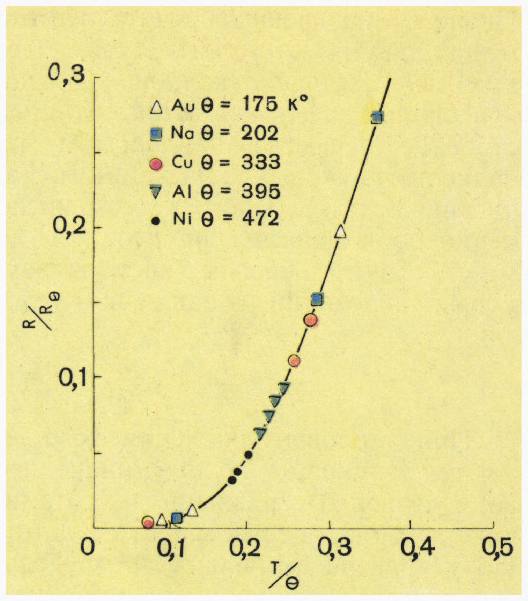
Fig. 8. Generalized temperature dependence curve of resistivity of pure metals.
Based on these reports, the following hypothesis was put forward: the temperature dependence of the electrical resistance of pure metals is expressed by a universal function of the measure of the number of phonans . Mathematically, this hypothesis is written as follows: , where is the resistance at temperature , is at temperature , and is a function, the form of which can be found from experience. What is important is what the function promises for different pure metals. How well this hypothesis is justified experimentally can be seen from figure 8. This graph was constructed at one time by the American physicist Bardeen, who later became famous for his work on the theory of superconductivity.
It is interesting and useful to relate the Debye temperature to the speed of sound . Let us remember that matter consists of atoms and the wave does not propagate continuously, but jumps from atom to atom. During the oscillation period the wave cannot travel a path less than the distance between neighboring atoms .