Rough automatic draft, low quality: expect mistakes and awkward wording. It will be replaced by a better translation. Original →
28
AUXILIARY CIRCLE
The solution to many geometric problems begins with drawing auxiliary lines that help establish a connection between data and unknown elements of the figure. Recalling a successful auxiliary formation is often difficult. Therefore, you should approach each solved problem and try to find out why certain auxiliary lines lead to the goal. Is it possible to use the found example to solve some other problems?
At the next meeting of the mathematical circle, we will consider one of the interesting examples of solving geometric problems, which consists of introducing an auxiliary circle into the drawing.
Example 1. The altitudes AP, BQ and CR are drawn in an acute triangle. Prove that ).
Solved and e. Let H be the point of intersection of the altitudes of triangle ABC (Fig. 1). Since and are straight lines, a circle can be described around the quadrilateral BPHR by taking BH as the diameter. Having constructed it, we replace that (as inscribed angles based on the same arc).
*) See «Kvant» No. 1, 1970, p. 59.
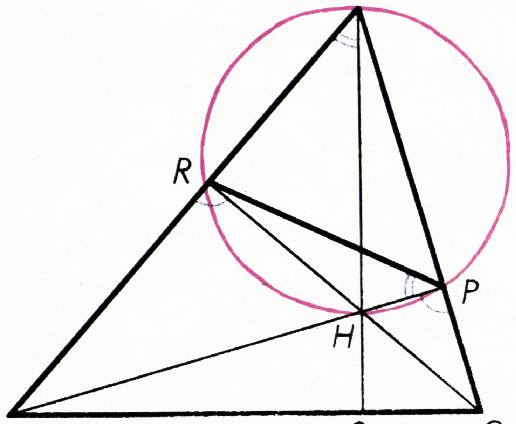
Fig. 1.
Thus, constructing an auxiliary circle allows you to use the inscribed angles theorem and thereby establish a connection between the angles specified in the task.
Find out how the result changes if of triangle ABC is obtuse.
Solve several similar problems yourself.
-
From an arbitrary point M ka-tega BC of right triangle ABC, a perpendicular MN is dropped onto the hypotenuse AB. Prove that .
-
Prove that the line connecting the vertex of a right angle of a right triangle with the center of a square externally constructed on the hypotenuse bisects the right angle of the triangle.
-
From an arbitrary point M inside a given angle, perpendiculars MP and MQ are dropped to the sides of the angle. From the vertex of angle A a perpendicular AK’ is dropped onto the segment PQ. Prove that .
Example 2. Prove that a segment connecting the bases of two altitudes of an acute triangle cuts off from it a triangle similar to the given one.
29
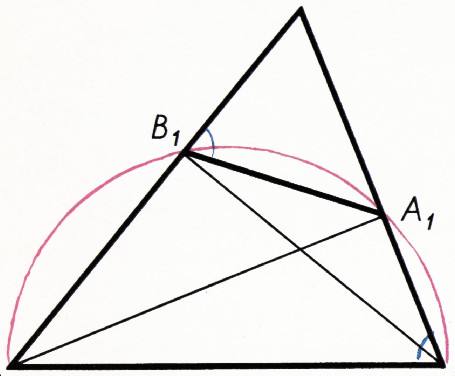
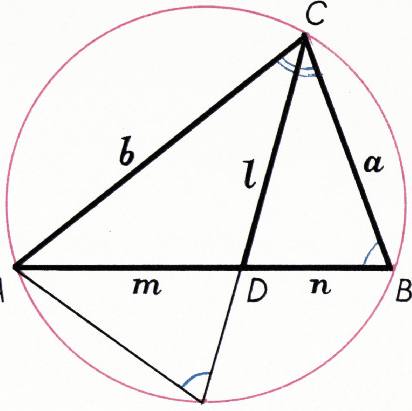
Fig. 2.
Solved and e. Let and be the altitudes of the acute triangle (Fig. 2). and are straight, so a circle constructed on the side of the triangle as a diameter will pass through the points and . Further, - , - , therefore , and triangles and are similar.
This problem can be solved without auxiliary constructions, if we notice that the triangles and are similar and write down the proportion
Solve each of the following two problems in ways to work around them.
-
From the vertex of the parallelogram the heights and are drawn. Prove that triangles and are similar.
-
From the base the heights of the triangle are lowered to the sides and perpendiculares and . Prove that triangle is similar to triangle .
Sometimes it is advantageous to describe a circle and a triangle.
Example 3. Prove that the square bicsectrix of a triangle is equal to the difference between the product of its enclosing sides and the product
segments of the third side into which it is divided by a bicector.
Solved and e. We describe a circle around the triangle and extend the bicsectrix of the triangle until it meets the circle at the point (Fig. 3). Let , , , , , .
According to the conditions, , in addition, , are like inscribed angles based on the same arc. Consequently, the triangles and are similar and the equality is true, hence . Chords and intersect at point . Therefore the equality holds. Therefore, .
Example 4. The altitude and median of a triangle drawn from one vertex inside it are different and form equal angles with the sides emerging from the same vertex. Prove that the triangle is right-angled.
Solved and e. Let the height and the median of the triangle oblige the sides and to be equal angles (Fig. 4). Let us describe a circle around the triangle and extend the median until it meets the circle at point . Consider triangles and . Since is by conditions and ,
30
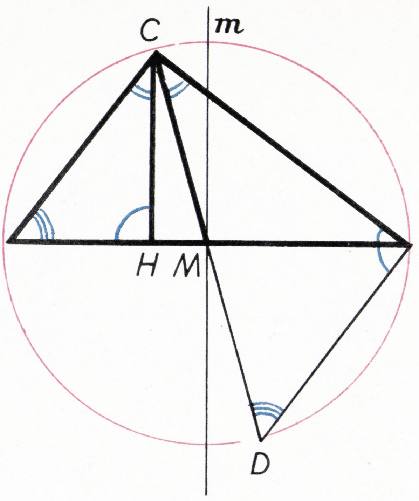
Fig. 4.
as inscribed angles based on the same arc, then . Therefore, is the diameter of the circle.
The center of the circle lies on the diameter and on the perpendicular to the side at its midpoint . Since the median is not a height, the lines and have only one common point , which is the center of the circumscribed circle. Therefore, is the diameter of the circle and .
Use the result to solve the next two problems.
- Determine the angles of the triangle in which
a) the median and height drawn from one vertex divide the angle into three equal parts;
b) the median, bisector and altitude drawn from one vertex divide the angle at this vertex into four equal parts. - Construct a triangle, knowing the angles formed by the median, bisector and altitude emerging from one vertex.
Example 5. Construct an equidistant triangle so that its vertices lie respectively on three given parallel lines.
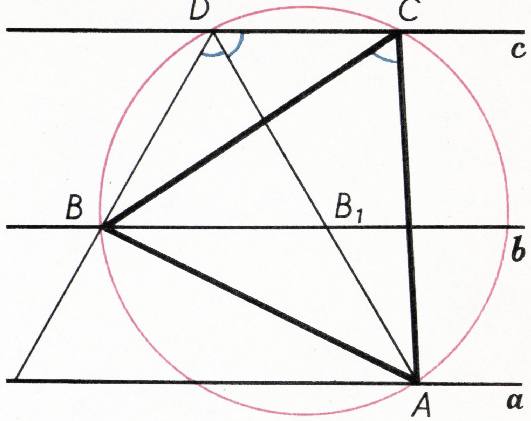
Fig. 5.
There are several known solutions to this interesting problem using expressions around a point, similarity and algebraic methods. A very short solution is obtained by constructing an auxiliary circle.
Solution. Let be the original equidistant triangle whose vertices lie respectively on the parallel lines and (Fig. 5). The circle circumscribed around it intersects the line , in addition to the point , at some point . Then, based on the property of inscribed angles, we have .
The following construction follows from this. From an arbitrary point of line we draw rays that form angles and with line . Let one of the rays intersect line at point and line at point , and the other ray intersect line at point . Then the segment will be the side of the triangle .
Let us plot on the line the segment equal to the segment , so that the points and lie on the same side of the line . Then the point is a triangle of triangle , since triangles and are equal, which means that and .
Thus, the construction technique
31
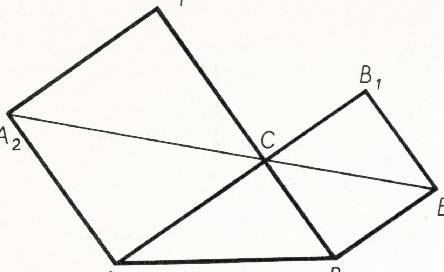
Fig. 6.
It is advisable to use the construction of an auxiliary circle when solving some construction problems.
Let’s consider another difficult problem, in which the most difficult thing to solve is to guess how to describe a circle around the squares.
Example 6. On sides AC and BC of triangle ABC, squares ACA₁A₂ and BCB₁B₂ are constructed outside it. Prove that lines AB₁, A₁B and A₂B₂ intersect at one point, and determine the angles between these lines.
Solution. If ∠ACB = 90°, then the validity of the theorem is obvious. Lines AB₁ and A₁B are redefined and each of them intersects line A₂B₂ at point C at an angle of 45° (Fig. 6).
If ∠ACB ≠ 90°, then the circles circumscribed about the squares have, in addition to the point C, another common point C₁, which turns out to be the intersection point of the lines AB₁, A₁B and A₂B₂ (Fig. 7). Indeed, ∠A₂C₁C = 90°, like a hanging one, resting on a semicircle. Similarly ∠CC₁B₂ = 90°. Therefore, ∠A₂C₁C + ∠CC₁B₂ = 180°, i.e. rays C₁A₂ and C₁B₂ form a straight line.
In the same way, it is proved that the point C₁ lies on the lines AB₁ and A₁B.
Considering the obtained inscribed angles, we find that the straight lines AB₁ and A₁B are mutually redefined and each of these straight lines makes an angle of 45° with the straight line A₂B₂.
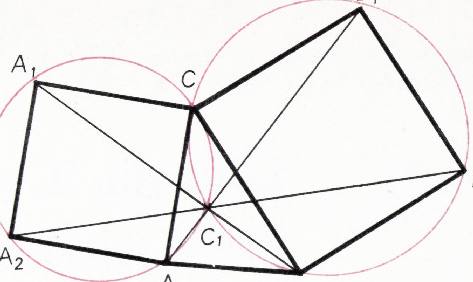
Fig. 7.
The next task has a lot in common with the previous one.
-
On the sides AB, BC and CA of an arbitrary triangle ABC, equilateral triangles ABC₁, BCA₁ and CAB₁ are constructed outside it. Prove that lines AA₁, BB₁, CC₁ intersect at one point and each of them forms an angle of 60° with the other.
-
Prove that if two opposite angles of a quadrilateral are obtuse, then the diagonal connecting the vertices of these angles is shorter than the second diagonal.
Let us present two more problems involving maximum and minimum, for solving which it is also advisable to construct an auxiliary circle in a certain way.
-
On one side of the angle with the vertex at point S are the given points A and B. Find on the other side the point C from which the segment AB is visible at the most angle.
-
From an arbitrary point M lying on side AB of triangle ABC (or on its extension), perpendiculars MP and MQ are drawn to sides AC and BC. Under what conditions will the segment PQ be the longest?
Thus, various geometric problems are solved using the same technique. The construction of an auxiliary circle allows you to increase the number of theorems that can be used when solving a problem, and thanks to this, you can find dependencies between the elements of the figure.