Decide at your leisure
Rough automatic draft, low quality: expect mistakes and awkward wording. It will be replaced by a better translation. Original →
61
Hence .
-
electrons fly through the capacitor per unit time. Since the field of the capacitor is electric, then far from the capacitor, before and after the passage of electrons, they must have the same energy and, therefore, the same momentum . This means that each electron passing through the capacitor transfers momentum to it in the vertical direction. Per unit time, the capacitor is supplied with a pulse . If we neglect the vertical deflection of the capacitor and use Hooke’s law, we find that the additional distance of the spring is .
-
Let the fixed point be at a distance from the lower end of the roof when it is heated and at a distance from it when it is cooled. Since the point is motionless, the sum of the forces applied to it is equal to zero:
Hence .
Same as .
If , then in days the leaf will slide a distance
Decide on access
- The globe was pulled along the equator with a steel hoop, then the diameter of the hoop was increased so that the length of the hoop increased by 1 m. Will a cat be able to crawl into the gap formed between the earth and the hoop (we consider the Earth to be a ball with a radius of 6400 km) (Fig. 1)?
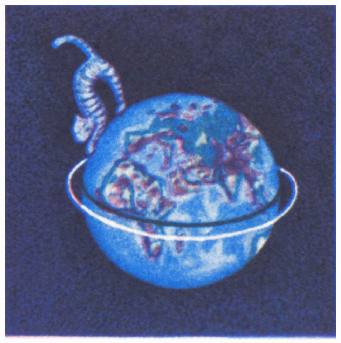
Fig. 1.
- Here, two numbers are divided in the ternary number system. Decipher!
- There are five bowls of different weights and a lever scale, the structure of which is shown in figure 2. Each pan of the scale is identical together.
Using no more than seven weighings, arrange the bulzhniks in descending order of their weights.
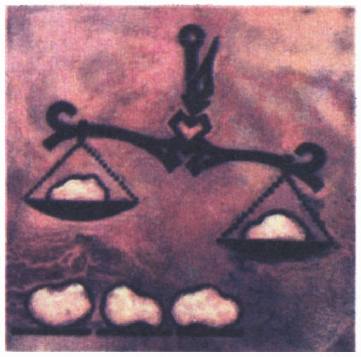
Fig. 2.