Rough automatic draft, low quality: expect mistakes and awkward wording. It will be replaced by a better translation. Original →
20
This article talks about some of the properties of the ellipse and the different laws of planetary motion, the most important of which are called Kepler’s laws.
Gravity
The law of inertia now seems to be the most elementary and natural law - the study of mechanics will begin with it. However, in order to understand it, it was necessary to distract ourselves from what was happening directly before our eyes. Under normal conditions, the movement of the body in the horizontal plane is hampered by friction and air resistance; When moving in a vertical plane, the forces of air resistance and gravity act on the body. It was necessary to get used to their influence, at least mentally. It took many years.
Only after the law of inertia—the law of body motion under idealized conditions—was understood, could it be possible to consider the movement of bodies under the action of forces.
The law of falling bodies on Earth was established by Galileo (1564-1642). He was the first to set himself the task of understanding how the speed of a falling body changes in successive periods of time. Thus, he introduced acceleration into mechanics and established that the accelerations of all bodies falling to the ground are identical and constant. But the fact that the cause of acceleration is gravity was only later understood by Newton.
Almost this years after the publication of Galileo’s work, Newton discovered the law of universal gravitation (1687), according to which the force of gravity is not constant, but decreases with increasing distance between bodies as the square of this distance.
If physics had historically developed in the order in which it is presented in textbooks, then only after Newton’s discovery would it be possible to move on to the study of the laws of planetary motion. But the development of science does not follow the logic of the textbook. Much earlier than Newton, these laws were established by Galileo’s contemporary Johannes Kepler (1571-1630).
Kepler’s meanings in mechanics were extremely meager in comparison with those of a modern schoolchild. Not only did he not know Newton’s laws (they had not yet been discovered), but he also had a very vague idea of what force was. All that Kepler had in his hands were very neat ancient observations of the movements of celestial bodies, which his teacher Tycho Brahe had conducted for many years *) and he himself continued to conduct. Only extraordinary hard work and confidence in the existence of simple laws governing the movement of the planets allowed him to discover the laws that have since bear his name.
Kepler’s laws are not so strong even now. This is mainly due to the fact that ellipses - the curves along which the planets move - are poorly understood by the average reader. In reality, obtaining Kepler’s laws is not so difficult. To do this, you need to use two laws of mechanics: the law of conservation of energy (which was not known to either Kepler or Newton) and the law of conservation of angular momentum. The latter, as we will see, is equivalent to Kepler’s second law: the areas slowed down by the planet’s radius vector over equal periods of time are the same.
*) Tycho Brahe was one of the last astronomers to observe the movement of celestial bodies with the naked eye.
22
Law of Conservation of Energy
On the surface of the Earth the force of gravity is . If we introduce the potential energy of a body into the gravitational field (h is the distance from the body to the Earth), then we can say that when the body moves, the sum of its kinetic and potential energy does not change.
However, the expression for that we wrote is valid only at small distances from the body to the Earth, when is small compared to the radius of the Earth and gravity can be considered constant. If the height becomes greater, then the force of gravity decreases with distance. According to Newton’s law
where is the gravitational constant, is the mass of the Earth and is the distance from the body to the center of the Earth.
If we use the exact expression for gravity, then the potential energy must be replaced by . Let’s check it out. Let us remember that the work done by a body during movement is equal to the decrease.
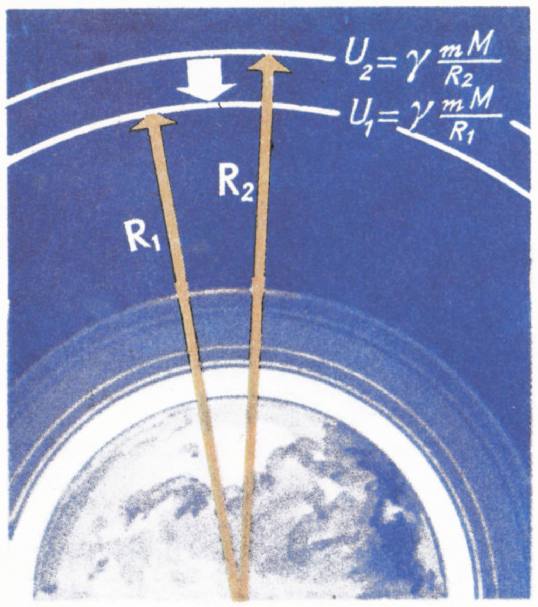
Fig. 2.
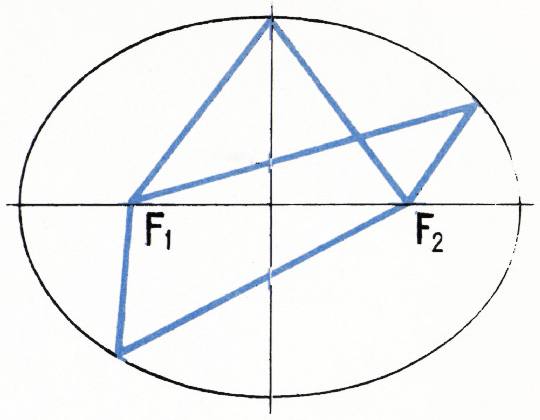
Fig. 3.
reducing its potential energy. We calculate the work done by the body feeding from the height to the height from the center of the Earth (Fig. 2). To do this, you need to calculate the difference in potential energies of the body:
If (), then the product can be replaced by - the square of the geometric mean and (for : ), and can be replaced by - the path traversed by the body. Then the last formula takes the form
force path of gravity
This means that the expression for , which we wrote above, is the real potential energy of the body.
Now we need to write the formula for the total energy of the body differently:
Ellipse
Let’s start with the general definition of an ellipse (Fig. 3). An ellipse is the geometric locus of lobes, the sum of the distances of which to two lobes (the foci of the ellipse) is constructed.
23
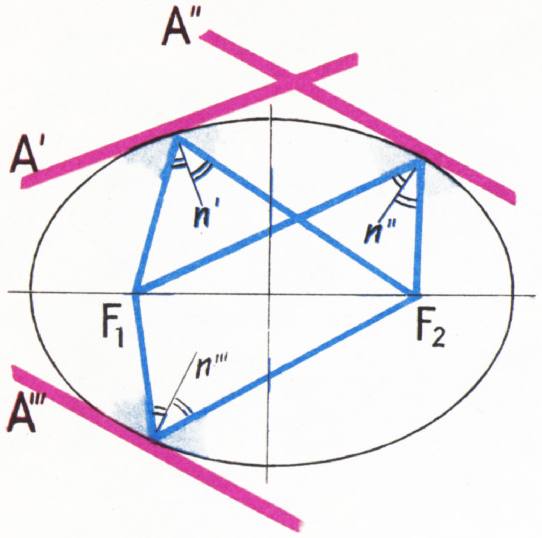
Fig. 4.
From this definition we can deduce an interesting “optical” property of the ellipse: if a light source is placed at one of the focuses of the mirror ellipse ), then all the rays coming out of it will be collected at another focus of the ellipse*). This means that the angles between the straight lines going to the point of the ellipse from its foci and the tangent to the ellipse are equal to each other (Fig. 4).
Let us prove that the ellipse has one more property, which is even convenient to take as the definition of an ellipse. To do this, we draw a tangent to the ellipse at point and lower the redistributions from both foci of the ellipse to this tangent (Fig. 5). We extend one of the redistributions beyond the straight line to a distance equal to . Let us now connect the points and with the point . Let us prove that is a straight line.
This is immediately clear from the fact that (by construction) and (according to the optical property of the ellipse). Therefore, , and therefore , is a straight line.
*) An ellipside is the geometric locus of a point, the sum of the distances from which to two fixed points is constructed. Such a surface is obtained by growing an ellipse around its axis.
**) The easiest way to prove this property of an ellipse is to use Fermat’s principle (see «Kvant» No. 11, 1970).
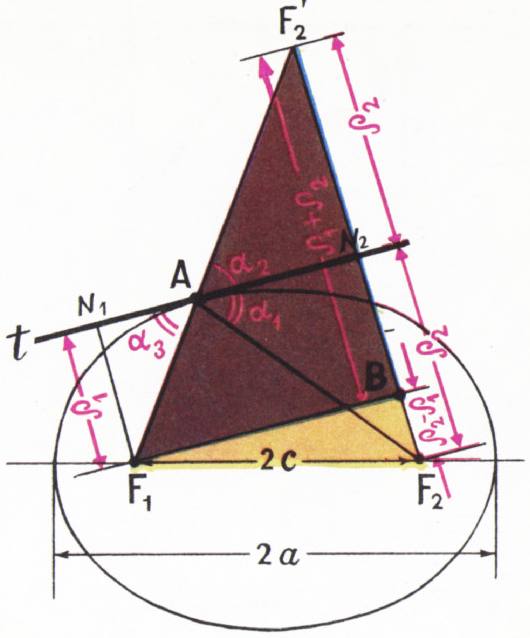
Fig. 5.
Further, since , then , that is, the segment is equal to the sum of the distances from the ellipse point to the foci. Let’s denote this sum . Let us now lower the redistribution onto the line , calculate the length of the leg from two right triangles - brown and yellow - and equate both expressions for to each other:
.
Opening the brackets, we get
.
So, the product does not depend on the point at which the tangent is drawn. Let’s draw it at the end of the semi-minor axis (Fig. 6). In this case . Therefore .
Thus, we got the main theorem:
The product of the distances from two foci to any tangent of the ellipse is a constant value equal to the square of the semi-minor axis.
24
Kepler’s first law
Now we can consider the movement of the planet. For simplicity, we will not prove that the planet’s orbit is an ellipse, but, assuming this and using the laws of conservation of the moment of motion and energy, we will find it and make sure that the movement along ellipses in a gravitational field does not contradict the laws of conservation.
Let us note two positions of the planet and , symmetrical relative to the center of the ellipse (Fig. 7). We can say it another way: point is the true position of the planet at some point in time, and is obtained from the first by transferring the Sun to another focus, while the planet remains in the same place.
Let’s write down the law of conservation of energy. Marking the quantities with index 1 for point and index 2 for point , we obtain .
The angular momentum of the planet is equal to the product of the amount of motion (or ) and the “play” - the impact parameter (or ), while the total energy is .
How is the angular momentum for both positions of the planet the same:
Let us calculate the product of the kinetic energies of the planet at points and :
(Here .)
Replacing the velocities in this equation with their expressions through the moment of quantity of motion, after simple transformations we obtain:
It is easy to see that this equality holds if the planet’s orbit is an ellipse. Indeed, for this you need to put
And
Both of these equalities are nothing more than the two definitions of an ellipse given above.
Thus, our trajectory is an ellipse with semi-axes: large
26
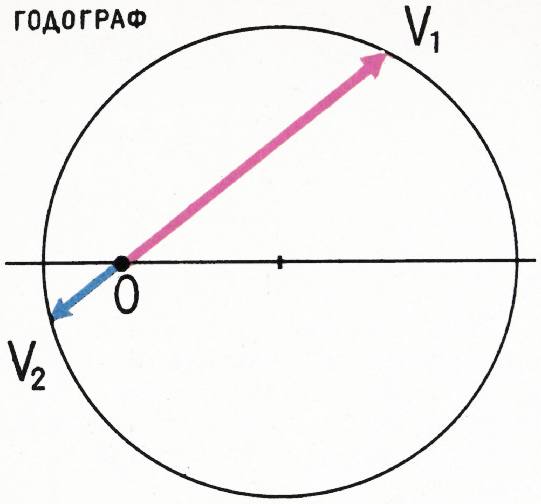
Fig. 8.
Then the speed of the planet will be dimensionless. Speed is a number that shows how many times is contained in the speed of the planet:
According to the previous speeds and are related by the relation
What does it mean? If a particle moves at some point in the orbit with a speed of , then at a point symmetric relative to the center of the orbit, its speed will be equal to
We described the trajectory of the planet, specifying its position (coordinates) at each moment in time. You can do it differently - set the speed of the planet. The curve that we get in this case is called the velocity graph (we can say that this is a trajectory in velocity space). Since the product of the segments and has been constructed, the speed graph of the planet is a circle (Fig. 8) (remember the theorem: “A point is given inside a circle. Then for all chords passing through this point, the product of the lengths of the segments on which this point divides the chords are the same”).
If we replace the speed with at each point of the godgraph, then the godgraph will not change, but simply the surface speed at . This property is called relative surface motion invariance.
If the planet’s trajectory is circular, then (prove it!). In this case, the godgraph is a circle with its center at the origin.
Circulation period
In order to calculate the orbital period - the time of a complete revolution of a planet around Coln or an artificial satellite around the Earth, it is necessary to calculate the time of passage of each section of the trajectory (separately, since the speed changes all the time) and then sum it over all sections. Of course, this cannot be done simply, but all difficulties can be circumvented.
From Kepler’s second law we know that in time the radius vector of the planet “sweeps” an area equal to (recall that ). This means that the period of revolution can be calculated by dividing the area of the ellipse by the constant speed of “sweeping”
Since the ellipse is obtained from a circle sloping in one direction times), then the area of the ellipse is equal to
From these formulas we get
But , therefore
) See the article by I. N. Bronstein “Ellipse” («Kvant» No. 9, 1970).
27
or, substituting here the expressions for and replacing with , we get
From this formula it is clear that the period of revolution depends only on the value . If several identical satellites are released from the same point above the Earth’s surface in different directions, but with the same speed , then all of them will simultaneously (after a time ) converge at the same point.
Kepler’s third law
If now in the formula (*) for the period of revolution of the planet together the energy substitute her expression with a larger one , then we get
Therefore, is proportional to , that is, the square of the planet’s orbital period is proportional to the cube of the large half-ellipse. And this is Kepler’s third law.
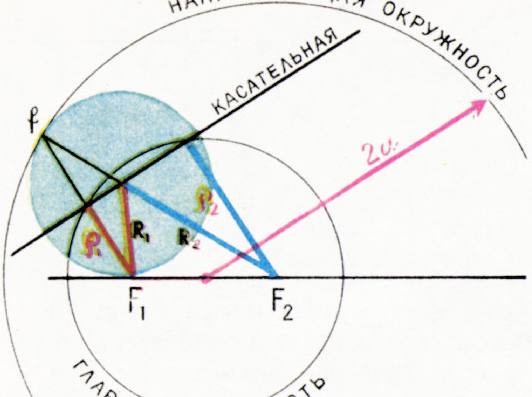
Fig. 9.
An ellipse is the geometric locus of the centers of a circle passing through the focus and touching a given circle (guide circle).
In this article we talked a little about geometry, optics and mechanics. Now solve the problems.
Optical problem
In one of the focuses of the ellipson, the inner surface of which is mirrored, there is an exact light source. Construct an image of this source for an observer located at the second focus of the ellipson.
Geometric problem
Show that the ellipse is the locus of the centers of a circle passing through the focus and touching a given circle (guide circle) (Fig. 9).
At figure it is clear that the bases of the perpendiculars and lie on the “principal circle”. Are you listening to this?
Space challenge
The orbit of the Earth’s satellite has the following parameters: greatest distance , shortest distance . Calculate the total energy and angular momentum of the satellite. Find the speed of the satellite at the ends of the major and minor axes.
Beautiful formation
The drawing on the cover of the magazine is constructed like this: a point is selected inside a circle, and a circle smaller than it is drawn from it, as from the center. Rays are drawn from the center of this second circle until they meet the larger circle. Through a point on each ray lying in the middle between two circles, a chord is drawn perpendicular to this ray. The spot inside has the shape of an ellipse.