Correspondence School of Physics and Technology at the Moscow Institute of Physics and Technology
Rough automatic draft, low quality: expect mistakes and awkward wording. It will be replaced by a better translation. Original →
61
The correspondence school of physics and technology was created in 1966 with the aim of providing assistance to students in grades 9 and 10 of secondary schools. To study at 3FTSH you do not need any special abilities, the main thing is a love of science and a desire to work hard.
3FTS strives to develop students’ physical intuition and logical thinking, as well as skills in using mathematical methods when studying issues of physics and technology.
Admission of students to 3FTS is limited and is carried out by competition based on the completion of the introductory task published below. In order to cover the opportunities of a large number of people wishing to study at 3FTSH, locally, in agreement with public education organizations, the organization of physics and technology circles.
Students who want to and have completed the introductory task well, but could not be accepted due to lack of space, are enrolled in these circles. Education in circles will be conducted according to the general program of 3FTS and under its methodological guidance, but with a merger of local physics and mathematics teachers.
In addition, physics and technology circles can be organized on the initiative of two teachers - physics and mathematics. Recruitment for these circles is carried out on the spot from among the students who have solved the introductory task of 3FTS.
Enrollment in circles is carried out by the circle leader. A circle is considered organizational if the director of a local school reports to 3FTSH the names of its two leaders, a list of members of the circle and a summary sheet of grades received by members of the circle when completing the introductory task. Further work of the circle will take place within 3FTSH.
Students admitted directly to study at 3FTS, as well as heads of physics and technology circles, will receive regulated assignments in physics and mathematics in accordance with the 3FTS program. The tasks are designed in such a way as to develop students’ independence, initiative, physical intuition and logical thinking. Students admitted directly to 3FTS will receive an analysis of the results of their assignments, as well as solutions to tasks recommended by 3FTS. The leaders of the circles will receive the solutions to the assignments recommended by 3FTSH, and they will analyze and evaluate each student’s work themselves.
Below are introductory tasks in physics and mathematics, each consisting of seven tasks. The tasks are tested in order from 1 to 10. Tasks 1-7 are intended for eighth grade students, tasks 4-10 for ninth grade.
The solution to the introductory task must be completed by each student independently. Collective
62
decisions are not allowed and will not be considered.
The decision must be written in Russian. Works on physics and mathematics must be written in different terms. The order of the task should be the same as in the assignment. When sending the terdi, it should not be rolled into a tube. The best shipments are in a large envelope with a simple parcel post.
The solution to the introductory assignment must be sent in full, that is, both in physics and mathematics. Along with the decision, you must send a certificate from the school where you study, indicating your class. The certificate should be pasted on the inside cover of the paper, in which the solution to the physics assignment is rewritten. Without this certificate, decisions will not be considered.
On the outside cover of the same paper, paste a piece of paper with the answers to the questions in the table.
Please send your solutions with solutions to: e. Dolgoprudny, Moscow region, Moscow Institute of Physics and Technology, for ZFTSH.
The deadline for sending the decision is no later than March 10, 1972 (by mail)
| № № | Question | Sample answer |
| :— | :— | :— |
| 1. | Region, region or ASSR | Tula |
| 2. | Last name, first name, patronymic | Andreev Mikhail Dmitrievich |
| 3. | The class you are in | Eighth |
| 4. | School number and address | School No. 1, st. Karl Marx house no. 41. |
| 5. | Nationalityis | Russian |
| 6. | Profession of parent and position held: Father Mother | Mechanic, foreman |
| 7. | Detailed home address | Nurse, LABORANT Efremov, st. Tulskaya, 1/24, apt. 8. |
62
63
Introductory assignment in physics
- The device, designed to study the laws of equilibrium motion, consists of two weights of mass , connected by an inextensible thread, thrown over a stationary block (see Fig. 1). An additional weight is placed on the right weight and the system begins to move. When the right load passes the distance , the additional load is picked up by a special stop, and the main loads continue to move further at a constant speed .
Find the acceleration due to gravity .
-
The lifting device shown in figure 2 consists of a uniform rod of length and mass . The device is hinged at its lower end to the wall (can rotate freely). The rod forms a constant angle with the vertical thanks to a horizontal tensioned cable, which is connected to the rod at a distance of from the hinge. Cable length . A load of mass is suspended from the top point of the rod. Find the tension of the cable.
-
figure 3 shows two electrical circuits consisting of
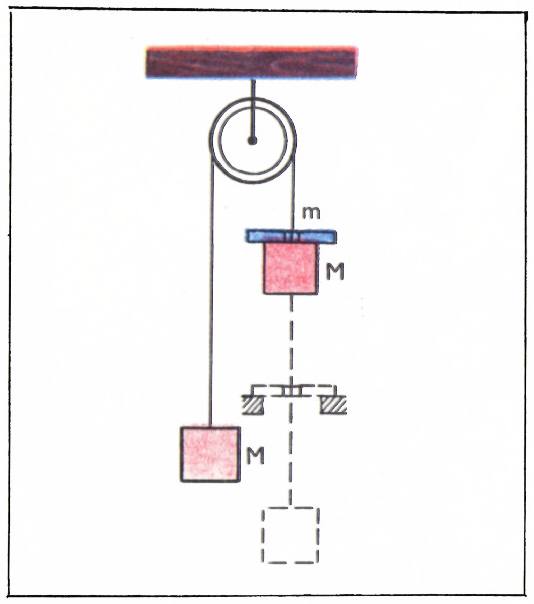
Fig. 1.
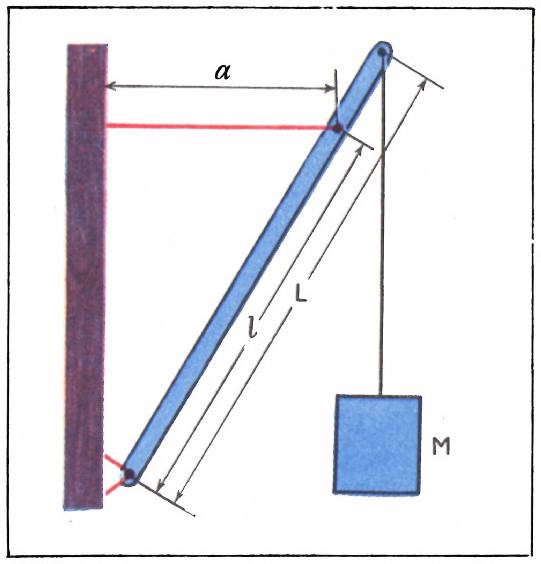
Fig. 2.
known resistances and and unknown resistance . At what value the resistances of both circuits, changed between points and , are the same and what is the total resistance of these circuits?
- A bucket of water falls freely into the house of visas. There are holes in the side walls and bottom of the bucket. Will water flow out through these holes if the bucket falls? Neglect air resistance.
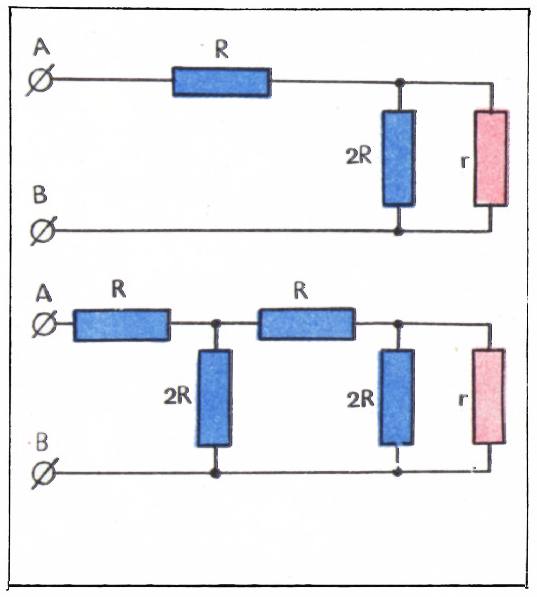
Fig. 3.
64
-
There are three light bulbs, designed for a voltage of 110 V and having a power of 50, 50 and 100 W. What scheme can be used to connect these light bulbs to a network with a voltage of 220 V so that they all burn at full intensity?
-
The work involves hammering an iron nail weighing 50 g into a board and hitting it 20 times with a hammer whose mass is 0.5 kcal and final speed is 10 m/sec. How many degrees will the nail heat up, if we assume that half of the heat released during impacts was used to heat it? Assume that the hammer is motionless after impact.
-
The two rods are connected at right angles (see Fig. 4). A ball A weighing 50 g can slide along a horizontal rod, and a load B weighing 200 g can slide along a vertical rod. The rotation axis of the device is a vertical rod, ball A is located at a distance of 5 cm from this axis. How many revolutions per minute must the spinner make for the load B to begin to rise? Let’s make a claim.
-
The vessel contains a mixture of nitrogen and hydrogen. At a temperature T, when nitrogen has completely disintegrated into atoms, and hydrogen is still in a molecular state, the pressure is equal to P. At a temperature of 2 T, when both gases have completely disintegrated into atoms, the pressure in the vessel is equal to 3P. What is the ratio of the number of gram atoms of nitrogen and hydrogen in the mixture?
-
A pressure of 3 kgG is applied to the syringe piston with a cross section of S=16 cm². At what speed should a stream of water flow out of the answer in a horizontal direction? Jet cross section s=0.016 cm².
-
When heating 7 g of nitrogen located in a cylinder under a piston on which a constant load rests, 26 cal of heat was consumed. To what temperature did the gas heat up if its initial temperature was 10°C? The heat capacity of one gram-molecule of nitrogen at constant volume is 5 cal/mol deg.
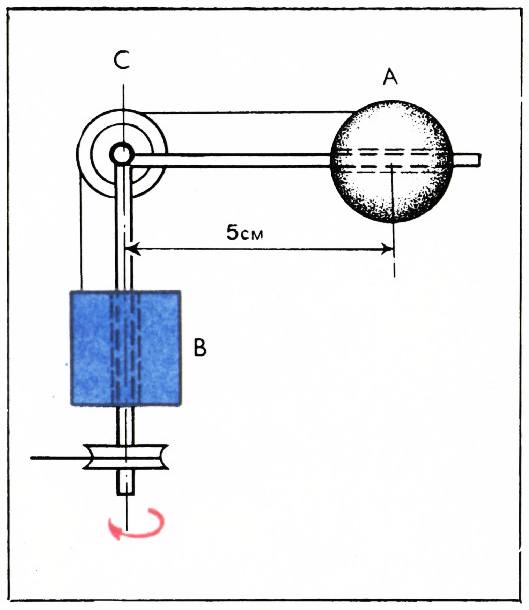
Fig. 4.
Introductory math assignment
-
The boy swims against the current of the river and meets an empty boat floating along the current. He continues to swim against the boat for another 2 minutes after the meeting point, and then turns and catches up with the boat 76 meters from the meeting point. What is the speed of the river?
-
Prove that the amount
for any integer n is divisible by 3 without remainder. -
Triangle ABC is inscribed in a circle. At point B a tangent to the circle is drawn. The distances from points A and C to this tangent are 15 cm and 21 cm. Find the height of triangle ABC dropped from vertex B.
-
The roots of the equation are and . Find p and q if and are roots of the equation
-
Two sides of a triangle are equal to 6 cm and 8 cm, and its two medians intersect at right angles. Find the third side of the triangle.