Rough automatic draft, low quality: expect mistakes and awkward wording. It will be replaced by a better translation. Original →
68
Physics and mathematics school
at MIIT
A. L. Sadovsky
In January 1968, the Moscow Institute of Transport Engineers had an organizational evening physics and mathematics school. Initially, the Physics School accepted everyone who wanted to study mathematics and physics in depth both within the school curriculum and beyond. However, the level of those attending FMS turned out to be very varied. Some of the applicants did not expect that they would also have to work at evening school, and therefore quickly lost interest in it.
I had to turn to a tried and tested method: in the spring and fall, when the 1970 intake was formed, exam competitions were held. These exams consisted of three stages: written work (two problems in physics, three in mathematics) and oral exams in physics and mathematics. As a result of the selection, out of 320 candidates, 250 students were accepted (110 in the ninth and 140 in the tenth grades), from which two streams were compiled, one in nine and the other in tenth grade. In 1971, two streams of tenth graders were formed (who studied in the previous year in the ninth grade and from new admissions), a stream of ninth graders and a stream of eighth graders.
Classes at Physics School are conducted as follows: on Wednesdays there is a lecture in physics and a seminar in mathematics, and on Fridays there is a lecture in mathematics and a seminar in physics. The duration of lectures and seminars is two academic hours. Lectures are given by professors, teachers and graduate students of the institute; classes are taught by students of the Faculty of Automation and Computer Science (specialty “Applied Mathematics”) and other faculties of MIIT. Among the leaders of the busy group there are many graduates of specialized physics and mathematics schools.
There are two main directions in the work of the school and its program. The first of them is a more detailed study of the traditional school course and sections of mathematics and physics very close to it (elements of combinators, complex numbers, polynomials and algebraic equations, and others). The second direction is the development of mathematical culture and broadening the horizons of students. For this purpose, series of lectures are given on special issues, lectures outside the school curriculum: geometric transformations, the concept of Lobachevsky geometry, elements of set theory, the theory of active numbers, elements of the theory of probability and the theory of ingredients.
It is known that the problems facing Physics and Mathematics School students are different: tenth-graders strive to prepare for competitive exams at a university or technical college, ninth-graders have not yet set themselves such a task. In this regard, the programs of the oldest ones are more utilitarian, that is, within the limits of their material, we adhere mainly to the first direction. A completely different approach to ninth grade students. Taking into account the available time reserve, the physics and mathematics school creates a base consisting of such functional theories as set theory and the foundations of mathematical analysis, so that later, relying on this basis, it would be easier for the teacher to explain an elementary mathematics course, and for schoolchildren to understand.
It is somewhat more difficult for our physicists, since in an ordinary school physics there is often insufficient attention to some information on the entire Physics School program in physics, which, in practice, does not provide for the study of many interesting problems and tasks that are not included in the standard school course.
The organization of work at the Physics School is carried out in two sections: physics and mathematics. The governing body of the school is the Physics and Music School Council, headed by the institute’s chairman for educational work, Professor I.P. Isaev, deputy. Chairman for General Issues Associate Professor V.I. Malakhov and Head of Student Viktor Matveychkom. The FMS Council consists of four students each - representatives of the physics and mathematics sections.
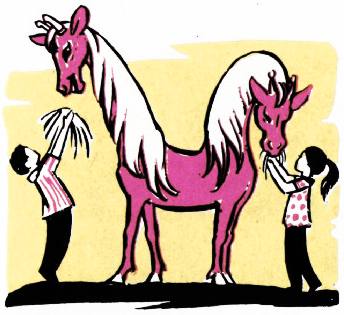
Fig. 1.
Every week the sections hold a methodological seminar for student teachers, at which the topics of the lessons, the displayed tasks, the reasons for their solution and other issues are discussed. These seminars are conducted in direct contact with lecturers. Associate professors V.I. Korovin, A.S. Drobat, T.A. Shulman, Professor E.S. Ventzel and many teachers from the Department of Applied Mathematics provide great assistance in this physics and mathematics school.
The MIIT Publishing House provides teaching aids for school students. However, one of the goals of the functioning of the school is to prepare applicants for MIIT, which practically turns into a modern polytechnic institute.
Physics and Mechanics School teachers also participate in traditional MIIT Olympiads in mathematics and physics. In 1971, the Department of Computational Mathematics held the V Olympiad in Mathematics, and the Department of Physics held the IV Olympiad in Physics. Below are some of the Olympiad problems in mathematics.
Quests
-
Two lines and a point are given on a plane. On one of the lines, find a point equidistant from the other line and the given point.
-
A train of n steps is sent from A to B, some of which are loaded, into the gorons NUMerated in order, the sum of the numbers loaded into the gorons is a multiple of k, where k>n. During the haul, the train may be attacked by robbers, who can clear no more than one carriage. In point B the numbers n and k are known. After checking all the cars, how can you find out whether there was a restriction and which car was restricted?
-
Prove that for a polynomial P(n)=a1968n1998+…+a1n+a0 with natural coefficients, find a natural n0 such that P(n0) is not a prime number.
-
The polynomial f(x)=a_nx^n+…+a_1x+a_0 when divided by x-a gives remainder a^2, when divided by x-b leaves remainder b^2, and when divided by (x-c) gives remainder c^2. Find the remainder when dividing the polynomial f(x) by (x-a) (x-b) (x-c), where a, b, c are pairwise unequal numbers.
-
Given a square with side 1. Prove that no matter how large the number N is, it is possible to construct a system of non-overlapping circles that lie entirely inside the square and such that the sum of their lengths will be greater than N, and the sum of their areas less than .
-
Given 2n digits a1, a2, …, an, an+1, …, a2n. The number A, formed by the first n digits, is 2 times larger than the number B, formed by the remaining digits. The sum of the first n digits is equal to the sum of the second n digits. Prove that the sum of the digits is divisible by 9.
-
Monkey Chi-chi-chi owns bananas. I’ll give her 100 bananas. When Doctor Aibolit weighed these bananas, they found out that they weighed 10 kg, but not a single banana weighed more than 200 g. Prove that with these bananas
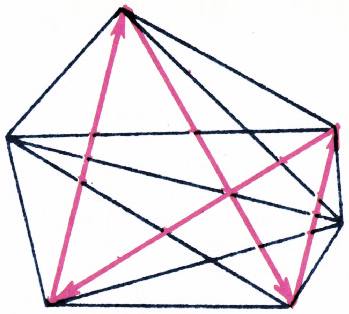
Fig. 2.
you can feed Pull - Pushing so that he is not offended (Fig. 1).
And not: Pull - Pushing will be offended if one head eats at least 100 g more bananas than the other; otherwise.
-
The graph of the function y=x^n+a1x^n+1+…+a_n(n>1) intersects the line y=a at points A1, …, An, and the line y=b at points B1, …, Bn. Straight lines AiBi relate angles αi to the abscissa axis. Prove that .
-
In a convex n-convex all diagonals are drawn. On each side there are arrows in such a way that there are no cycles. A cycle is a closed broken line, on each link of which there is an arrow so that the beginning of each arrow is aligned with the end of the previous one (an example of a cycle is shown in figure 2).
-
A secant is drawn from a point outside the circle so that it bisects the circle.
-
Prove that between n and n! there is at least one prime number.
-
A set of segments is given on a line, each pair of which has at least one common point. Prove that all segments have at least one common point.
70
To the article “How low temperatures are obtained”
- In a detaner, the expansion process occurs so quickly that heat transfer does not have time to occur. The choke is a fairly good heat conductor.
- It is forbidden. Because in ferromagnetic elementary magnets are not misoriented. The magnetization of ferromagnetic materials, especially at low temperatures, is practically independent of the magnetic field. They are magnetized to saturation in weak fields.
- In joules/degree. The thermal simpleness of a body is measured in the same units (not specific, but total).
To the article “Application of the Bunyakovsky–Cauchy inequality to the solution of some problems”
- a) First we need to show that
Then ;
- show that
Then ;
c) first show that
Then ;
d) , since ;
e) .
- .
- Note. In inequality (*) put
- Note. We use the previous inequalities:
- Note. In inequality (*) put
then .
For the problem “Number triangle” (see page 25)
The middle line contains the number . From here it is easy to derive all three properties.
To the article “Pins with magnets”
2. A magnetic weight with an arm suspension describes a figure of eight, when the periods of oscillation in osm and are related as , that is, at . It is difficult to accurately select this ratio of double periods, so the trajectory turns from V-shaped to C-shaped and back.
3. One “second” magnet, its length ( m) can be measured with a ruler. The length of the other is selected experimentally so that the moments of most one deviation coincide after 5 full periods of the “second” magnet.
To the article “Irrational equations”
- No solutions.
- . Note. Rewrite the equation in the form and raise to the sixth power; At the same time, take into account the additional condition .
- . Note. Bring the left side to a common denominator, raise the equation to the seventh power, and then take the root from both sides; the result is equation .
- . Note. The numerator of the fraction on the left side is the sum of the cubes .
- No solutions. Note. Put .
- . Note. Put .
- . Note. Convert the equation to the form and multiply both sides by .
- at ; for there are no solutions.
71
- at ; for other values of there are no solutions.
To the entrance exam option
MOSCOW STATE UNIVERSITY
Faculty of Computational Mathematics and Cybernetics
- .
- . 3. Britad three; each unit has 3 crawler and 5 wheeled tractors. 4. . Note. Distance on the circle circumscribed about the triangle , the point of intersection with the perpendicular, rising from the middle of the triangle . 5. .
Department of General Geology, Faculty of Geology
- , where and are any integers. 2. 450 cars and 550 trucks automatic. 3. . 4. see 5. .
Department of Geophysics, Faculty of Geology
- . 2. . 3. , where is any integer. 4. 3, 9, 27, 81, 243. 5. cm.
Faculty of Chemistry
- . Note. Make sure . Extending the sides and of the trapezoid to the intersection at point , express the angles and in terms of the angle and prove that .
- . 3. . 4. , where is any number. 5. . Note. The center of the ball lies in the middle of a segment (length ) connecting the centers of regular triangles and (a circle of radius can be inscribed in each of these triangles). The base of the cylinder is a circle obtained in the section of the ball by the plane , and the height of the cylinder is equal to twice the distance from the center of the ball to this plane. Prove that the base of the perpendicular dropped from the point onto the plane lies at the height of the triangle dropped from the vertex , and calculate the length of this perpendicular.
PEOPLES’ FRIENDSHIP UNIVERSITY
Faculty of Physics and Mathematics
- For hours. 2. .
- , , where is any integer.
- .
Faculty of Engineering
- The speed of a passenger train is 30 km/h. 2. , where and are any integers. 3. . 4. 27:16 .
Faculty of Economics
- 12 days with the first machine and 15 days with the second machine. 2. . 3. , where is any integer.
- .
To the note “Physics and Mathematics School at MINTA”
- Use likeness.
- At station you need to add up the numbers of all loaded cars and divide this amount by . minus the remainder is equal to the number of the departing car.
- Write the polynomial in the form , where is some polynomial, is a natural number and . Substitute .
-
By Bezout’s theorem
Dividing by means representing as
Substituting into this equality successively, we obtain a system of equations for the unknowns . -
We need to construct circles with a radius . Then
-
On the one hand, and give the same remainder when divided by 9. On the other hand, gives twice the remainder. From this it is easy to deduce that both and are divisible by 9.
-
There is a banana that weighs less than 100 g, put it in your pocket. We feed the heads of Pull - Pushing one by one: as soon as one starts to shrink, we feed it. We give the last banana to the offended head.
-
It is enough to replace that is the real root of the equation , and is the real root of the equation . From here the required equality is easily deduced.
-
There is a straight line on the plane that is not parallel to the sides and diagonals of the polygon, or a finite number of them. Let all arrows point towards this straight line.
-
Consider the number and its prime divisor , which does not exceed . It is easy to see that , otherwise is divisible by .
-
It is necessary to consider the rightmost of the left ends of the segments, and the most left of the right ends of the segments. Then show that the rightmost one is not more right than the leftmost one.
Head of the editorial office L. V. Chernova. Chief artist A. I. Klimanov
Art editor O. N. Yakovleva. Proofreader M. L. Medvedskaya
Publishing house “Science”. Main editorial office of physical and mathematical literature
117071, Moscow, V-71, Leninsky Prospekt, 15. Tel. 234-08-11, 234-07-93
Delivered as a set on 28/IX-71. Sub. in print 7/XII-71 Paper 70×100/16 Phys. oven l. 4.5 Cond. oven l. 5.8 Academic ed. l. 6.40 Circulation 333920 T-19563 Price 30 kopecks. Order 1882
Chekhov printing plant of the Glavpolygraphprom of the Printing Committee under the Council of Ministers of the USSR, Chekhov, Moscow region
MANUSCRIPTS ARE NOT RETURNED